
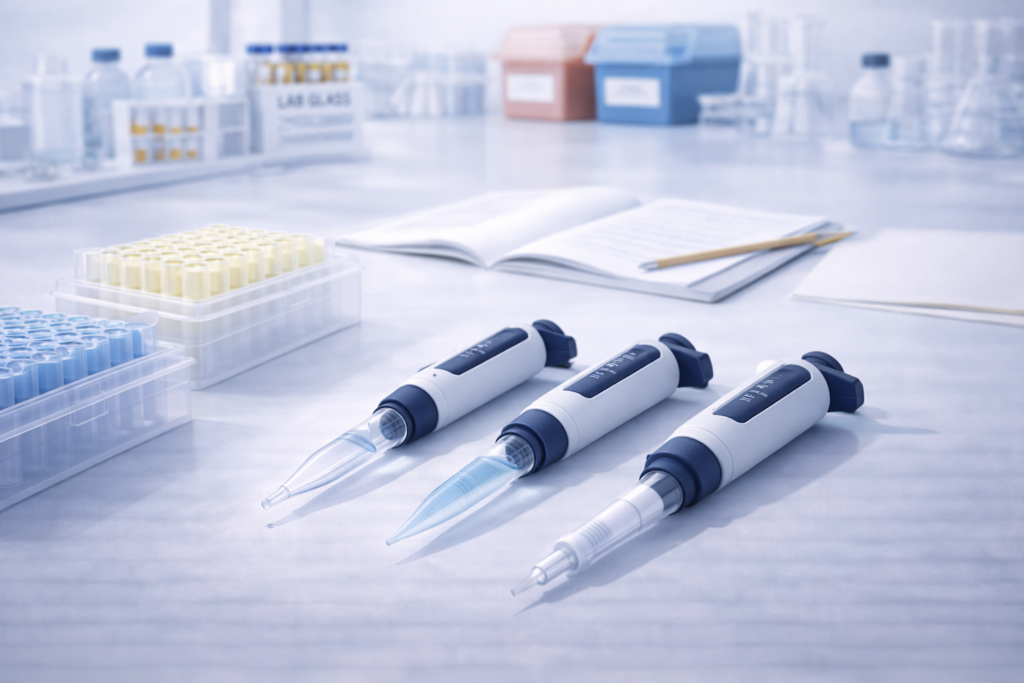
Teaching laboratories face fundamentally different challenges than research environments. Students are learning proper pipetting technique for the first time, often making mistakes that can damage delicate instruments. Educational labs prioritize durability, ease of use, and reproducibility over ultra-precision. Equipment must withstand repeated mishandling while remaining accurate enough to demonstrate scientific principles effectively. Budget constraints mean every purchase must deliver maximum teaching value, and standardization across workstations ensures consistent learning experiences. This guide provides practical, pedagogy-focused advice for selecting pipettes and pipette tips that support effective laboratory education while managing costs and maintaining safety standards.
Quick Selector for Teaching Labs
Application Table
| Education Level | Typical Volumes | Main Learning Goals | Recommended Pipette Type | Notes |
|---|---|---|---|---|
| High school chemistry/biology | 100–1000 µL | Basic liquid transfer, volume concepts | Fixed volume or simple adjustable | Durability critical; consider color-coded sets |
| Introductory undergraduate labs | 10–1000 µL | Reproducibility, technique fundamentals | Single-channel adjustable (P20, P200, P1000) | Standardize one brand/model across benches |
| Teaching-only labs | 1–1000 µL | Error analysis, contamination awareness | Adjustable volume set with visual feedback | Include technique assessment protocols |
| Demonstration labs | Variable | Visual learning, conceptual understanding | Serological or larger volume pipettes | Visibility matters more than precision |
| Skill-training courses | 0.5–200 µL | Professional technique, accuracy | Research-grade adjustable | Investment justified by career preparation |
Selection Logic
Fewer pipette models lead to better learning outcomes. When students encounter the same pipette design at every workstation, they develop muscle memory and confidence faster. Switching between different brands or mechanisms creates confusion and slows skill acquisition.
Fixed vs adjustable volume decision: Fixed-volume pipettes eliminate calibration errors and force students to think about experimental design beforehand. They work exceptionally well for protocols with standardized volumes. Adjustable pipettes teach volume selection and calibration skills but introduce more opportunities for user error. Most teaching labs benefit from a hybrid approach-fixed volumes for routine work, adjustable for flexibility.
Consistency across benches prevents inequality. When different workstations have different equipment, some students receive superior training. Standardization ensures fair learning experiences and simplifies troubleshooting when instructors help multiple groups simultaneously.
Pipette tips choice directly affects teaching success. Using compatible, consistent pipette tips reduces variables during technique assessment. Mismatched tips cause leaks, affect accuracy, and create false error patterns that confuse learners trying to master proper technique.
Core Pipette Types for Educational Laboratories
Adjustable Volume Micropipettes
Adjustable pipettes allow students to select volumes within a specific range, teaching both mechanical operation and volume calculation skills. Single-channel adjustable pipettes in three ranges (2–20 µL, 20–200 µL, 200–1000 µL) cover most educational needs.
Pros for teaching: Students learn volume adjustment, understand range limitations, and practice reading digital displays or vernier scales. These skills transfer directly to research environments. One pipette set serves multiple protocols, reducing inventory.
Cons for teaching: Students frequently mis-set volumes, creating systematic errors that complicate data interpretation. Adjustable mechanisms require regular calibration checks. Inexperienced users may damage internal components by forcing adjustment beyond range limits.
Common student mistakes: Setting volumes outside the pipette’s optimal range (using a P1000 for 5 µL transfers), failing to verify settings before pipetting, and misreading volume displays. Combat these through pre-lab checks and color-coded volume range labels.
Fixed Volume Pipettes
Fixed-volume pipettes deliver one specific volume repeatedly, eliminating calibration variables and simplifying technique assessment. They excel in protocols requiring consistent repeated transfers.
Why they simplify learning: Students focus entirely on proper aspiration technique, tip mounting, and liquid handling without worrying about volume adjustment. Instructors can immediately attribute errors to technique rather than calibration mistakes. Visual volume indicators (often built into plunger travel) provide immediate feedback.
When they reduce errors: Standardized assays, serial dilution exercises, and any protocol where the same volume repeats multiple times. Fixed volumes prevent the common error of changing settings mid-protocol.
Typical use cases: DNA quantification exercises, enzyme assays, standard curve preparation, and basic dilution training. Many introductory labs use fixed 100 µL and 1000 µL pipettes for 80% of procedures.
Serological and Transfer Pipettes
Larger-volume serological pipettes (1–25 mL) and disposable transfer pipettes teach fundamental liquid handling concepts before students advance to micropipettes.
Teaching liquid transfer concepts: Visible meniscus reading, aspiration control, and dispensing technique become obvious with larger volumes. Students develop hand-eye coordination and understanding of liquid behavior before handling expensive micropipette tips.
Visual volume understanding: Graduated pipettes reinforce volume measurement fundamentals. Students see how surface tension affects readings and learn proper meniscus observation techniques that apply to all volumetric glassware.
Safety and disposability considerations: Disposable transfer pipettes eliminate cross-contamination risks in introductory labs. Plastic serological pipettes reduce breakage injuries compared to glass alternatives while maintaining sufficient accuracy for teaching purposes.
Choosing Pipette Tips for Teaching Labs
Pipette tips represent the primary consumable expense in educational laboratories, making selection critical for both budget management and teaching effectiveness.
Why tip fit consistency matters for students: Poorly fitting pipette tips leak during aspiration, deliver inaccurate volumes, and fall off during transfers-all creating false negatives when assessing student technique. Universal tips rarely fit perfectly across different pipette brands, leading to inconsistent performance. Teaching labs should standardize on pipette tips specifically designed for their chosen pipette brand or verified-compatible alternatives.
Racked vs bulk packaging: Pre-racked pipette tips in refillable racks reduce contamination and teach proper aseptic technique. Students learn to grab tips without touching adjacent ones, building habits essential for sterile work. Bulk-packed tips cost less but require manual loading into reusable racks, adding preparation time and contamination risk. Most teaching labs use racked tips for precision work and bulk tips for routine transfers where sterility matters less.
Filter vs non-filter tips in education: Filtered pipette tips contain hydrophobic barriers preventing aerosol contamination of pipette internals. In teaching contexts, they protect expensive equipment from student errors like over-aspiration. However, filtered tips cost 3–5 times more than standard tips. Reserve filtered tips for exercises involving volatile solvents, infectious materials, or expensive reagents. Standard pipette tips suffice for water-based solutions in introductory labs.
How pipette tips influence contamination and technique learning: Clear pipette tips allow students to visually confirm liquid aspiration and detect air bubbles. Colored tips help track which tips have been used. Low-retention tips reduce sample loss in viscous solutions but cost more-reserve them for specialized exercises demonstrating surface tension effects. Teaching proper tip disposal habits early prevents contamination issues in advanced courses.
Accuracy vs Learning Outcomes
Educational laboratories don’t always need research-grade accuracy. Understanding this distinction helps allocate budget effectively.
Why maximum accuracy is not always the goal: A pipette delivering ±5% error still effectively teaches proper technique, serial dilution concepts, and experimental design. Students learn more from performing replicates and calculating variation than from equipment that masks their technique errors. Over-specified equipment can actually hinder learning by producing artificially good results from poor technique.
Teaching reproducibility vs precision: Reproducibility (getting the same result repeatedly) matters more than absolute accuracy in many teaching contexts. Students who pipette 103 µL consistently learn better technique than those getting 98–108 µL with theoretically more accurate equipment. Choose pipettes that provide consistent performance rather than maximum specifications.
Demonstrating error sources intentionally: Deliberately using pipettes with moderate accuracy lets instructors demonstrate systematic vs random error. Students calculate standard deviations, identify outliers, and understand measurement uncertainty-skills more valuable than achieving perfect results with equipment they won’t encounter in many real-world settings.
Safety and Durability Considerations
Teaching laboratory equipment endures conditions research pipettes never face, requiring specific durability features.
Tip ejection force: Students learning pipette operation often struggle with tip ejection buttons, either failing to fully eject tips or applying excessive force that damages mechanisms. Pipettes designed for teaching should have smooth, moderate-resistance ejectors. Adjustable ejection force mechanisms help accommodate users with different hand strengths.
Ergonomics for inexperienced users: Heavy pipettes fatigue students who lack developed hand strength, leading to poor technique and potential repetitive strain. Lightweight polymer construction works well for teaching labs. Single-channel pipettes under 100g reduce fatigue during long lab sessions. Consider multi-channel pipettes only for advanced courses where the time savings justify the additional complexity.
Reducing breakage and misuse: Autoclavable pipettes withstand cleaning after contamination incidents. Chemical-resistant exteriors handle accidental solvent exposure. Drop-resistant construction survives inevitable bench accidents. Teaching-grade pipettes should survive being knocked to the floor, stored incorrectly, and cleaned improperly-conditions that would destroy delicate research instruments.
Waste management in teaching labs: With 20–30 students using pipette tips simultaneously, waste volume becomes significant. Plan for sharp container capacity and tip disposal logistics. Pre-lab training on proper disposal prevents overflowing bins and scattered contaminated tips. Some programs collect non-contaminated plastic tips for recycling, teaching sustainability alongside technique.
Budget and Standardization Strategy
Strategic purchasing maximizes educational value while controlling costs in resource-constrained environments.
Reducing SKUs: Every different pipette tip type added to inventory increases ordering complexity, storage requirements, and risk of using wrong tips. Standardize on 3–4 pipette tip sizes that cover 90% of procedures rather than maintaining 10+ specialized types. This simplification reduces costs and prevents errors.
Standardizing volumes and tips: Choose one volume scheme (e.g., 20 µL, 200 µL, 1000 µL) and stick with it across all courses. When biology and chemistry departments use different pipette systems, students must relearn technique unnecessarily. Institution-wide standardization enables equipment sharing and bulk purchasing discounts.
Where to spend more and where not to: Invest in durable pipettes that will last 10+ years with proper maintenance. Buy mid-grade rather than premium models-the performance difference rarely justifies doubled costs in teaching contexts. On consumables, use standard pipette tips for routine work, reserving expensive filtered or specialty tips for specific exercises that justify the cost.
Planning consumables for semesters: Calculate pipette tips needed per student per lab session, multiply by enrollment and sessions per term, then add 25% buffer for mistakes and repeats. Bulk purchasing at semester start prevents mid-term shortages and captures volume discounts. Track actual usage to refine estimates annually.
Common Mistakes in Teaching Labs
Avoiding these frequent pitfalls improves learning outcomes and equipment longevity.
Overcomplicating equipment: Providing too many pipette options overwhelms beginners. Start with one adjustable pipette per volume range. Add specialized equipment only when pedagogical goals specifically require it. Multi-channel pipettes, repeater pipettes, and electronic models introduce complexity that distracts from fundamental technique learning.
Mixing too many tip types: Using different pipette tips at different stations creates inconsistent experiences. Students blame equipment when results vary, missing opportunities to learn technique affects outcomes. Standardize tips across all benches, even if some pipettes could theoretically use cheaper alternatives.
Teaching technique without visual feedback: Pipetting colorless water gives students no confirmation of success. Use diluted food coloring or dyes whenever possible, allowing visual volume verification. This feedback accelerates learning and helps students self-correct technique errors.
Ignoring consumable logistics: Running out of pipette tips mid-semester forces last-minute purchases at premium prices or canceling experiments. Inadequate waste disposal creates safety hazards. Include consumable planning in course preparation with the same rigor as lesson planning.
Frequently Asked Questions
What pipettes are best for beginners?
Fixed-volume pipettes or simple adjustable single-channel pipettes with clear volume indicators work best for beginners. Choose models with smooth operation, visible plunger travel, and ergonomic grips. Avoid electronic or multi-channel pipettes until students master basic technique with manual single-channel models.
Should teaching labs use filtered pipette tips?
Filtered tips protect pipettes from contamination but cost significantly more than standard tips. Use them selectively: for volatile solvents, potentially infectious materials, expensive reagents, or when teaching cross-contamination awareness. Standard pipette tips suffice for most water-based educational exercises, allowing budget allocation to other teaching resources.
Are fixed-volume pipettes better for students?
Fixed-volume pipettes eliminate calibration errors and simplify technique assessment, making them excellent for introductory students and standardized protocols. However, students also need experience with adjustable pipettes to prepare for research environments. An ideal teaching lab uses both: fixed volumes for beginners and routine work, adjustable pipettes for advanced courses.
How many pipettes does a teaching lab need?
Plan for one pipette per student for individual work, or one set per 2–3 students for collaborative exercises. For a 24-student lab, provide 8–12 complete sets (three volume ranges each) to allow pair work while maintaining equipment reserves. This prevents bottlenecks and ensures availability during maintenance.
How often should equipment be replaced in education?
Pipettes last 10–15 years with proper maintenance in teaching environments. Replace tips after any contamination incident. Schedule annual calibration checks; replace pipettes showing >10% deviation that cleaning and servicing cannot correct. Budget for replacing 10–15% of pipette inventory every 2–3 years to maintain performance standards.
Key Takeaways
- Standardize on fewer pipette models across all benches to accelerate student learning and reduce equipment variability
- Fixed-volume pipettes simplify initial technique training; adjustable pipettes teach volume selection skills for advanced students
- Choose pipette tips specifically compatible with your pipette brand to prevent leaks and ensure consistent performance
- Invest in durable, teaching-grade pipettes rather than premium research models-moderate accuracy suffices for educational purposes
- Use racked pipette tips for precision work and sterile technique training; reserve bulk tips for routine exercises
- Filtered pipette tips protect equipment but cost 3–5× more-use selectively for hazardous materials or expensive reagents
- Plan semester consumable needs in advance with 25% buffer to prevent shortages and capture bulk discounts
- Visual feedback (colored solutions) dramatically accelerates technique learning compared to pipetting clear liquids
- Reducing SKU variety for pipette tips simplifies ordering, storage, and prevents using incorrect tips
- Teaching reproducibility and error analysis often matters more than achieving maximum accuracy in educational contexts