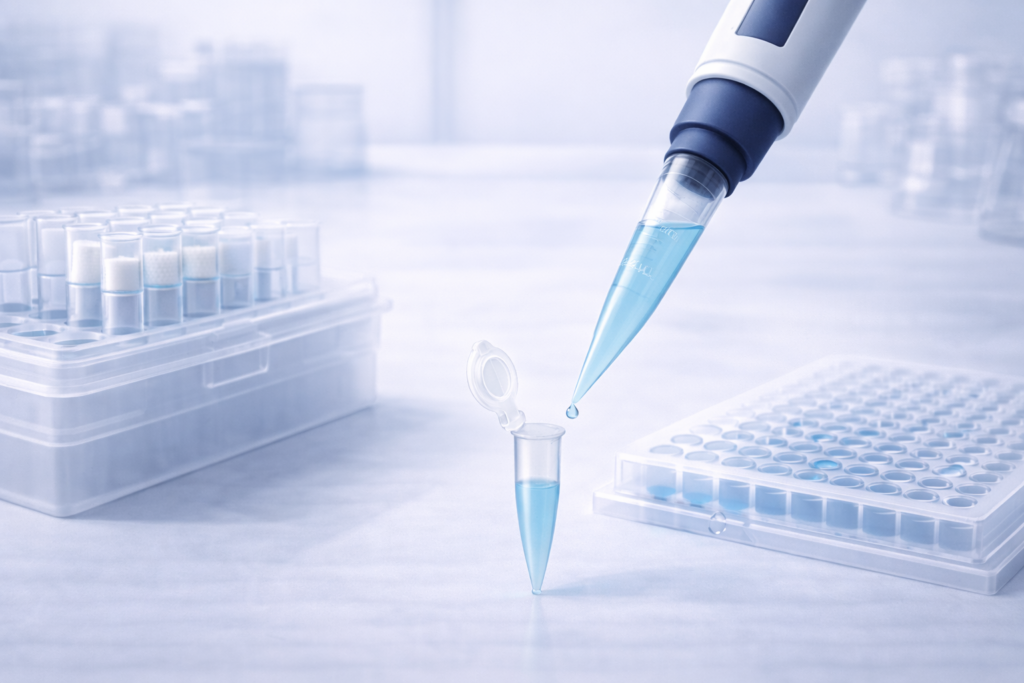
Polymerase Chain Reaction (PCR) and quantitative PCR (qPCR) are the workhorses of modern molecular biology, but they are unforgiving techniques. Because PCR amplifies specific DNA sequences exponentially, even microscopic errors in volume or trace amounts of contamination can ruin an experiment. A variation of just 0.5 µL in a reaction mix can alter enzyme concentrations enough to shift Ct values in qPCR, leading to false data interpretation. Furthermore, aerosol contamination remains the primary cause of false positives in diagnostic and research settings.
Success in PCR does not just depend on high-quality enzymes or primers; it depends heavily on the liquid handling ecosystem-specifically the interaction between the pipette mechanics and the consumable tip. Selecting the correct equipment is not merely a purchasing decision; it is a critical scientific control. This guide provides a practical framework for selecting the optimal pipette setup and consumables to ensure reproducibility, accuracy, and data integrity in your PCR workflows.
Quick PCR Selector (Most Valuable)
For rapid decision-making, use this selector to match your specific application with the necessary equipment specifications.
Workflow Compatibility Table
| Workflow | Typical Volumes | Main Risks | Recommended Pipette Features | Recommended Tip Type |
|---|---|---|---|---|
| Master Mix Preparation | 100 µL – 1000+ µL | Volume inaccuracy, foaming | Single-channel, P1000 or P5000 | Standard or Extended Length (to reach bottom of tubes) |
| Template Addition (DNA/RNA) | 1 µL – 5 µL | Cross-contamination (Aerosols) | Single-channel, P2 or P10 | Aerosol Barrier (Filter) |
| qPCR Plate Setup (96-well) | 10 µL – 20 µL | Inconsistency between replicates | Multichannel (8 or 12), P20 | Low-Retention, Aerosol Barrier |
| High-Throughput / 384-well | 2 µL – 10 µL | RSI (Repetitive Strain Injury), Fatigue errors | Electronic Multichannel (16-channel if applicable) | High-Precision, Low-Retention |
| Viscous Samples / Detergents | Varies | Sample retention inside tip | Positive Displacement (optional) or Slow Aspiration | Low-Retention |
| Sterile/Sensitive (RNA work) | Varies | RNase/DNase degradation | Fully autoclavable lower parts | Sterile, Certified RNase/DNase Free |
Selection Decision Tree (IF/THEN)
- IF you are handling genomic DNA, plasmid templates, or RNA samples THEN you must prioritize Aerosol Barrier tips to protect the pipette barrel from contamination.
- IF you are setting up full 96-well plates with replicates THEN switch to a multichannel pipette to reduce time and ensure simultaneous reaction starts.
- IF your protocol requires dispensing reagents into many wells (e.g., adding Master Mix to 96 wells) THEN consider electronic pipettes with multi-dispense modes to improve consistency and reduce thumb fatigue.
- IF you are working with volumes ≤ 2 µL THEN use a dedicated P2 pipette rather than a P10; the stroke length difference significantly impacts precision at the bottom of the range.
- IF the liquid has low surface tension (contains Triton X, Tween, or glycerol) THEN utilize Low-Retention tips to ensure the full calculated dose is delivered rather than sticking to the plastic wall.
PCR Accuracy Basics
Understanding the mechanics of liquid handling is essential for troubleshooting PCR failures. While many researchers focus on the biology, the physics of the pipette dictates the accuracy of the reaction setup.
Why Small Volume Errors Matter (Precision vs. Accuracy)
In qPCR, data is logarithmic. A pipetting error of 5% in a linear assay might be negligible, but in qPCR, variances in template volume or primer concentration can shift the Threshold Cycle (Ct) significantly.
- Accuracy refers to delivering the intended volume (e.g., setting the dial to 10 µL and delivering exactly 10 µL).
- Precision refers to reproducibility (e.g., delivering exactly 10.2 µL ten times in a row).
For qPCR replicates, precision is often more critical than absolute accuracy. If you consistently pipet slightly more master mix into every well, the data remains comparable. However, if your technique lacks precision, your replicates will show high standard deviations, rendering the data useless.
Air Displacement vs. Positive Displacement
The vast majority of PCR work is performed using air displacement pipettes. These rely on a piston creating a vacuum to pull liquid into the tip. An air cushion separates the liquid from the piston. This cushion is susceptible to expansion or contraction based on temperature and atmospheric pressure, and it can be compressed by volatile liquids.
Positive displacement pipettes have a piston that physically contacts the sample (often inside a specialized capillary tip). While less common for general PCR, they are superior when handling:
- Extremely viscous glycerol stocks (enzyme buffers).
- High-vapor-pressure liquids that drip from standard tips.
- Situations where zero cross-contamination is non-negotiable (forensics), as the tip contains the piston mechanism.
Single-Channel vs. Multichannel for Plates
Manual single-channel pipetting for a 96-well plate involves nearly 300 plunger movements (tip attachment, aspiration, dispense, ejection). This induces fatigue, which directly correlates with “drifting” accuracy as the user’s thumb muscles tire.
- Single-channel: Best for Master Mix creation, adding distinct templates to distinct tubes, and non-standard formats.
- Multichannel: Essential for plate loading. It reduces setup time by ~80%, minimizing evaporation effects in the first wells filled compared to the last. It also ensures that replicates are handled with identical force and speed.
Manual vs. Electronic Pipettes
Manual pipettes are the industry standard due to lower cost and robustness. However, user technique accounts for the largest source of error in manual pipetting (speed of aspiration, angle of hold).
Electronic options eliminate the variable of thumb force and speed. They use a motor to drive the piston, ensuring that the aspiration rate and dispensing speed are identical for every single aliquot. For high-density layouts (384-well plates), an electronic pipette is virtually mandatory to maintain spatial precision and prevent Repetitive Strain Injury (RSI).
Choosing Tips for PCR Workflows
The pipette is only as good as the tip attached to it. Using a premium pipette with a low-quality tip is like putting budget tires on a race car-performance will suffer. Here is how to select the right consumable for the specific stage of your PCR workflow.
Aerosol Barrier (Filter) Tips
These are the gold standard for PCR. They contain a porous filter (usually polyethylene) located inside the proximal end of the tip.
- Function: They allow air to pass through for displacement but block aqueous liquids and aerosols.
- Why they are critical: When you aspirate, microscopic aerosols form inside the tip. Without a barrier, these aerosols can float up into the pipette shaft (barrel). The next time you use that pipette, the airflow can blow those contaminating DNA/RNA molecules into a new sample.
- Recommendation: Use these for all template (DNA/RNA) handling and primer additions.
Sterile vs. Non-Sterile
“Sterile” usually means the tips have been irradiated (Gamma or E-beam) to destroy viable organisms. However, for molecular biology, you specifically need “Bio-Clean” or certified free of RNase, DNase, DNA, and endotoxins.
- The Reality: Autoclaving standard tips in the lab kills bacteria but may not destroy free-floating DNA amplicons or robust RNases. Buying pre-sterilized, certified tips eliminates the risk of introducing nucleases that degrade your RNA template before the RT-PCR step even begins.
Low-Retention Tips
These tips are manufactured with a specialized hydrophobic resin or surface treatment that repels liquid more effectively than standard polypropylene.
- When they help: Standard tips often retain a thin film of liquid on the inner wall. If you are pipetting 100 µL, a loss of 0.5 µL is negligible. If you are pipetting 2 µL of a viscous enzyme mix, retaining 0.5 µL is a 25% error.
- Usage: Ideal for master mixes containing glycerol, detergents (Tween-20), or expensive reagents where maximizing recovery is cost-effective.
Extended Length Tips
These tips are longer and narrower than standard designs.
- Application: They are designed to reach the bottom of 1.5 mL or 15 mL conical tubes without the pipette shaft touching the sidewalls of the tube. This prevents “shaft contamination,” where the non-sterile part of the pipette accidentally picks up liquid and transfers it to the next tube.
Tip Selection Summary
| Tip Type | Best For in PCR | Trade-offs | Common Mistakes |
|---|---|---|---|
| Standard / Bulk | Buffer prep, water aliquoting | Not sterile; no aerosol protection | Using for DNA template (high contamination risk) |
| Aerosol Barrier | DNA/RNA template, Primers | Higher cost | Allowing liquid to touch the filter (contaminates the sample) |
| Low-Retention | Enzymes, Glycerol, Viscous Mixes | Slightly higher cost | Assuming they eliminate need for pre-wetting |
| Extended Length | Reaching into 15mL / 50mL tubes | Can be fragile | Using them for high-precision low-volume work (air gap is larger) |
Best Practices to Reduce PCR Problems
Even the most expensive pipette tips cannot compensate for poor technique. Implement these operational standards to protect your data.
- Immersion Depth: Immerse the tip just below the surface of the liquid (1–2 mm for micro-volumes). Dipping too deep causes liquid to stick to the outside of the tip, which is then inadvertently added to the destination vessel, increasing the volume.
- Vertical Aspiration: Always hold the pipette vertically (within 20 degrees of vertical) when aspirating. Holding it at an angle changes the hydrostatic pressure and results in under-pipetting.
- Pre-Wetting: For volumes > 10 µL, aspirate and dispense the liquid 2–3 times before the final draw. This humidifies the air cushion inside the tip and coats the tip surface, equilibrating the temperature and significantly improving accuracy.
- Consistent Plunging: Use a smooth, controlled motion. Do not let the plunger “snap” back. A snapping plunger creates aerosols and can splash liquid onto the filter or into the pipette shaft.
- Dispensing Angle: When dispensing into a plate or tube, touch the tip against the sidewall at a slight angle (usually 45 degrees). This capillary contact helps draw the liquid out of the tip completely.
- Clean-to-Dirty Workflow: Physically separate your workspace. Have a dedicated “Pre-PCR” area (Master mix prep) where no DNA is ever handled. Have a separate “Template Addition” area. Never move pipettes from the DNA area back to the Master Mix area.
Common Pitfalls (Newbie + Real Lab Pain)
Identifying these common errors can save weeks of troubleshooting failed amplification plots.
- The “Universal” Trap: Assuming that because a tip fits onto the cone, it seals correctly. A poor seal leads to leaking and massive volume inaccuracies.
- Temperature Disequilibrium: Pipetting cold reagents with a warm pipette (heated by your hand) causes the air cushion to expand, forcing liquid out of the tip (dripping).
- The “Blow-out” Forget: Not using the second stop to blow out the final residual liquid when dispensing, leaving volume behind.
- The “Blow-out” Mistake: Using the second stop when aspirating, which pulls in too much liquid.
- Viscosity Ignorance: Pipetting 50% glycerol like it is water. Viscous liquids require slow aspiration and a pause at the top of the draw to allow the liquid to finish moving.
- Tip Rocking: Jamming the pipette into the tip rack and rocking it back and forth to get a seal. This can crack the pipette cone or bend the tip.
- Over-Greasing: On older pipettes, using too much grease on the O-rings can clog the air passage.
- Ignoring Range: Using a P1000 to pipette 100 µL. Pipettes are most accurate in the upper 50-100% of their range. Using them at the bottom 10% (e.g., 100 µL on a 1000 µL pipette) usually falls outside acceptable error tolerances.
- Aerosol Build-up: Never cleaning the pipette shaft. Even with filter tips, the exterior of the pipette can carry contamination.
- Inconsistent Tip Fit: Using mixed brands of tips that sit at different heights on a multichannel pipette, causing some tips to crash into the plate while others barely touch the liquid.
Procurement & Standardization Checklist for a PCR Lab
When setting up a new lab or auditing an existing one, standardization is key to reproducibility. A haphazard mix of brands leads to confusion regarding which tips fit which pipette.
Essential Hardware:
- Micro-volume set: P2 (0.2–2 µL) and P10 (0.5–10 µL). Essential for primers and template.
- Mid-volume set: P20 (2–20 µL) and P200 (20–200 µL). Used for reaction setup and sample dilution.
- Macro-volume: P1000 (100–1000 µL). Used for buffers and water.
- Multichannel: One 8-channel or 12-channel P20 or P10 (depending on your typical reaction volume) is highly recommended for plate work.
Consumables Strategy:
- Stock Barrier Tips: Standardize on high-quality aerosol barrier tips for all P2, P10, and P20 work. The cost difference is negligible compared to the cost of contamination.
- Packaging: Buy racked tips for PCR. Bulk bags require hand-racking, which introduces massive contamination risks (skin cells, RNases, dust).
- Validation: Before buying a year’s supply, request samples. Perform a gravimetric test (weighing water) to ensure the tips seal perfectly with your specific pipette brand.
Maintenance:
- Calibration Schedule: Calibrate at least annually, or semi-annually for ISO-certified labs.
- Visual Inspection: Check O-rings and nose cones monthly for cracks or chemical corrosion.
FAQs
Do I always need filter tips for PCR?
For the template addition step (DNA/RNA) and primer handling, yes. It is the cheapest insurance against contamination. For making up large buffers or aliquoting sterile water that hasn’t touched DNA yet, you can use standard tips, but mixed workflows often lead to mistakes.
Why do results vary between replicate wells?
This is usually a user technique issue or a tip fit issue. If the tips are not sealing consistently on a multichannel pipette, volumes will vary. Alternatively, if the user is tired, the aspiration speed may vary across the plate.
What is the best pipette range for 1–10 µL work?
A P10 is the standard choice. However, if you frequently pipette 1–2 µL, a P2 is significantly more accurate. Avoid using a P20 for volumes under 2 µL.
Are universal tips fine for PCR?
“Universal” is a marketing term, not a technical specification. Many universal tips fit loosely on certain brands (e.g., Rainin LTS vs. standard cones). Always test the fit. A loose tip draws up less volume than the dial indicates.
When does low-retention make sense?
Use them for viscous liquids (glycerol, Triton-X), detergents, or low-concentration samples where losing 1 µL to the tip wall represents a significant percentage of the total mass.
How often should pipettes be calibrated?
Ideally every 6–12 months. However, if a pipette is dropped, it should be recalibrated immediately.
Can I autoclave filter tips?
Generally, no. While the plastic can handle the heat, the filter material often warps or blocks airflow after autoclaving, rendering the tip useless. Buy them pre-sterilized.
Why is my negative control showing amplification?
This is classic contamination. It often comes from aerosols in the pipette barrel (if not using filter tips) or from “splash back” where liquid touched the pipette shaft.
Key Takeaways
- Match the Tool to the Volume: Work within the optimal range (35–100%) of the pipette’s total capacity for best accuracy.
- Barrier Tips are Mandatory: Use aerosol barrier tips for all DNA/RNA handling to prevent carryover contamination.
- Consistency is King: Precision (reproducibility) often matters more than absolute accuracy in qPCR; standardized technique is vital.
- Multichannels Save Data: Use multichannel pipettes for plates to ensure all reactions start simultaneously and reduce fatigue-induced errors.
- Check the Fit: Never assume “universal” tips seal perfectly; specific tip-cone geometry affects volume draw.
- Protect the Piston: Keep the pipette vertical. Laying it down with liquid in the tip allows fluid to enter the piston assembly.
- Pre-wetting Improves Accuracy: Pre-wetting tips neutralizes humidity and temperature differences in the air cushion.
- Low-Retention for Sticky Samples: Use specialized surfaces for enzyme mixes and detergents to ensure full delivery.
- Separate Workflows: Dedicate specific pipettes to Pre-PCR and Post-PCR areas and never cross them.
- Regular Calibration: A drifting pipette will ruin experiments silently; maintain a strict service schedule.