
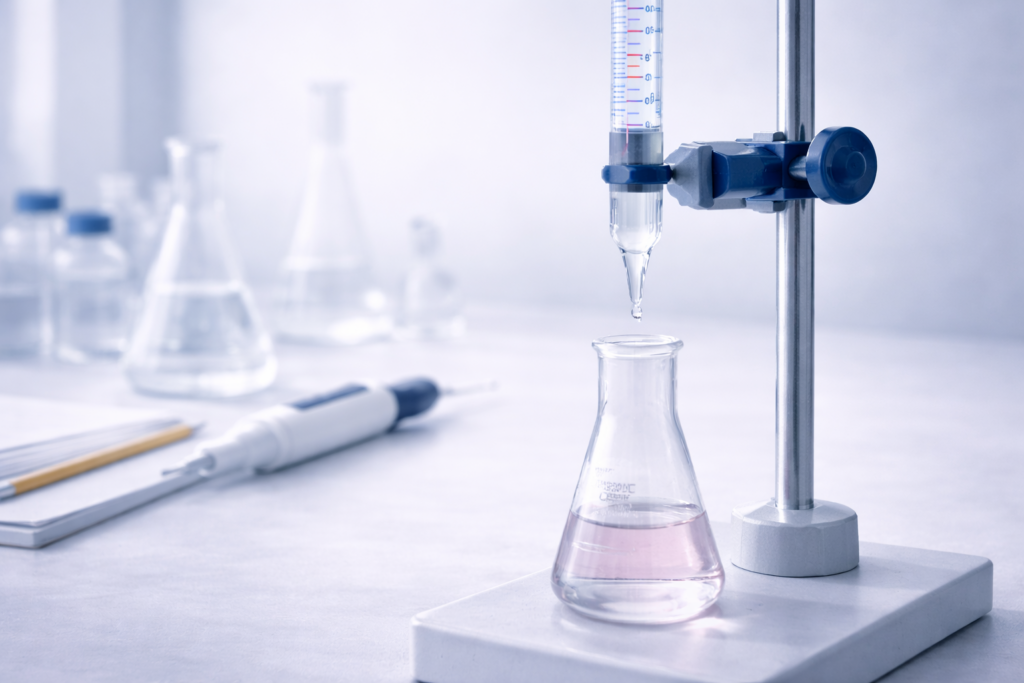
Laboratory burettes deliver controlled, incremental volumes with exceptional resolution-typically 0.05 to 0.1 mL-making them irreplaceable for titration and quantitative analysis where endpoint precision determines result accuracy. Unlike graduated cylinders or beakers, burettes enable real-time control during reagent addition, allowing technicians to approach titration endpoints drop-by-drop and achieve reproducible results across multiple trials. This guide provides a practical selector framework and technique protocols that address the most common sources of measurement error, helping students, QC staff, and procurement teams choose appropriate configurations and execute reliable titrations.
Quick Selector
Use Case Selection Table
6-Step Decision Checklist
- Choose capacity (10/25/50 mL) based on expected consumption: Match burette capacity to 50–80% of typical titrant volume consumed; undersized burettes require mid-titration refilling that introduces air bubbles and handling errors
- Choose class (A vs B) and tolerance expectations: Class A burettes offer tighter tolerance-±0.03 mL for 25 mL capacity versus ±0.06 mL for Class B-essential for analytical work requiring traceable accuracy; Class B suits teaching environments where cost matters more than certification
- Choose scale readability (Schellbach line, colored/white background): Schellbach burettes incorporate a vertical blue stripe that appears hourglass-shaped when viewed through the meniscus, significantly reducing parallax and improving reading precision with colored solutions
- Choose stopcock type (PTFE plug, needle valve, glass): PTFE stopcocks eliminate lubrication requirements and contamination risks inherent to glass stopcocks, offer superior chemical resistance to acids/bases/solvents, and resist freezing over time
- Choose material/color (clear vs amber) and chemical compatibility: Standard clear borosilicate glass handles most aqueous acids, bases, and mild oxidizers; amber glass protects light-sensitive reagents like iodine or permanganate solutions during titration
- Choose accessories (stand, clamp, funnel, reservoir/automatic options): Secure clamping to stable stands prevents vibration and tilt that cause reading errors; automatic zero burettes or reservoir systems reduce setup time in high-volume labs
Burette Types Explained
Standard Manual Burettes (Class A / Class B)
Class A burettes comply with ASTM E-287 and DIN EN ISO 385 standards, delivering certified accuracy through individual or batch calibration with tolerances half those of Class B equivalents. For a standard 50 mL glass burette, Class A tolerance is ±0.05 mL compared to ±0.10 mL for Class B. Class A burettes include permanent, high-contrast graduation markings and often come with calibration certificates traceable to national metrology institutes, meeting requirements for pharmaceutical QC, clinical labs, and research documentation.
Class B burettes provide reliable performance for general laboratory work, educational demonstrations, and preparatory experiments where the additional precision of Class A does not justify doubled cost. The tolerance difference becomes most significant when titrating small volumes; at 10 mL delivered from a 50 mL Class B burette, relative error reaches 1%, while Class A maintains 0.5%.
Schellbach Burettes (Readability Advantage)
Schellbach burettes incorporate a vertical white backing strip with a central colored line (typically blue) running the length of the graduated tube opposite the scale. When viewed through the liquid meniscus, this line appears pinched to an hourglass shape, with the narrowest point precisely indicating the meniscus level. This optical aid virtually eliminates parallax errors that occur when operators read graduated scales from slight angles.
Schellbach design proves most valuable when working with colored solutions where traditional meniscus visualization becomes difficult, during extended titration sessions where operator fatigue affects reading consistency, and in teaching environments where students initially struggle with meniscus interpretation. The enhanced readability justifies the modest cost premium in labs prioritizing measurement reproducibility across multiple technicians.
Microburettes and Small-Capacity Options
Microburettes in the 5–10 mL capacity range feature finer graduations (0.02–0.05 mL) and tighter tolerance specifications (±0.02 mL for Class A 10 mL) that dramatically reduce relative error when titrating small sample volumes. When consuming only 2–5 mL of titrant-common in microchemistry, precious sample analysis, or expensive reagent conservation-a 10 mL microburette maintains 0.4–1.0% relative accuracy compared to 2–5% for a standard 50 mL burette at these low volumes.
Typical applications include pharmaceutical potency assays with limited API availability, environmental analysis of low-concentration samples, and research settings where sample quantity constraints demand miniaturized procedures. Microburettes require careful technique due to enhanced sensitivity to temperature fluctuations and evaporation, but deliver unmatched precision in their volume range.
Automatic Zero / Reservoir Burettes
Automatic reservoir burettes incorporate a reagent bottle that screws directly to the burette assembly, eliminating repeated funnel-filling operations and associated contamination risks. After each titration, a simple mechanism resets the meniscus to zero while refilling from the reservoir, maintaining consistent starting conditions and reducing setup variability between runs.
These configurations save substantial time in high-throughput QC environments performing dozens of identical titrations daily, reduce reagent waste from spillage during manual filling, and improve safety when handling corrosive or toxic titrants. The trade-off involves higher initial cost and added complexity in cleaning protocols, making them most cost-effective when titration frequency exceeds 10–15 analyses per day.
Bottle-Top and Digital Burettes (Where They Fit)
Bottle-top burettes mount directly onto reagent bottles and incorporate digital volume displays with precision gear mechanisms or electronic sensors, achieving Class A accuracy (±0.1% or better) without glass burette fragility. Modern digital units like the Titrette® meet or exceed traditional burette error limits while adding features including programmable dispensing sequences, data logging to LIMS systems, and pause functions for complex titrations.
These systems excel in industrial QC, field testing where transport resilience matters, and production environments where titration throughput directly impacts manufacturing efficiency. Limitations include dependency on battery or power supply, higher purchase cost ($500–2000 versus $50–300 for glass burettes), and periodic electronic calibration requirements. Validation considerations include verifying digital readout accuracy against certified volumetric standards and documenting calibration frequency in quality systems.
Key Specs That Actually Matter
Capacity and graduation: Standard burettes offer 0.1 mL divisions for 25 and 50 mL capacities, suitable for titrations consuming 10–45 mL; microburettes provide 0.02–0.05 mL graduations essential when total volumes fall below 10 mL and relative accuracy requirements tighten.
Tolerance and calibration markings: Class A tolerance specifications range from ±0.02 mL (10 mL capacity) to ±0.05 mL (50 mL capacity), double that for Class B; permanent enamel or ceramic markings resist chemical attack and repeated cleaning better than painted graduations.
Stopcock choices: PTFE (polytetrafluoroethylene) plugs offer self-lubricating operation, eliminate grease contamination that interferes with many analyses, and provide superior chemical resistance to strong acids, bases, and organic solvents. Glass stopcocks require periodic lubrication with specialized greases that can contaminate sensitive titrations and may freeze during storage, but some analysts prefer their precise tactile feedback for slow endpoint approaches.
Chemical compatibility basics: Borosilicate 3.3 glass withstands most aqueous acids (HCl, H₂SO₄, HNO₃), bases (NaOH, KOH), and mild oxidizers (I₂, KMnO₄ at moderate concentrations) without degradation. Hydrofluoric acid and extremely concentrated alkaline solutions at elevated temperatures can attack glass and should prompt consideration of alternative materials or specialized coatings. PTFE stopcocks tolerate virtually all laboratory reagents except molten alkali metals and elemental fluorine.
Amber vs clear: Amber (brown) borosilicate glass blocks UV and visible light wavelengths that degrade photosensitive reagents including iodine solutions, permanganate, silver nitrate, and many organic indicators during extended setup or titration periods.
Technique: How to Get Accurate Volumes in Titration
Conditioning/rinsing concept: Rinse the clean burette 2–3 times with small portions (3–5 mL) of the actual titrant solution before filling for analysis; this conditioning displaces residual water that would dilute the titrant and ensures concentration accuracy from the first titration.
Filling, removing bubbles, and setting the meniscus: Fill above the zero mark using a funnel, then open the stopcock fully to flush solution rapidly through the tip, dislodging any trapped air bubbles; tap the burette gently while liquid flows to encourage bubble release. Adjust the meniscus to sit precisely at or just below the zero graduation by dispensing small amounts into a waste beaker while viewing at eye level.
Reading at eye level (parallax): Position your eyes horizontally aligned with the bottom of the meniscus to eliminate parallax error-the apparent position shift when viewing from above or below the actual level. Parallax can introduce systematic errors of 0.05–0.15 mL depending on viewing angle, nullifying the precision advantage of Class A burettes.
Recording initial/final readings correctly: Record the initial reading after setting the meniscus and allowing 10–15 seconds for drainage film to stabilize; record the final reading after titration endpoint using the same eye-level technique and allowing equivalent drain time. Volume delivered equals final reading minus initial reading, not simply the final value.
Drain time consistency: Burettes are calibrated “to deliver” (TD) with specific drainage characteristics; maintain consistent flow rate during endpoint approach (typically 1 drop per 2–3 seconds) and wait 10–15 seconds after closing the stopcock before taking final readings to ensure complete drainage.
Common Errors and Troubleshooting
Overshooting endpoint: Approach within 1–2 mL of the expected endpoint quickly (3–5 mL/minute), then reduce flow to half-drop increments; rinse flask walls with distilled water from a wash bottle to capture any splashed titrant before determining true endpoint.
Air bubbles near tip/stopcock: Flush burette vigorously after initial filling, tap gently on the tip area while solution flows to dislodge stubborn bubbles, and verify the tip is completely filled before recording initial reading; trapped air produces apparent volume delivery greater than actual, causing systematically low results.
Leaking stopcock or inconsistent flow: For PTFE stopcocks, tighten the retaining nut gradually until leaking stops but the plug still turns smoothly without excessive resistance; overtightening deforms the PTFE and actually worsens sealing. For glass stopcocks, disassemble, clean thoroughly, apply fresh thin coat of appropriate stopcock grease, and reassemble with identifying marks aligned.
Meniscus hard to see: Use a burette reading card-white card with a thick black horizontal stripe-positioned immediately behind and slightly below the meniscus; the black stripe provides sharp contrast making the meniscus boundary obvious. Schellbach burettes eliminate this issue entirely through their integrated optical aid.
Inconsistent results between students/technicians: Standardize technique through written protocols specifying drain time (e.g., “wait 15 seconds after endpoint before final reading”), flow rate during endpoint approach, and eye positioning for meniscus reading; systematic technique differences often cause reproducibility problems exceeding burette tolerance limits.
Cleaning, Storage, and Maintenance
Rinse burettes immediately after use with tap water (3–4 full volumes), followed by distilled or deionized water (2–3 rinses) to remove all titrant residue before it crystallizes or forms deposits. For PTFE stopcocks, unscrew the retaining nut, remove the stopcock key, wash both components with laboratory detergent solution, and rinse thoroughly with distilled water. Avoid abrasive brushes inside the burette bore, as scratches compromise drainage characteristics and make accurate reading difficult.
For stubborn deposits, prepare appropriate cleaning solutions matched to the residue type-dilute acid for basic salt deposits, dilute base for acidic residues, organic solvents for oil-based contaminants-then rinse exhaustively with water. Store burettes vertically in dedicated racks with stopcocks slightly open to prevent PTFE deformation or glass stopcock freezing; never store with stopcock fully closed as this can cause permanent seizing.
PTFE stopcocks require minimal maintenance beyond cleaning and should never be lubricated, as grease degrades their self-lubricating properties. Inspect stopcock sealing periodically by filling the burette with water and observing for drips over 1–2 minutes with the stopcock closed; replace worn PTFE plugs when tightening the retaining nut no longer prevents leakage.
FAQ
What is a burette used for in titration?
A burette delivers controlled, measurable volumes of titrant solution during quantitative analysis, enabling precise determination of analyte concentration through drop-by-drop reagent addition until reaching a stoichiometric endpoint.
How do you read a burette accurately?
Position your eye horizontally level with the bottom of the meniscus (the curved liquid surface), read the graduation mark at this lowest point, and use a burette card with a black stripe behind the meniscus to enhance visibility and prevent parallax error.
What is the difference between a burette and a pipette?
Burettes deliver variable, controlled volumes (typically 0–50 mL) with readings taken before and after dispensing, while pipettes transfer fixed volumes (e.g., 10.00 or 25.00 mL) in a single operation, making burettes suitable for titrations and pipettes ideal for sample/standard preparation.
When should I use a 25 mL vs 50 mL burette?
Use a 25 mL burette when expected titrant consumption falls between 10–20 mL, providing finer relative precision (0.15% vs 0.25% for 50 mL) at these volumes; reserve 50 mL burettes for titrations consuming 20–45 mL to avoid mid-procedure refilling.
What is a Class A burette?
A Class A burette meets the most stringent accuracy specifications in ASTM E-287 and ISO 385 standards, delivering certified tolerance (±0.03 mL for 25 mL capacity), permanent graduation markings, and often individual calibration certificates required for regulatory and research applications.
What helps prevent parallax and reading mistakes?
Reading with eyes level to the meniscus bottom, using a burette card with a black background stripe for contrast, choosing Schellbach burettes with integrated optical alignment aids, and ensuring the burette hangs perfectly vertical all significantly reduce parallax and improve reading reproducibility.
Key Takeaways
- Match burette capacity to expected titrant consumption, targeting 50–80% of burette volume to optimize relative accuracy and avoid mid-titration refilling
- Class A burettes provide half the tolerance of Class B (±0.03 mL vs ±0.06 mL for 25 mL), essential for QC, research, and regulatory compliance where documented traceability matters
- PTFE stopcocks eliminate lubrication requirements and contamination risks while offering superior chemical resistance compared to glass stopcocks requiring periodic greasing
- Schellbach optical design with vertical blue stripe dramatically improves meniscus reading accuracy, particularly valuable for colored solutions and multi-operator environments
- Microburettes (10 mL capacity with 0.02–0.05 mL graduations) become essential when titrant volumes fall below 10 mL and relative error must stay under 1%
- Conditioning burettes with 2–3 small rinses of actual titrant before filling prevents dilution errors from residual water
- Always read the meniscus bottom with eyes horizontally level to eliminate parallax errors that can exceed burette tolerance specifications
- Remove all air bubbles from burette tip by flushing vigorously after filling and tapping gently; trapped air causes systematic low results
- Wait 10–15 seconds after endpoint before taking final readings to ensure complete drainage according to “to deliver” (TD) calibration
- Store burettes vertically with stopcocks slightly open to prevent PTFE deformation or glass stopcock freezing between uses