
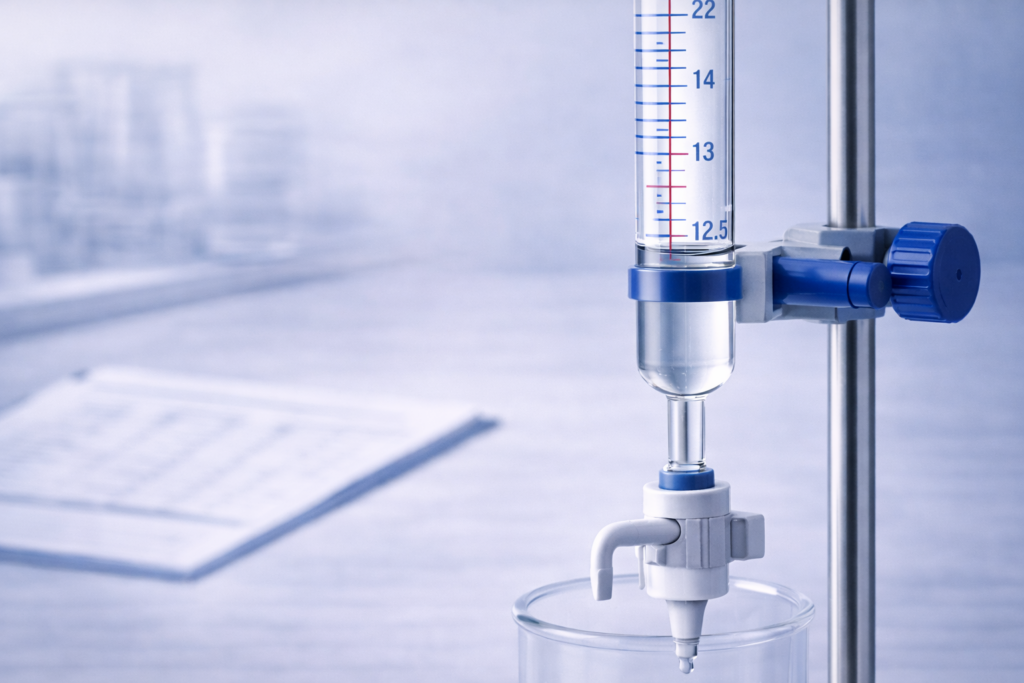
Titration is a cornerstone of analytical chemistry, and the burette is its primary tool. While often viewed as simple glass tubes, burettes are actually high-resolution instruments capable of delivering liquids with precision down to 0.01 mL. However, because they are analog devices read by the human eye, they are uniquely susceptible to operator error.
The “true” volume delivered is rarely exactly what the meniscus reads. Accuracy depends on glass quality, temperature, cleanliness, and the operator’s technique. Whether you are a student writing a lab report or a QA manager validating equipment, understanding uncertainty is just as important as the measurement itself.
This guide provides a comprehensive workflow for burette calibration, explains the difference between Class A and Class B accuracy, and offers a step-by-step method for calculating and reporting uncertainty.
Quick Start: If You Only Do 10 Things…
If you need to ensure high-quality results immediately, follow this 10-point “Best Practices” checklist before starting your titration.
- Check for “Beading”: Rinse the burette with water. If water forms droplets on the inner wall (beading), the glass is dirty. Clean it until water sheets down evenly.
- Vertical Alignment: Mount the burette in a stand. It must be perfectly vertical. A slanted burette distorts the meniscus shape and the reading.
- The “Hidden” Bubble: Check the tip below the stopcock. An air bubble trapped here will eventually leave during titration, counting as liquid volume delivered. Remove it by opening the stopcock fully for a second.
- Parallax Error: Always read the meniscus at eye level. If you look up or down at the line, your reading will be biased.
- Meniscus Convention: For clear liquids, always read the bottom of the curve (the meniscus).
- Leak Check: Fill the burette, dry the tip with a tissue, and let it sit for 5 minutes. If a drop forms, the stopcock needs tightening or lubrication.
- Temperature Stability: Ideally, reagents and glassware should be at room temperature (typically 20°C–25°C). Cold liquids in a warm lab cause condensation and volume contraction.
- Drainage Time: Do not drain a burette too fast. Gravity needs time to pull the film of liquid down the walls. Allow 30 seconds after dispensing before taking the final reading.
- Consistent Background: Hold a white card with a black mark behind the meniscus to make the curve distinct and reproducible.
- Record Two Decimals: If your burette has 0.1 mL markings, you must estimate the next digit. Record to 0.01 mL (e.g., 24.50 mL, not 24.5 mL).
Key Terms Defined (Simple Definitions)
To manage data quality, you must distinguish between these often-confused terms.
- Accuracy: How close your delivered volume is to the true volume.
- Precision (Repeatability): How close multiple measurements of the same volume are to each other, regardless of whether they are “correct.”
- Bias: A consistent error in one direction (e.g., a burette that always delivers 0.05 mL less than the reading).
- Resolution: The smallest distinction the instrument can show. For a standard 50 mL burette, the markings are 0.1 mL, but the resolution (readable by eye) is typically 0.01 mL or 0.02 mL.
- Tolerance: The maximum error allowed by manufacturing standards (ISO or ASTM).
- Class A: High grade, tighter tolerance (e.g., ±0.05 mL for 50 mL). Used for quantitative analysis.
- Class B: General purpose, looser tolerance (e.g., ±0.10 mL for 50 mL). Used for education.
- Uncertainty: A statistical estimate of the range within which the true value lies. It combines random error (precision) and systematic error (bias).
What Determines Burette Accuracy in Real Labs?
Even a certified Class A burette can produce poor data if environmental and human factors are ignored.
Reading Error (Meniscus + Parallax)
The thickness of the graduation line on the glass usually represents about 0.02 mL. The human eye must interpolate the position of the meniscus between these lines. “Parallax” occurs when the eye is not level with the liquid; looking up makes the volume appear lower, and looking down makes it appear higher.
Drainage and Wetting
When liquid leaves a burette, a thin film remains on the glass walls. Calibrated burettes account for this “hold-up volume.” However, if the glass is dirty (grease spots), the film breaks, and drops stick to the wall instead of draining. This causes the volume delivered to be less than the volume read.
Stopcock Integrity
A stopcock that is too loose may leak (positive error-liquid leaves but isn’t meant to). A stopcock that is too tight may be hard to turn, leading to over-shooting the endpoint. Modern Teflon (PTFE) stopcocks reduce the need for grease, which prevents the common issue of grease blocking the tip.
Bubbles in the Tip
This is the most common novice error. A bubble in the tip occupies space. If it dislodges during the titration, it enters the flask as air, but the meniscus drops as if it were liquid. This creates a “phantom volume” reading.
Temperature Effects
Glassware is calibrated at a specific temperature (usually 20°C).
- Glass expansion: Minimal. Borosilicate glass expands very little.
- Liquid expansion: Significant. Water and organic solvents expand as they warm up. Using a burette at 30°C that was calibrated at 20°C introduces a density error that affects gravimetric calibration.
Glass vs. Digital Burettes: Where Uncertainty Comes From
Digital burettes (bottle-top titrators) eliminate meniscus reading errors but introduce mechanical and electronic variables.
| Factor | Glass Burette (Manual) | Digital / Automatic Burette |
|---|---|---|
| Primary Error Source | Human reading (parallax/interpolation) | Mechanical drift (piston seal wear) |
| Resolution | 0.01 mL (estimated by eye) | 0.001 mL to 0.01 mL (digital display) |
| Bias | Drainage film & glass expansion | Air bubbles in piston & electronics calibration |
| Calibration Method | Gravimetric (weighing water) | Gravimetric (weighing water) |
| Documentation | Notebook recording | Often automated / RS232 output |
| Cost vs. Accuracy | Low cost, High accuracy (Class A) | High cost, High precision, Lower operator fatigue |
Burette Calibration: A Practical Workflow
Objective: Determine the true volume delivered at specific intervals using the Gravimetric Method (weighing the delivered water).
Reagents: Distilled or Deionized Water (degassed is best).
Equipment: Analytical balance (±0.001 g or better), thermometer (±0.1°C), beaker.
Preparation
- Clean: Ensure the burette is chemically clean (no beading).
- Fill: Fill with distilled water past the 0.00 mL mark. Open the stopcock to flush the tip and remove all air bubbles.
- Acclimate: Allow water and burette to reach room temperature. Measure and record the temperature of the water.
- Zero: Lower the meniscus exactly to the 0.00 mL mark (reading the bottom of the meniscus). Touch the tip to the side of a waste beaker to remove any hanging drop.
Calibration Runs
Perform this check at 3 to 5 intervals (e.g., 10 mL, 20 mL, 30 mL, 40 mL, 50 mL).
- Place a clean, dry, weighed beaker on the balance. Tare (zero) the balance.
- Dispense water from the burette into the beaker until the meniscus is close to the target interval (e.g., 10 mL).
- Wait 30 seconds for drainage.
- Read the burette precisely (e.g., 10.02 mL). Record this as $V_{read}$.
- Weigh the beaker. Record the mass of water ($m_{water}$).
- Refill and repeat for the next interval, or continue cumulatively if your balance capacity allows.
Data Template:
| Run # | Target Volume (mL) | Final Burette Reading ($V_{read}$) | Mass of Water (g) | Temperature (°C) | Correction Factor (Z) | Calculated True Volume ($V_{true}$) | Error ($V_{true} – V_{read}$) |
|---|---|---|---|---|---|---|---|
| 1 | 10.00 | 10.01 mL | 9.982 g | 22.0 | 1.0033 | 10.015 mL | +0.005 mL |
| 2 | 20.00 | 20.00 mL | 19.950 g | 22.0 | 1.0033 | 20.016 mL | +0.016 mL |
Note: The “Correction Factor (Z)” accounts for the density of water at that temperature and air buoyancy. Standard Z-value tables are available in ISO 3696 or online. (e.g., at 20°C, Z ≈ 1.0029 mL/g).
Troubleshooting Results
- Result is consistently low: Did you account for evaporation? Was the beaker covered? Did you allow for drainage time?
- Result varies wildly: Check for leaks in the stopcock or drafts affecting the analytical balance.
- Mass is higher than volume: Check the water temperature. Cold water is denser; if you use the wrong Z-factor, the calculation will be wrong.
Calculating Uncertainty: A Simple Template
Reporting a result as “25.00 mL” is incomplete. You must describe how sure you are.
Method 1: The Minimal Method (Teaching Labs)
For basic coursework, uncertainty is often estimated based on the instrument’s tolerance.
- Rule: Uncertainty = $\frac{\text{Tolerance}}{\sqrt{3}}$ (treating it as a rectangular distribution).
- Example: A Class B burette has a tolerance of $\pm 0.10$ mL.
- Calculation: $0.10 / 1.73 = 0.058$ mL.
- Report: $25.00 \pm 0.06$ mL.
Method 2: The Rigorous Method (QA/QC)
This combines three sources of uncertainty ($u$):
- Calibration Uncertainty ($u_{cal}$): Provided by the manufacturer certificate or your own calibration data.
- Repeatability ($u_{rep}$): The standard deviation of your own repeated measurements.
- Reading Uncertainty ($u_{read}$): The ability of the eye to resolve the scale (usually 0.01 mL or 0.02 mL).
Formula for Combined Standard Uncertainty ($u_c$):
uc=(ucal)2+(urep)2+(uread)2
Expanded Uncertainty ($U$):
To reach a 95% confidence level, multiply $u_c$ by a coverage factor, usually $k=2$.
U=uc×2
Example Calculation:
- $u_{cal} = 0.03$ mL
- $u_{rep} = 0.01$ mL
- $u_{read} = 0.01$ mL
- Sum of squares = $0.0009 + 0.0001 + 0.0001 = 0.0011$
- $u_c = \sqrt{0.0011} \approx 0.033$ mL
- Expanded Uncertainty ($U$): $0.033 \times 2 = \mathbf{0.066}$ mL
How Many Decimal Places Should You Report?
This is the most common error in student reports.
The Rule of Thumb:
Always estimate one digit beyond the smallest graduation.
- Standard 50 mL Burette: Graduations are every 0.1 mL.
- You report to: 0.01 mL.
- Micro-burette (10 mL): Graduations are every 0.05 mL or 0.02 mL.
- You report to: 0.001 mL (if possible) or nearest 0.005 mL.
Avoid False Precision:
Do not report “24.555 mL” from a standard burette just because your calculator shows it. You cannot see 0.005 mL with the naked eye on a standard scale.
Examples of Correct Reporting:
- “Volume delivered: $21.40 \text{ mL}$” (Indicates the meniscus was exactly on the line).
- “Volume delivered: $21.43 \text{ mL}$” (Indicates the meniscus was roughly 30% past the 21.4 mark).
- “Mean titre: $25.15 \pm 0.04 \text{ mL}$ (95% CI)”.
FAQ:
Q: What is the accuracy of a standard burette?
A: A Class A 50 mL burette typically has a tolerance of $\pm 0.05$ mL. A Class B burette typically has a tolerance of $\pm 0.10$ mL.
Q: How do you calibrate a burette?
A: By weighing the water delivered. Because we know the density of water exactly at any given temperature, we can convert the mass (grams) into the precise volume (mL) and compare it to the reading on the glass.
Q: How do you measure uncertainty in calibration?
A: You perform multiple runs (repeatability), calculate the standard deviation, and combine that with the resolution error of the instrument using the “root sum of squares” method.
Q: What is the uncertainty of a 50 mL burette reading?
A: A single reading has an uncertainty of roughly ±0.02 mL (visual estimation). However, a titration involves two readings (initial and final), so the uncertainty of the delivered volume is slightly higher (roughly $\sqrt{0.02^2 + 0.02^2} \approx 0.03$ mL).
Q: If a burette is calibrated at 25°C and used at 30°C, what changes?
A: The glass expands slightly (negligible), but the liquid inside expands significantly. The burette will physically contain the same volume, but the mass of the liquid delivered will differ, potentially affecting molarity calculations.
Recalibration Frequency and Service Life
Glass does not “drift” electronically, but it does wear physically. You should remove a burette from service or recalibrate it if:
- Physical Damage: Any chip in the tip affects drop size. Any scratch on the bore makes the meniscus hard to read.
- Stopcock Leaks: If the valve cannot hold liquid static for 15 minutes without a drop forming.
- Harsh Chemistry: Long-term exposure to strong bases (like NaOH) can etch glass, slightly changing the internal volume over years.
- Audit Requirements: GLP/GMP labs typically require annual recalibration.
- New Operators: In training environments, the operator is calibrated, not the burette. If a student’s results are erratic, they must perform a calibration run to verify their technique.
Quick Summary + Lab-Report Template
Summary:
- Cleanliness is key: No beading on the glass.
- Check the tip: Remove all air bubbles before starting.
- Read properly: Eye level, bottom of the meniscus, estimate to 0.01 mL.
- Class A vs B: Know your tool’s tolerance ($\pm 0.05$ vs $\pm 0.10$ mL).
- Temperature: Calibrate and work near 20°C–25°C for best accuracy.
- Uncertainty: Combines calibration error, repeatability, and reading error.
Reporting Template:
Copy and paste this into your lab notebook or report:
Instrument: 50 mL Class [A/B] Burette
Temperature: ____ °CExperimental Data:
- Initial Reading: . mL
- Final Reading: . mL
- Delivered Volume: . mL
Uncertainty Statement:
“The delivered volume is ____ mL ± ____ mL (Expanded uncertainty, $k=2$).”Notes: Uncertainty calculated based on instrument tolerance and reading error.