
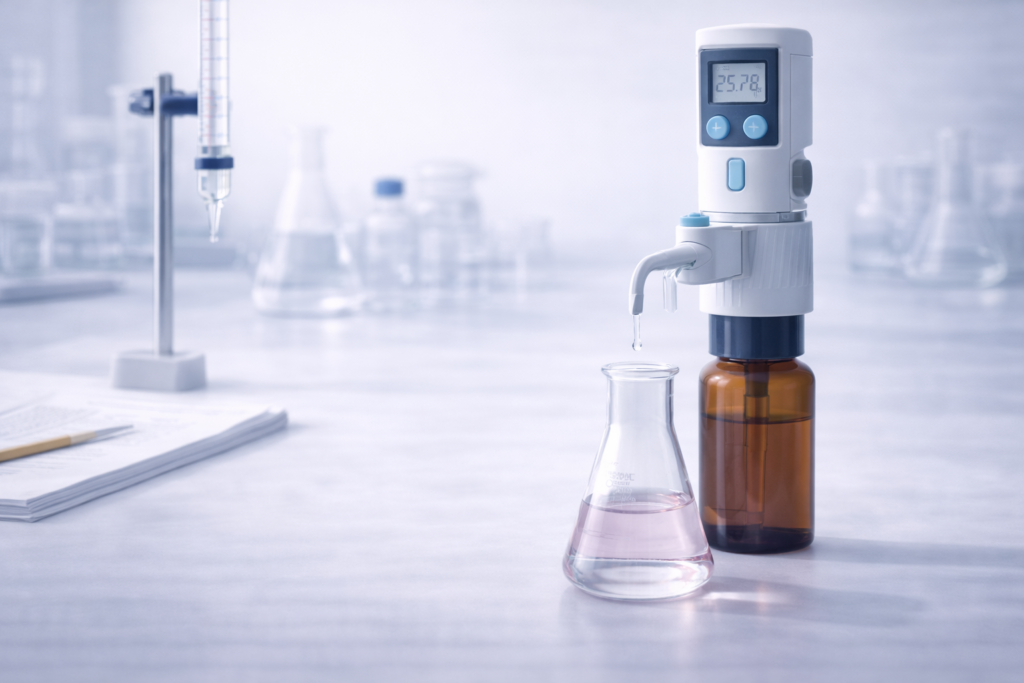
Automatic and digital burettes represent a practical upgrade from traditional glass burettes, offering faster reagent delivery, improved repeatability, and easier documentation of titration results. These bottle-top or piston-driven systems eliminate manual stopcock control and parallax reading errors, delivering volumes with electronic precision ranging from 10 µL increments to full-capacity refills. This guide provides a quick selector, procurement checklist, and honest guidance on when a glass burette remains the right tool-because not every lab needs motorized dispensing for every application.
Quick Selector
Decision Table
10-Point Procurement Checklist
- Volume range & resolution: Confirm the burette covers your typical titration volumes (e.g., 0.01–99.99 mL) and offers resolution matching your endpoint precision need (10 µL steps for routine work; finer for micro-titrations).
- Accuracy vs repeatability: Check manufacturer specs for both-repeatability (CV ≤0.1%) matters most for routine QC where you run the same method daily; accuracy (R ≤0.2%) matters for absolute quantification.
- Chemical compatibility: Verify valve and seal materials (PTFE, FKM, EPDM) against your reagent list-acids, bases, solvents, oxidizers; look for compatibility charts in product documentation.
- Valve/seal design & leakage risk: Piston seals and dispensing valves are the primary leak points; ask about replacement frequency and whether spare seal kits are readily available.
- Bottle-top fit/adapter system + venting: Confirm the burette fits standard GL45 or your lab’s reagent bottles; venting (air inlet) must be chemically resistant and prevent pressure buildup during dispensing.
- Ergonomics & training time: Consider button layout, handwheel feel (for manual-digital hybrids), and display readability; complex multi-button systems slow down new users.
- Cleaning / reagent changeover: Estimate how often you’ll switch reagents-some electronic burettes offer recirculation modes that simplify rinsing without wasting titrant.
- Calibration approach + traceability: Gravimetric calibration (weighing dispensed water at 20°C) is the standard method; check if the manufacturer provides calibration certificates and whether your lab can perform in-house verification.
- Data logging/export needs: If GLP/ISO compliance or audit trails are required, prioritize models with USB, RS-232, or wireless data export; otherwise, manual logbooks suffice.
- Serviceability + spare parts availability: Confirm local or regional availability of replacement seals, valves, and batteries; downtime for international shipping can halt QC workflows.
What Counts as “Automatic” vs “Digital” Burette?
The terminology varies across manufacturers, but these categories clarify the landscape:
- Manual glass burette: Traditional borosilicate tube with etched graduations and a glass or Teflon stopcock; operator reads meniscus and controls flow by hand (±0.05–0.10 mL typical precision).
- Bottle-top burette (manual): Piston-driven dispenser mounted on a reagent bottle; operator turns a handwheel to deliver titrant with better control than a stopcock, but still reads a mechanical counter or scale.
- Digital bottle-top burette: Adds an electronic display to a manual piston mechanism; the handwheel advances the piston, and a digital encoder shows dispensed volume to 0.01 mL.
- Automatic piston burette / electronic burette: Motor-driven piston system with push-button or touchscreen control; pre-set dispensing speeds (up to 16 levels), recirculation mode, and optional data output. These eliminate manual handwheel operation entirely.
- Full titrator (different category): Integrated systems combining burette, pH/conductivity meter, stirrer, and automated endpoint detection; typically benchtop units for dedicated titration stations-not covered in depth here, as they address different workflows.
Key Selection Criteria (The Stuff That Changes Results)
Resolution, Dosing Increments, and Endpoint Control
Resolution defines the smallest volume step the burette can deliver-typically 10 µL (0.01 mL) for digital and electronic models. This matters most near the titration endpoint, where a single 0.01 mL increment can shift pH by 0.5–1.0 units in sharp acid-base titrations. Electronic burettes offering variable-speed control (e.g., 16 stages) allow you to approach the endpoint at 0.010 mL/sec for precise stopping, reducing overshoot compared to fixed-speed manual delivery.
Accuracy vs Repeatability (Why Repeatability Often Matters Most for Routine QC)
Accuracy (systematic error) measures how close the dispensed volume is to the true value-expressed as relative error (R%), typically ±0.2% for Class A digital burettes. Repeatability (precision) measures variation between successive dispenses-expressed as coefficient of variation (CV%), often 0.07% for quality electronic models. In routine QC where you calibrate against a standard daily, repeatability drives your confidence interval; accuracy matters more when absolute quantification without external calibration is required.
Chemical Compatibility and Sealing
Piston seals and valve components contact the reagent continuously, making material selection critical. PTFE (Teflon) seals handle most acids, bases, and non-polar solvents but may swell in strong oxidizers; FKM (Viton) resists aromatic solvents and many acids; EPDM suits aqueous alkaline solutions. Product spec sheets should list compatible chemicals-when in doubt, request a compatibility chart from the manufacturer before purchasing, as seal degradation causes leaks and contamination.
Speed vs Control (Approach to Endpoint)
High dispensing speed (e.g., 5 mL/min) accelerates bulk titrant addition early in the titration, but endpoint precision demands slow, drop-wise control (0.01–0.05 mL/drop). Electronic burettes with multi-speed settings let operators switch modes mid-titration; manual and digital-manual hybrids rely on operator technique to slow handwheel rotation near the endpoint. Fixed-speed systems without a “pause” or “slow” button risk overshooting the endpoint in fast reactions.
Contamination Control (Carryover and Rinse Strategy Concepts)
Reagent carryover from the previous titration or calibration solution can introduce systematic error. Recirculation modes on electronic burettes allow the operator to flush the piston chamber and valve with fresh titrant without dispensing into the sample, reducing waste and contamination. For bottle-top systems without recirculation, a manual rinse protocol (aspirate and dispense to waste 2–3 times) is necessary when switching reagents or after storage periods.
Documentation & Data Integrity (Basic Logs, Exports, Audit Readiness)
Manual glass burettes require the operator to record initial and final readings in a lab notebook, introducing transcription errors. Digital burettes display the dispensed volume, reducing reading error but still requiring manual logging. Electronic models with USB or serial output can transfer data directly to a LIMS or spreadsheet, creating an audit trail for GLP and ISO 17025 compliance. If your lab undergoes regulatory inspections, prioritize models offering timestamped data export and user identification.
Practical Workflow Tips (Make Digital Actually Worth It)
Setup Basics: Priming, Removing Bubbles, Stable Zero Reference
Before the first titration, prime the burette by dispensing 5–10 mL to waste, ensuring the piston chamber and valve are filled with reagent and free of air bubbles. Air compresses under piston pressure, causing erratic dispensing and volume errors. For bottle-top models, check that the vent tube is open and not blocked, allowing air to replace withdrawn reagent without creating vacuum. Zero the display after priming and before each titration to establish a stable reference point.
Consistent Technique Near Endpoint
Approach the endpoint at reduced speed or in small increments (0.01–0.05 mL per addition), allowing time for indicator color change or pH stabilization. For manual-digital burettes, rotate the handwheel slowly and pause between additions; for electronic models, use the “dropwise” or “slow” speed setting. Record the endpoint volume immediately to prevent display drift or accidental button presses that reset the value.
Training Tips for Teams (Reduce User-to-User Variability)
Standardize the titration procedure across all operators: define priming steps, endpoint criteria (e.g., “first persistent pink lasting 30 seconds”), and recording protocol. Run a set of replicate titrations (n=5) with each new operator, calculating their CV% to identify training gaps. Digital and electronic burettes reduce technique-dependent variability compared to manual glass, but operator differences in endpoint judgment remain the largest source of error.
When to Use Manual Override / Slow Mode
In titrations with sluggish reactions (e.g., complexometric titrations with slow chelation kinetics), switch to manual or dropwise mode after 80% of the expected titrant volume has been added. This allows the reaction to approach equilibrium before the next addition, preventing false endpoints where the indicator color drifts after the burette stops.
Common Problems & Troubleshooting
Maintenance & Calibration (Safe, General)
Routine Checks vs Periodic Calibration
Perform daily checks before use: verify zero reading, dispense a known volume (e.g., 10.00 mL) into a tared flask, weigh on an analytical balance (±0.1 mg resolution), and compare to expected mass (9.982 g at 20°C for water). If the difference exceeds ±0.5%, investigate seal wear or calibration drift. Full gravimetric calibration is recommended every 3–6 months, testing at least two volume points (e.g., 10 mL and nominal capacity) with 10 replicate measurements.
Cleaning and Storage Principles
After use, rinse the burette with distilled water or a compatible solvent to remove reagent residue. For corrosive reagents, follow with a neutralizing rinse (e.g., dilute base after acid titrations). Store with the piston in the “empty” position to relieve seal compression and prevent deformation. For long-term storage (>1 week), remove the burette from the reagent bottle, rinse thoroughly, and store dry to prevent microbial growth or seal degradation.
When Replacement Seals/Valves Are the Right Fix
If cleaning and calibration do not restore accuracy, or if leaks persist, replace the piston seal and valve components. Most manufacturers provide seal kits with installation instructions; replacement typically takes 10–20 minutes and does not require returning the burette for service. Keep one spare seal kit in stock to minimize downtime.
Automatic/Digital vs Glass Burette: When Each Wins
FAQ
What is a digital burette used for?
A digital burette is used for precise liquid dispensing in titration and routine analytical work, displaying delivered volume on an electronic screen to eliminate parallax reading errors. It suits acid-base, redox, complexometric, and precipitation titrations where repeatability and documentation are priorities.
What is the function of an automatic burette?
An automatic burette (electronic burette) delivers titrant via a motor-controlled piston, allowing push-button operation and pre-set dispensing speeds. It reduces operator fatigue in high-throughput labs and improves repeatability by eliminating manual technique variability.
What are the two types of burettes?
The two primary types are manual burettes (glass with stopcock or bottle-top with handwheel) and electronic burettes (motor-driven piston with digital control). Within these, sub-categories include digital-display manual burettes (hybrid) and fully automated titrators (integrated systems).
Is a burette more accurate than a pipette?
Burettes excel in controlled, incremental delivery for titrations (dropwise to endpoint), while pipettes deliver fixed volumes with high accuracy for liquid transfer. For titration, the burette’s adjustable-volume capability is essential; for precise single-volume transfers, a calibrated pipette (Class A) is typically more accurate and faster.
Do I still need a glass burette if I buy digital?
Yes, for certain applications: teaching labs benefit from demonstrating fundamental meniscus reading; backup equipment during digital burette calibration or repair; and when working with reagents incompatible with available electronic burette seals. Glass burettes also have lower upfront cost and no battery/electronic maintenance.
Key Takeaways
- Match device type to workflow: Bottle-top digital burettes suit routine titrations; electronic models with recirculation fit high-throughput QC; glass burettes remain cost-effective for teaching and low-frequency use.
- Repeatability often matters more than accuracy in routine QC, where you calibrate against a daily standard-look for CV ≤0.1% in specs.
- Chemical compatibility is non-negotiable: Verify seal and valve materials (PTFE, FKM, EPDM) against your reagent list before purchase to prevent leaks and contamination.
- Resolution and speed control determine endpoint precision-electronic burettes with 16-level speed adjustment allow drop-wise approach (0.01 mL/step) for sharp endpoints.
- Priming and bubble removal are critical setup steps; air in the piston chamber causes erratic dispensing and volume errors.
- Gravimetric calibration every 3–6 months using distilled water at 20°C and an analytical balance maintains accuracy and traceability.
- Data logging and export justify the cost of electronic models in GLP/ISO labs where audit trails and transcription-error reduction are required.
- Training standardization across operators-define priming, endpoint criteria, and recording protocol-reduces user-to-user variability even with digital equipment.
- Recirculation modes on advanced electronic burettes simplify reagent changeover and rinsing without wasting titrant.
- Keep spare seal kits in stock: Piston seals wear over time and are the most common maintenance item; replacement takes 10–20 minutes and prevents extended downtime.