
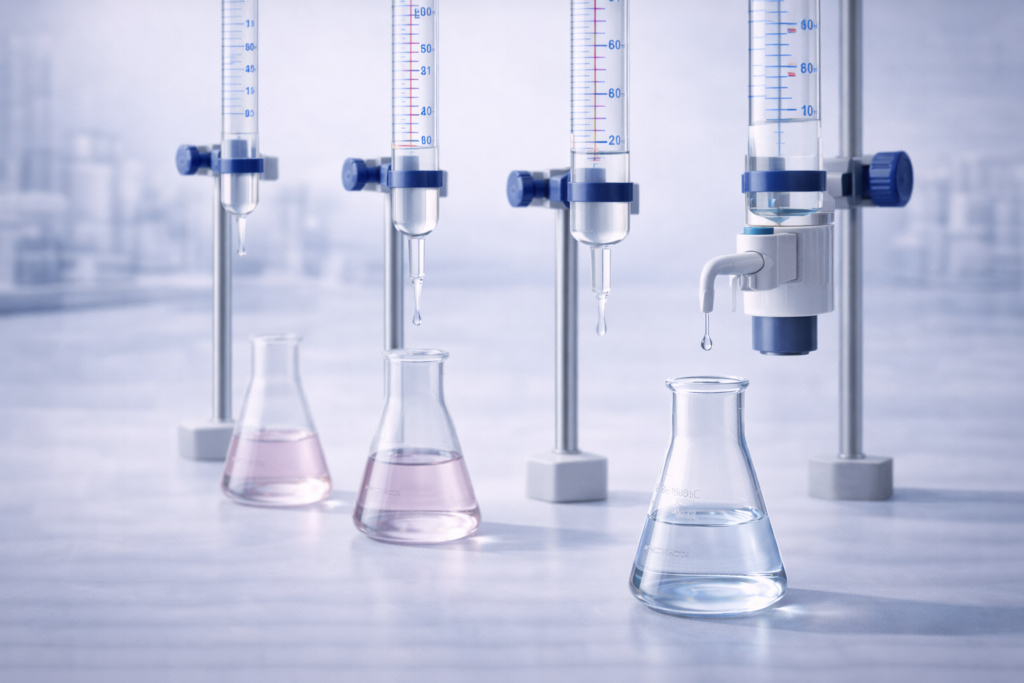
Burette capacity is not just “how much fits in the tube”-it affects how easily you can control the endpoint, how often you must refill, and how large your reading error becomes relative to the titration volume. When the capacity is too large for the job, you often sacrifice fine control near the endpoint; when it’s too small, you waste time refilling and increase the risk of tracking mistakes.
This guide gives you a quick selector (table + checklist), then practical notes for 10, 25, 50, 100 mL burettes and microburettes. You’ll also learn a simple way to estimate required capacity before you start, plus what to do if your method needs more than 50 mL of titrant.
Quick Selector (Most Valuable)
1) Decision table
| Expected titrant use per run | Best burette capacity | Typical use cases | Why it fits | Common mistakes |
|---|---|---|---|---|
| ≤5 mL | 10 mL or microburette (1–5 mL) | High-concentration titrant, small samples, micro-scale titrations, tight endpoints | Short scale + usually finer graduations makes small volume changes easier to see and control | Overshooting by 1–2 drops, ignoring bubbles in the tip, reading the wrong meniscus point |
| 5–15 mL | 10 mL (if near 10) or 25 mL | Routine titrations with moderate concentration, teaching labs with predictable volumes | Enough headroom without wasting a long scale; less frequent refills than micro/10 mL | Picking 50 mL “because it’s standard” and then struggling with endpoint control |
| 15–35 mL | 25 mL (if ≤25) or 50 mL | Many acid–base, redox, and complexometric titrations in general chemistry | Puts the endpoint in a comfortable working range without forcing a refill | Starting too close to the end of the scale, rushing the last 1 mL |
| 35–50 mL | 50 mL | Low-concentration titrant, dilute analyte, larger sample volumes | Uses most of the burette without refilling; common for general-purpose methods | Running out at 49–50 mL, then refilling without tracking readings correctly |
| >50 mL | Usually 50 mL with a plan; 100 mL only when justified | Very dilute samples, weak titrants, large-volume procedures | Large volumes increase time and mixing demands; often better solved by method adjustments | Choosing 100 mL by default and losing control near endpoint, or performing an untracked refill |
2) “Pick in 60 seconds” checklist
- Define your expected titrant volume window (typical run, not the worst-case outlier).
- Aim to keep the endpoint away from the extreme ends of the scale (avoid “nearly empty” or “nearly full” behavior).
- Decide how much precision you need near the endpoint (tight specs/QC vs teaching/rough checks).
- Check reading comfort: clear graduations, good contrast, and whether a Schellbach stripe would help you see the meniscus cleanly .
- Choose stopcock style with low leak risk and smooth flow control (leaks and sticky stopcocks create drift and overshoot).
- Understand Class A/AS vs Class B in plain terms: Class A/AS is the higher-accuracy grade; Class B is the lower-accuracy grade and is commonly looser by about 2× in permissible error.
- Confirm general chemical compatibility (glass type, stopcock material, and whether your reagents attack plastics, swell PTFE, or require special materials).
- Think about cleaning and maintenance: can you reliably rinse, remove bubbles, and keep the tip/stopcock clean between runs?
- If you’re doing lots of runs or using aggressive reagents, consider whether a bottle-top/digital burette or automated titration system reduces handling error and improves repeatability.
Common Burette Capacities and When to Use Them
10 mL burette (and microburettes)
Best-fit scenarios
- Expected titrant use is small (often ≤10 mL), especially when endpoint control matters more than speed.
- Micro-scale work (1–5 mL microburettes) when sample is limited or titrant is concentrated.
Pros
- Small changes in delivered volume are easier to “see” on a short scale, so you can dose more confidently near the endpoint.
- Less temptation to add large, fast volumes early (because you’re working in a tighter range).
Cons
- You may need refills for moderate-volume titrations (higher tracking burden).
- Beginners can overshoot quickly because each drop can be a large fraction of the total volume.
Typical student/tech errors
- Overshooting the endpoint in the last few drops.
- Leaving air bubbles in the tip/jet (especially after filling), then getting a false “extra” volume later when the bubble moves.
- Misreading the meniscus because the eye is not level (parallax).
Choose this if…
- Your method typically consumes ≤10 mL and you want better endpoint control.
- You’re doing micro-titrations or working with limited sample volumes.
Avoid this if…
- Your titration often needs 15–30 mL (you’ll refill frequently, and refill tracking becomes your dominant error source).
25 mL burette
Best-fit scenarios
- Many routine titrations that land in the 10–25 mL range.
- Teaching labs where students learn technique and benefit from a manageable scale length.
Pros
- A good balance of capacity and control: enough volume for most runs without the “long scale” feel of a 50 mL.
- Often helps place the endpoint in the mid-to-upper part of the scale where reading is comfortable.
Cons
- You can still run out if your estimate is wrong or the sample is more concentrated than expected.
- Not ideal for very dilute analytes unless you increase titrant strength or reduce sample size.
Typical student/tech errors
- Starting with the meniscus too close to the 25 mL limit (no safety margin).
- Inconsistent swirling/mixing near endpoint, causing delayed color change and overshoot.
Choose this if…
- You expect 15–25 mL most of the time and want minimal refills.
- You’re standardizing a titrant and want a comfortable mid-scale endpoint.
Avoid this if…
- Your runs frequently exceed 25 mL (you’ll be forced into refills or method changes).
50 mL burette
Best-fit scenarios
- General-purpose titrations where 20–50 mL may be required, especially for dilute analytes or lower-concentration titrants.
- Labs that want a “default” size that covers many methods.
Pros
- Wide applicability; fewer refills for moderate-to-large volumes.
- A common choice for routine volumetric analysis work.
Cons
- If your typical titration is only 5–10 mL, a 50 mL burette can make fine endpoint control feel harder than it needs to be (more scale to read, and small volume changes look small).
- The longer tube can make bubbles, drainage behavior, and reading consistency more noticeable between operators.
Typical student/tech errors
- Adding too fast early, then trying to “fix it” near endpoint.
- Not checking for slow stopcock leakage, which can shift the meniscus during setup or between readings (ISO 385 describes leakage limits as part of burette requirements).
- Recording only a single reading instead of both initial and final readings (then losing traceability).
Choose this if…
- Your expected titrant use is often 25–50 mL or uncertain.
- You want fewer refills across varied methods.
Avoid this if…
- Your method consistently uses <10 mL and endpoint control is tight (consider 10 or 25 mL instead).
100 mL and large-volume burettes (when they’re justified)
Best-fit scenarios
- Truly high-volume titrations where changing concentration/sample size is not feasible or would break the method.
- Specific workflows where long runs are expected and the lab accepts the trade-off in endpoint handling.
Pros
- Can deliver large volumes without refilling, which can simplify tracking for very large titrations.
- Useful when >50 mL is routine, not occasional.
Cons
- Large volume work magnifies practical issues: longer titration time, greater mixing demand, and potentially less comfortable endpoint “feel.”
- Not automatically “more accurate”-you still need appropriate class, good technique, and a sensible endpoint volume range.
Typical student/tech errors
- Treating a 100 mL burette like a 50 mL and dosing too aggressively near endpoint.
- Letting the titration drag on without consistent mixing, leading to creeping endpoints.
Choose this if…
- Your method truly requires >50 mL most runs and you cannot reasonably adjust conditions.
Avoid this if…
- You only occasionally exceed 50 mL (a planned refill strategy is often safer than moving to 100 mL just for rare cases).
How to Estimate the Right Capacity Before You Start
A simple planning method is to estimate the titrant volume from (1) how much analyte is in your sample and (2) how strong your titrant is. Conceptually: more analyte (higher concentration or larger sample volume) needs more titrant, and a stronger titrant needs less volume.
Worked example (round numbers)
- Suppose your sample is 25 mL of an acid solution around 0.08 mol/L.
- You plan to titrate with ~0.10 mol/L base.
- Because the concentrations are similar and the sample is 25 mL, you should expect a titrant volume on the order of “a couple of tens of mL” (roughly around 20 mL for a 1:1 reaction).
That estimate points you toward a 25 mL burette (if you’re confident it stays under 25 mL) or a 50 mL burette (if you want margin for real-world variation).
Rule of thumb
- Aim for a titration volume that is large enough to control the endpoint smoothly, but not so large that you’re forced into refills or very long runs; many labs target an endpoint somewhere in the middle portion of the burette scale rather than near 0 or near the maximum.
What If You Need More Than 50 mL From a Burette?
If your predicted or observed volume exceeds 50 mL, you have several practical options-pick the one that protects endpoint control and traceability.
- Adjust titrant concentration (conceptually): a more concentrated titrant reduces the required volume, which can move you back into a 25–50 mL window.
- Use a larger burette only when it won’t hurt endpoint control: ISO 385 includes 100 mL burettes as a defined nominal capacity with typical subdivisions and permissible error guidance, but larger capacity is not automatically better for endpoint handling.
- Use a refill strategy (when allowed by your SOP): record initial and final readings for each segment, and sum delivered volumes; avoid “continuing without documenting” because that breaks traceability.
- Consider a bottle-top/digital burette or an automated titration system for high-throughput or high-volume work: these can reduce manual reading and refill mistakes, and some designs avoid meniscus reading altogether.
Reading Accuracy and Resolution: What Changes With Size?
Your burette reading has an absolute uncertainty (set by graduation spacing, meniscus clarity, and operator technique). That same absolute uncertainty becomes a smaller fraction of the result when the total titration volume is larger-up to a point.
However, very large capacities can still make endpoint control harder in practice because you may be delivering more total liquid, spending more time approaching the endpoint, and relying on consistent mixing and dropwise control for longer. Also, typical burette subdivisions and maximum permissible errors vary by nominal capacity and class; for example, ISO 385:2005 lists commonly used subdivisions such as 0.10 mL for 50 mL burettes and 0.20 mL for 100 mL burettes (with corresponding maximum permissible errors that are tighter for Class A/AS than Class B).
Schellbach stripe (quick explanation)
- A Schellbach stripe is a narrow blue band centered in a white stripe printed on the back of the burette to improve meniscus readability .
- The stripe creates a visual effect (two “arrow points”) that meet at the correct reading point, helping reduce meniscus reading ambiguity for clear solutions .
Class A/AS vs Class B (Simple Buying Guidance)
In general purchasing language: Class A (and AS) is the higher-accuracy grade, while Class B is the lower-accuracy grade. ISO 385 explicitly specifies two classes of accuracy-Class A (subdivided into A and AS) and Class B-and also distinguishes burette types that do or do not require a specified waiting time (Class AS specifies a 30 s waiting time).
Practical meaning:
- Choose Class A/AS when you need better tolerance control, stronger traceability expectations, or you work in QC/regulatory environments where tighter volumetric performance matters.
- Class B is often acceptable for teaching labs, training, and rough work, and it is commonly permitted to have about double the error limits of Class A/AS.
Common Questions
What is the volume capacity of a burette?
It’s the maximum nominal volume the burette is designed to deliver on its graduated scale (commonly 10, 25, 50, or 100 mL for general lab use). Standards such as ISO 385 define an internationally acceptable series of burettes for general purposes and include nominal capacities across micro to large volumes.
What is a 50 mL burette used for?
A 50 mL burette is commonly used for routine titrations where expected titrant volumes can range up to about 50 mL, especially when analytes are dilute or titrant concentration is relatively low.
How do you calculate volume in a burette?
You calculate delivered volume as: (final reading) − (initial reading). This approach also supports refills if you document each segment consistently (each segment has its own initial and final reading).
Do you have to start at 0.00 mL?
No-what matters is the difference between the initial and final readings, not starting exactly at zero. Starting near zero can be convenient for mental checks, but it is not required for correct volume calculation.
What should you do if you need more than 50 cm³ from a burette?
Treat 50 cm³ as 50 mL (they’re equivalent units for this purpose), then use one of the practical options: increase titrant concentration, plan a documented refill, or justify a larger burette or an alternative dispensing/titration device.
Key Takeaways
- Pick capacity based on expected titrant volume, not habit.
- Put your endpoint in a comfortable working range; avoid living at the extremes of the scale.
- ≤5 mL runs often benefit from microburettes or 10 mL burettes.
- 10–25 mL runs often fit 25 mL burettes well; consider 50 mL if you need margin.
- 35–50 mL runs generally point to a 50 mL burette.
- 50 mL is a signal to rethink concentration, plan refills carefully, or justify 100 mL.
- Meniscus readability matters; a Schellbach stripe can make reading clearer for colorless solutions .
- Class A/AS is the higher-accuracy grade; Class B is lower grade and often looser by about 2× in permissible error.
- Larger capacity does not automatically improve results; endpoint control and operator technique still dominate.
- If refills are likely, prioritize traceable recording (initial/final for each segment) to avoid hidden errors.