
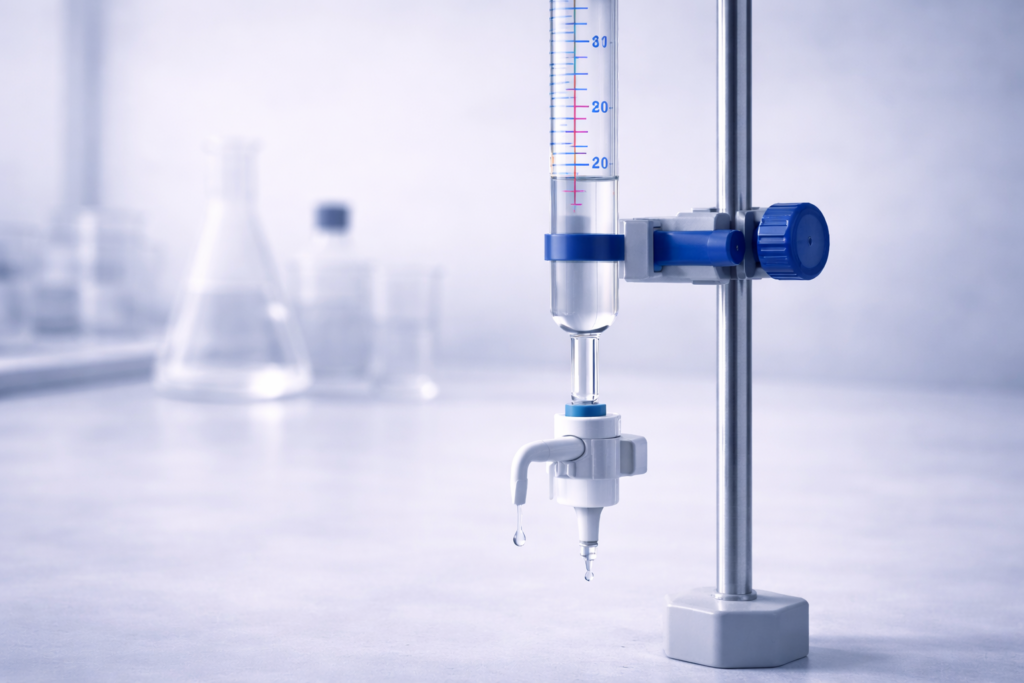
A 25 mL burette is the “control-focused” choice for analytical chemistry. While the standard 50 mL model is the workhorse of most undergraduate labs, the 25 mL variant offers tighter tolerances and finer control for smaller titration volumes. It is the ideal instrument when your expected titre is between 10 mL and 20 mL, allowing you to maximize precision without the bulk of a larger column.
This guide helps you decide if a 25 mL burette fits your workflow, explains which specifications (like Class A vs. Class B) actually affect your results, and highlights common handling errors that compromise data quality.
Quick Selector (Most Valuable)
Before buying, confirm that a 25 mL capacity matches your typical titration volumes. Using a burette that is too small leads to refilling errors, while one that is too large reduces relative precision.
Decision Table: 25 mL vs. 50 mL
| Expected Titrant Volume | Choose 25 mL? | Better with 50 mL? | Why? | Typical Use Case |
|---|---|---|---|---|
| ≤ 5 mL | Yes (or 10 mL) | No | A 50 mL burette reading error is significant here. | Micro-scale acid-base checks. |
| 5 – 15 mL | Yes (Ideal) | No | Perfect balance of resolution and capacity. | Routine QC; teaching labs saving reagent. |
| 15 – 25 mL | Risky | Yes | You risk running dry or reading the murky bottom lines. | Standardizations requiring ~20 mL. |
| 25 – 40 mL | No | Yes | Requires refilling, doubling your reading error. | Environmental water hardness testing. |
10-Point Buy/Specify Checklist
- Capacity Fit: Ensure your average titre falls between 30% and 80% of the burette’s total volume (approx. 8–20 mL for a 25 mL burette).
- Class A vs. Class B: Choose Class A for quantitative analytical work (QC, research); Class B is sufficient for general education.
- Tolerance Check: Verify the tolerance is ±0.03 mL (Class A) or ±0.05 mL (Class B).
- Graduation Interval: Standard is 0.1 mL. High-precision models may offer 0.05 mL subdivisions-only specify this if your method requires it.
- Schellbach Stripe: Highly recommended for clear solutions; the blue stripe makes the meniscus appear as two touching points for faster, more consistent readings.
- Stopcock Material: PTFE (plastic) keys are standard for low maintenance. Glass keys require grease but offer a smoother “traditional” feel.
- Valve Style: A standard “plug” key is reliable. A “needle valve” (Rotoflo) offers finer drop-wise control but feels different to operate.
- Bore Type: “Precision bore” tubing ensures the diameter is uniform throughout, essential for Class A accuracy.
- Chemical Compatibility: Ideally made from borosilicate glass for thermal and chemical resistance against acids and bases.
- Documentation: For regulated labs (ISO/GLP), ensure the burette comes with a batch or individual calibration certificate.
Why Choose a 25 mL Burette (Instead of 50 mL)
The primary reason to choose a 25 mL burette is endpoint control. In a titration, the validity of your result depends on stopping exactly at the color change. A 25 mL burette is shorter and often has a slightly narrower column than a 50 mL version, making the spacing between graduation marks slightly easier to read in some designs, or simply making the entire setup less top-heavy and easier to manage.
More importantly, it forces the analyst to work with appropriate volumes. If a protocol calls for a 10 mL titrant volume, using a 50 mL burette leaves 80% of the glass unused and makes the meniscus movement appear slower. A 25 mL vessel provides better visual feedback on flow rate, helping you slow down effectively as you approach the endpoint. However, if your titrations frequently exceed 25 mL, this advantage vanishes-refilling a burette mid-titration introduces a second “initial reading” error and should be avoided.
Key Specifications That Actually Matter
Class A/AS vs. Class B (What it means for real labs)
The “Class” designation refers to the tolerance (accuracy) of the glassware.
- Class A (or AS): The gold standard for analytical work. For a 25 mL burette, the tolerance is ±0.03 mL. “AS” stands for “swift delivery,” meaning it is calibrated to drain quickly but accurately.
- Class B: Suitable for educational settings. The tolerance is typically double that of Class A, around ±0.05 mL or ±0.06 mL for a 25 mL size.
- Recommendation: For any commercial or research application, the price difference is negligible-always specify Class A.
Graduations and Resolution
Most 25 mL burettes are graduated in 0.1 mL intervals. This means you can read the volume with certainty to the tenths place (e.g., 12.1 mL) and must estimate the hundredths place (e.g., 12.15 mL).
- Reporting: You should generally report readings to two decimal places (e.g., 24.05 mL).
- Resolution: While 0.05 mL subdivisions exist, they can be cluttered and hard to read without a magnifying lens. The standard 0.1 mL scale is sufficient for most titrimetry.
Stopcock Types: PTFE vs. Glass vs. Needle
The stopcock is the only moving part and the most common point of failure.
- PTFE Key (Teflon): The modern standard. It requires no grease, is chemically inert, and will not freeze (seize up) if left with base inside. It is “self-lubricating” and easy to clean.
- Glass Key: The traditional option. It requires a thin film of grease to seal. If not maintained, it can leak or freeze solid. Only choose this if you need the specific smooth friction of ground glass.
- Needle Valve (Rotoflo): Uses a screw-threaded PTFE spindle. These are excellent for fine flow control (drop-by-drop) and have zero dead volume, but they require many turns to open fully, which some users find tedious.
Schellbach Stripe
This is a vertical blue line printed on a white background running down the back of the tube. When you look at the meniscus, the refraction of the liquid causes the blue line to form a “point” or hourglass shape at the very bottom of the meniscus.
- Benefit: It eliminates the guesswork of finding the lowest point of the curve.
- Limitation: Only works with clear or very pale solutions. It is useless for dark titrants like potassium permanganate.
Materials and Durability
High-quality burettes are manufactured from borosilicate glass because it has a low coefficient of expansion. This ensures that the calibrated volume remains accurate even if the room temperature fluctuates slightly, although all volumetric glassware should ideally be used near 20°C.
Common Errors and How to Prevent Them
Even a Class A burette will yield Class B results if handled poorly.
- Parallax Error: Reading the meniscus from an angle rather than eye level.
- Fix: Adjust the burette stand height so the meniscus is exactly at your eye level, or use a burette reading card.
- Trapped Bubbles: An air bubble in the tip (below the stopcock) will eventually escape during the titration, registering as dispensed liquid.
- Leakage/Drift: If the stopcock is too loose or the grease (for glass keys) is channelled, the level may drop without you turning the key.
- Inconsistent Drainage: If the glass is dirty, droplets will cling to the sides rather than sliding down, causing “holdup” volume errors.
- Fix: Clean thoroughly. A proper burette drains, it does not leave droplets behind.
Typical Use Cases for a 25 mL Burette
- Teaching Labs: Ideal for introductory chemistry where 50 mL of reagent per student is wasteful. 25 mL allows for duplicate titrations with a standard 50 mL refill bottle.
- Routine Acid-Base Titrations: For standardization of 0.1 M solutions where the target titre is calculated to be roughly 12–15 mL.
- Water Quality Testing: Used for alkalinity or chloride determinations where expected concentrations are low, and precision is critical.
- Pharmaceutical QC: High-value or hazardous reagents often dictate smaller titration volumes. A 25 mL Class A burette ensures compliance with strict SOPs while minimizing waste.
FAQ
What is the tolerance of a 25 mL burette?
For a Class A burette, the tolerance is ±0.03 mL. For Class B, it is typically ±0.05 mL or ±0.06 mL.
How to read a 25 mL buret?
Read the bottom of the curved meniscus at eye level. If the liquid is between the 12.4 mL and 12.5 mL marks, estimate the second decimal place (e.g., 12.45 mL).
How many decimal places is a 25 mL burette?
You should record measurements to two decimal places (0.00 mL). The first decimal is certain (read from the line); the second is an estimate.
Do you have to start at 0.00 mL?
No. You can start at any clear graduation (e.g., 1.50 mL). Just record the initial volume accurately and subtract it from the final volume.
What size burette is used for titration?
The 50 mL burette is the industry standard, but 10 mL, 25 mL, and 100 mL sizes are common depending on the required titrant volume.
Quick Summary: What to Buy/Specify
- Capacity: 25 mL (best for 10–20 mL titration runs).
- Accuracy: Class A (±0.03 mL tolerance) for professional use.
- Material: Borosilicate 3.3 glass for thermal stability.
- Stopcock: PTFE Key (straight bore) for general maintenance-free use; Needle Valve for precision flow control.
- Graduations: 0.1 mL intervals (read to 2 decimal places).
- Visual Aid: Schellbach stripe if working with clear liquids.
- Tip: Luer lock or fixed glass (fixed is standard and less prone to leaks).
- Brand: Look for traceability (batch certificate) if working in a regulated environment.