
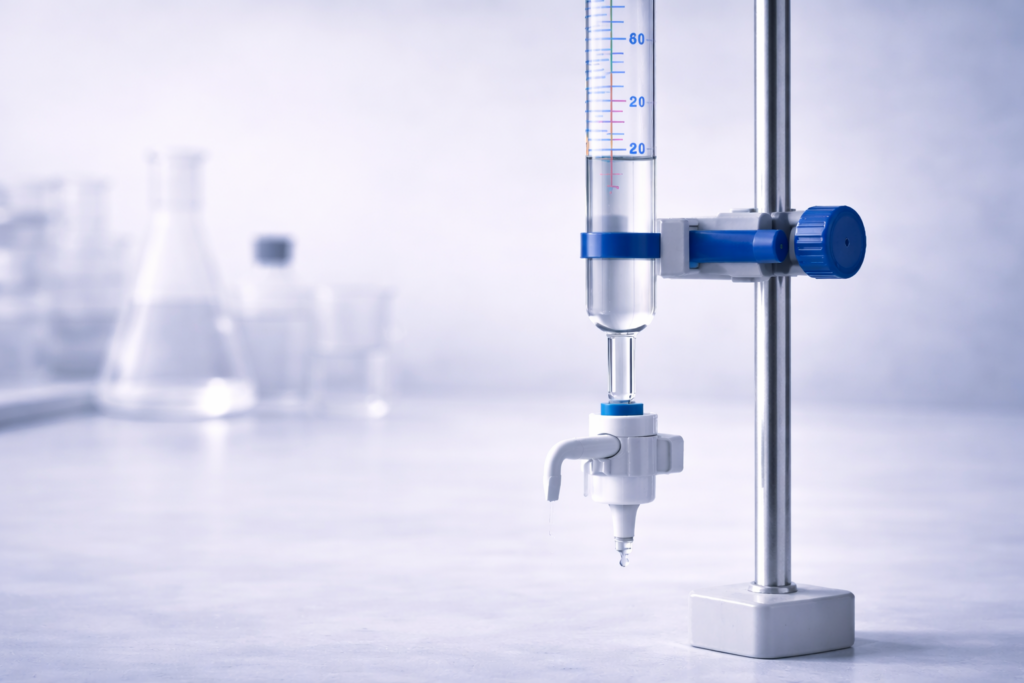
In analytical chemistry, the 50 mL burette is the standard workhorse for volumetric analysis. It strikes the perfect balance between capacity and readability, handling the majority of acid-base and redox titrations without requiring a mid-experiment refill. However, simply buying “a 50 mL burette” is a recipe for poor data. The difference between a high-precision analysis and a frustrated lab technician often comes down to specifications that are invisible at a glance: the tolerance class, the stopcock material, and the bore geometry.
This guide helps you look past the volume label to select a glass burette configuration that meets your precision requirements. Below, you will find a quick selector tool, a specification checklist, and a breakdown of common error sources to ensure your procurement leads to reliable results.
Quick Selector
Before worrying about brands, determine if 50 mL is actually the correct size for your standard operating procedure (SOP). The goal is to use between 40% and 90% of the burette’s capacity for a single titration to minimize relative error.
Decision Table: Is 50 mL Right for You?
| Expected Titrant Volume | Choose 50 mL? | Better Option | Why? |
|---|---|---|---|
| ≤ 10 mL | No | 10 mL or 25 mL | Reading errors on a 50 mL scale (0.1 mL div) are too high relative to the total volume delivered. |
| 10 – 25 mL | Acceptable | 25 mL | 25 mL burettes often have finer graduations (0.05 mL), offering better precision for this range. |
| 25 – 45 mL | Yes | – | Ideal range. Maximizes the use of the scale while leaving a safety margin to avoid draining the tip. |
| > 50 mL | No | 100 mL | Refilling a 50 mL burette mid-titration doubles your reading error and introduces contamination risks. |
Buy/Specify Checklist
When ordering, verify these 10 points to avoid receiving equipment that drifts or leaks:
- Capacity: 50 mL (Standard).
- Class: Specify Class A (or Class AS) for analytical work; Class B is only for education.
- Tolerance: Ensure it meets ASTM E287 (±0.05 mL) or ISO 385 standards.
- Traceability: For ISO 17025 labs, require a batch certificate or individual serial number.
- Graduation Interval: 0.1 mL is standard; ensure lines are sharp and etched (not just printed).
- Stopcock Type: PTFE is preferred over glass for ease of maintenance.
- Bore Type: Look for a straight bore design to ensure laminar flow and easy cleaning.
- Control: The valve must turn smoothly without “jumping” to allow drop-wise addition.
- Mounting: Ensure you have a burette clamp that does not obscure the graduation lines.
- Spare Parts: Check if the manufacturer sells replacement keys/plugs separately.
When a 50 mL Burette Is the Best Choice
The 50 mL size is dominant because it covers the widest range of “wet chemistry” applications. In a typical triplicate analysis, you might consume 30 to 40 mL of titrant. A 50 mL vessel allows you to complete these runs comfortably. Smaller burettes (10 or 25 mL) force you to work with more concentrated titrants or smaller sample sizes, which can magnify weighing errors. Larger burettes (100 mL) are heavy, unwieldy, and often harder to read precisely due to a wider column diameter.
However, if your method consumes very small volumes (e.g., 2–5 mL), a 50 mL burette is not ideal. The uncertainty in reading the meniscus (±0.01–0.02 mL) becomes a significant percentage of your total measurement, degrading your data quality.
Key Specifications That Actually Matter
Class A/AS vs. Class B
The most critical specification is the tolerance class.
- Class A (or AS): This is the analytical standard. For a 50 mL burette, the tolerance is ±0.05 mL. This means if you deliver 50.00 mL, the actual volume is guaranteed to be between 49.95 and 50.05 mL. “AS” denotes a specified waiting time (usually 30 seconds) to allow fluid to drain down the walls before reading.
- Class B: These have double the tolerance (±0.10 mL) and are intended for educational settings. For professional QC or R&D, the cost savings of Class B are never worth the loss in accuracy.
Graduations and Resolution
A standard 50 mL burette has graduation marks every 0.1 mL.
- Reporting: You should estimate the reading to one-tenth of the smallest division. This means you report values to two decimal places (e.g., 24.53 mL).
- Readability: Look for burettes with a “Schellbach stripe”-a vertical blue or white line behind the glass. This optical aid makes the meniscus appear as two touching points, significantly reducing eye strain and reading error.
Bore Design and Flow Control
The bore refers to the internal channel through which the liquid flows. A straight bore ptfe stopcock is the modern standard because it offers a direct, unrestricted path for the liquid. This design minimizes the trapping of air bubbles, which is a leading cause of volumetric error. If air is trapped in the bore, it may dislodge during the titration, counting as “delivered” volume without actually reacting with your sample.
Stopcock Types and Sealing
The stopcock is the mechanical heart of the burette. You generally have two choices:
1. PTFE Stopcock (Recommended)
The ptfe stopcock has become the industry favorite. The rotating plug is made of Polytetrafluoroethylene (Teflon), which is self-lubricating and chemically inert.
- Pros: No grease is required. It will not freeze (seize up) if left unused. It resists almost all corrosive titrants.
- Cons: PTFE flows under pressure. If the tension nut is overtightened, the key can deform.
2. Glass Stopcock
Traditional burettes use a ground glass key.
- Pros: Extremely dimensionally stable.
- Cons: Requires stopcock grease. If the grease layer is too thin, it leaks; if too thick, it clogs the tip. Grease can also contaminate sensitive titrants.
The Assembly
In technical catalogs, you will often see the valve assembly referred to as a key stopcock. This simply means the flow is controlled by a rotating cylinder (key) rather than a needle valve. A ptfe key stopcock combines the traditional rotatory feel with the maintenance-free benefits of modern materials.
When purchasing replacement parts, pay attention to the spec strings. A listing might read “2 mm bore ptfe plug,” indicating the diameter of the hole and the material of the plug. Ensure the ptfe key you buy matches the taper of your glass barrel exactly, or it will leak.
Common Errors That Ruin “Precision”
Even a Class A burette will yield Class B results if used incorrectly.
- Parallax Error: This occurs when your eye is not level with the meniscus. If you look up at the liquid, you read too low; if you look down, you read too high. Always use a burette reader card or line up your eye until the graduation mark is a flat line, not an oval.
- Bubbles in the Tip: Before starting, you must purge the air from the space below the stopcock. If a bubble escapes during titration, that volume is recorded as titrant used, falsely inflating your result.
- Leakage: A slow leak at the stopcock can ruin an experiment. This is common with glass keys that are poorly greased or PTFE keys that are too loose. Verify the seal by letting the burette stand for 5 minutes before use.
- Inconsistent Drainage: If the glass is dirty, droplets will cling to the sides rather than sliding down. This “sheeting” action ruins accuracy. Clean your burette until it drains without forming discrete droplets.
50 mL vs. 25 mL: Practical Trade-offs
If you are on the fence between sizes, this comparison highlights the operational differences.
| Feature | 25 mL Burette | 50 mL Burette |
|---|---|---|
| Tolerance (Class A) | ±0.03 mL | ±0.05 mL |
| Graduations | Often 0.05 mL | Standard 0.1 mL |
| Readable Precision | High (thinner column) | Standard |
| Refill Frequency | High (annoying for >20 mL runs) | Low (Best for routine work) |
| Primary Use Case | Research, micro-titrations | QC, teaching, general analysis |
FAQ
What is the precision of a 50 mL burette?
A Class A 50 mL burette has a tolerance of ±0.05 mL. However, “precision” also depends on the operator. With careful technique, you can reproduce readings within ±0.02 mL.
What is the tolerance of a 50 mL burette?
For Class A/AS, it is ±0.05 mL. For Class B, it is ±0.10 mL. Always check the print on the glass to confirm.
How many decimal places for a 50 mL burette?
You should record readings to two decimal places (0.00). The second decimal is an estimate (e.g., 21.45 mL).
Do you have to start at 0.00 mL?
No. It is often better to start slightly below zero (e.g., 0.50 mL) to avoid the “expansion error” sometimes found at the very top of the scale, though this is negligible in Class A glassware. Just record your initial volume precisely.
What is a 50 mL burette used for?
It is used for quantitative chemical analysis to determine the concentration of an unknown solution (analyte) by adding a known volume of a standard solution (titrant).
Quick Summary: What to Buy
- Standardize on 50 mL if your titrations typically consume 25–45 mL.
- Specify Class A (±0.05 mL) for any professional or regulatory work.
- Select a PTFE stopcock to eliminate grease and prevent seizing.
- Check the bore: A straight bore design is easier to clean and purge of bubbles.
- Verify the scale: Ensure markings are etched and durable.
- Read carefully: Record to two decimal places and read the bottom of the meniscus at eye level.
- Maintenance: Store clean and loosen the nut on the ptfe key stopcock when not in use to prevent deformation.