
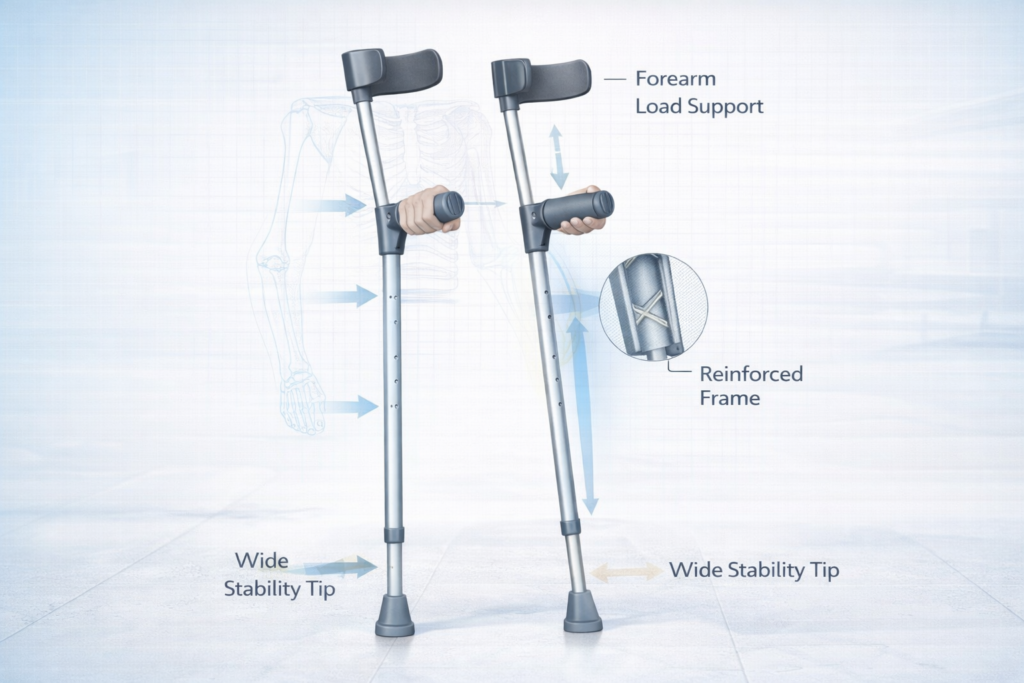
Weight capacity determines whether crutches provide safe mobility support or create catastrophic fall risk through structural failure. Standard crutches designed for users under 250–300 pounds employ frame construction, materials, and components inadequate for adults with higher body weight—loading these devices beyond rated specifications generates frame bending, tip compression, accelerated component wear, and sudden collapse potential. Reinforced bariatric crutches feature heavy-duty steel frames, thick-gauge aluminum construction, dual-bolt adjustment mechanisms, wider rubber tips, and full cuff support systems engineered to safely accommodate users from 300 to 650 pounds. The critical distinction between standard and bariatric designs lies not merely in stated weight limits but in fundamental structural engineering addressing the biomechanical demands imposed by higher bodyweight during dynamic ambulation, stair navigation, and uneven terrain.
Why Standard Crutches May Not Be Safe Above 250–300 lbs
Standard aluminum crutches utilize thin-wall tubing (0.065–0.083 inches wall thickness, 1-inch outer diameter) optimized for users under 250 pounds. When loaded beyond design parameters, these frames experience structural stress exceeding yield strength—aluminum undergoes elastic deformation initially, then catastrophic brittle fracture with minimal warning once material limits are exceeded. A 325-pound user generates 487–650 pounds peak force during stair descent (1.5–2.0× bodyweight from dynamic loading), overwhelming the safety margin of 300-pound rated devices.
Frame bending manifests as visible flexion during weight-bearing, creating instability that undermines confidence and increases fall risk. Users perceive this compliance as device failure rather than normal behavior, often compensating with altered gait mechanics that accelerate upper extremity fatigue and generate secondary injuries. Progressive bending permanently deforms frames, reducing load capacity further with each use cycle. Adjustment mechanisms designed for standard loads experience shear forces exceeding design specifications—spring-pin systems strip or fail, causing sudden height changes during ambulation.
Tip compression occurs when standard rubber tips (0.875-inch diameter, Shore A durometer 65–75) contact hard surfaces under excessive load. The concentrated stress (350–500 pounds per square inch for a 300-pound user on bilateral crutches) exceeds material elastic limit, causing permanent deformation that reduces ground contact area and increases slip probability. Worn tips on overloaded crutches fail catastrophically on smooth surfaces, particularly during lateral weight shifts or rapid direction changes.
Wrist overload intensifies for heavier users—forearm crutches concentrate 40–60% of bodyweight at the radiocarpal joint during swing phase. A 350-pound user generates 140–210 pounds wrist loading per crutch, approaching or exceeding joint tolerance limits. Standard grip dimensions (1.0–1.25 inches diameter) distribute this force across 1.5–2.5 square inches of palm surface, creating pressures of 60–140 pounds per square inch that compress neurovascular structures causing numbness, pain, and accelerated tissue damage. Fall risk escalates when structural inadequacy combines with user factors—obesity has been identified as an independent risk factor for walking aid-related injuries, with studies documenting increased incidence of device-related falls in heavier individuals.
What Defines a High Weight Capacity Crutch?
High weight capacity crutches incorporate five critical engineering features distinguishing them from standard models: reinforced steel frames, thick-gauge aluminum alternatives, dual-bolt adjustment systems, wider rubber tips, and full cuff support structures.
Reinforced steel frames utilize tubing with 1.25–1.5 inch outer diameter and wall thickness of 0.095–0.120 inches, providing 2–3× the load-bearing capacity of standard aluminum. Steel’s superior yield strength (36,000–50,000 psi versus 35,000 psi for 6061-T6 aluminum) permits higher stress tolerance before permanent deformation. Drive Medical bariatric models employ powder-coated steel construction rated for 500 pounds, featuring contoured underarm pads and reinforced handgrip mounting points.
Thick-gauge aluminum represents a lighter alternative—bariatric forearm crutches from Drive Medical use reinforced aluminum frames with increased wall thickness and diameter, achieving 500-pound capacity at 4.86 pounds per pair versus 6–8 pounds for equivalent steel models. The weight reduction decreases upper extremity fatigue by 15–25% during extended ambulation, particularly beneficial for users with limited shoulder strength.
Dual-bolt adjustment mechanisms replace single spring-pin systems with through-bolts secured by wing nuts or hex fasteners, distributing shear forces across greater surface area and preventing adjustment slippage under high loads. Independent leg and forearm section adjustment in bariatric forearm crutches permits precise fitting despite non-standard body proportions common in heavier individuals.
Wider rubber tips increase ground contact diameter from standard 0.875 inches to 1.25–1.5 inches, reducing floor stress by 40–60% and improving traction on smooth surfaces. The enlarged base enhances lateral stability during weight shifts, particularly important for users with balance challenges associated with higher body weight. Full cuff support in bariatric forearm designs features 4-inch diameter vinyl-coated contoured cuffs distributing compressive forces across 8–12 square inches of forearm surface area, reducing peak pressures by 50–70% compared to standard open-cuff designs.
Load distribution mechanics differ fundamentally between standard and bariatric crutches—reinforced frames maintain rigidity under higher loads, transmitting weight through frame geometry rather than flexing. This stiffness requires shock-absorbing components at contact points (grips, cuffs, tips) to prevent excessive impact transmission to upper extremity joints during heel strike.
Types of High Weight Capacity Crutches
Bariatric Forearm Crutches
Bariatric forearm crutches eliminate axillary contact, featuring reinforced forearm cuffs terminating 2–3 inches below the elbow and handgrips positioned for 20–30° elbow flexion. Drive Medical bariatric forearm models accommodate users 5’0″–6’6″ with independently adjustable leg and forearm sections, vinyl-coated ergonomically contoured arm cuffs, and extra-large tips rated for 300–500 pounds depending on model specification.
Better posture: Forearm designs promote upright trunk positioning by distributing load through the forearm and hand rather than creating the forward lean characteristic of underarm crutches. This biomechanical advantage proves particularly important for heavier users, as excessive spinal flexion concentrates compressive forces on anterior vertebral bodies and intervertebral discs, accelerating degenerative changes.
Improved long-term tolerance: Medical bariatric forearm crutches reduce energy expenditure by 15–20% compared to underarm designs, enabling sustained daily use for months to years without developing secondary overuse injuries. The ergonomic cuff design prevents the axillary nerve compression that limits underarm crutch use beyond 8–12 weeks.
Load through forearm: Force distribution across the proximal forearm (4-inch cuff contact area) and hand reduces peak stress at any single anatomical site. However, this loading pattern requires adequate ulnar bone strength—case reports document ulnar stress fractures in obese forearm crutch users, particularly with asymmetric weight-bearing patterns that overload one limb. Reduced axillary compression: Complete elimination of underarm contact prevents brachial plexus and radial nerve compression that causes crutch palsy in 5–15% of prolonged axillary crutch users.
Bariatric Underarm (Axillary) Crutches
Bariatric underarm crutches position reinforced upper support pads 1–2 inches below the axilla, providing three-point contact through both handgrips and shoulder girdle stabilization. Drive Medical bariatric steel crutches feature durable steel construction with 500-pound capacity, comfortable contoured underarm design with extra-thick latex-free pads, large non-skid vinyl contoured tips, and height adjustment in 1-inch increments.
Traditional support: Three-point contact provides maximum stability for users with balance challenges or limited upper body coordination, making underarm designs preferable for short-term recovery in heavier individuals lacking experience with assistive devices. Short-term use: Bariatric underarm crutches suit temporary injuries healing within 8–12 weeks, offering adequate stability at lower cost than forearm alternatives ($60–120 versus $120–200 for bariatric forearm models).
Higher upper-body load: Axillary designs distribute forces differently than forearm models—when used correctly (weight on handgrips, not axillary pads), upper extremity loading patterns resemble forearm crutches. However, compliance challenges persist, with many users inadvertently leaning on axillary pads, creating nerve compression risk that intensifies with higher bodyweight.
Materials & Frame Strength
Steel dominates bariatric crutch construction due to superior yield strength and ability to support 400–650 pounds without permanent deformation. Powder-coated steel frames resist corrosion while providing maximum structural integrity—Drive Medical bariatric steel crutches utilize 1.25–1.5 inch diameter tubing that eliminates flexion under load, creating rigid stability preferred by heavier users. Weight penalties reach 6–8 pounds per pair for underarm models and 4–6 pounds for forearm designs, accelerating upper extremity fatigue particularly during extended ambulation periods.
Reinforced aluminum achieves 400–500 pound capacity through increased wall thickness (0.095–0.120 inches versus 0.065 standard) and larger diameter tubing (1.125–1.5 inches). The Drive Medical bariatric forearm crutch model 10403HD employs heavy-duty aluminum construction supporting 500 pounds at 4.86 pounds per pair—approximately 35% lighter than equivalent steel models. This weight reduction translates to 10–15% lower energy expenditure during 30-minute ambulation trials, extending comfortable use duration for users with limited upper body strength.
Hybrid construction combines steel lower sections (highest stress concentration points) with aluminum upper sections, balancing strength and weight optimization. Some manufacturers reinforce stress points (handgrip junction, adjustment collars, tip ferrules) with steel inserts or gussets while maintaining aluminum frame cores. Weight of device directly impacts fatigue—each additional pound per crutch increases upper extremity metabolic demand by approximately 8–12% over extended use periods. Heavier users already operating at elevated baseline energy expenditure benefit substantially from lighter devices when structural safety permits.
Durability favors steel for rough handling or outdoor use—steel frames tolerate impact damage better than aluminum, which develops fatigue cracks after 18–36 months of daily use. Steel maintains structural integrity for 5+ years under normal conditions, though corrosion becomes problematic if powder coating sustains damage exposing bare metal.
Flex resistance determines stability perception—steel’s rigidity eliminates the 2–4mm deflection common in standard aluminum frames, providing solid feedback during weight transfer that enhances user confidence. However, increased rigidity amplifies shock transmission to upper extremity joints, necessitating enhanced grip padding and cuff cushioning to prevent accelerated joint stress.
| Material | Weight (pair) | Capacity Range | Flex Characteristics | Durability | Cost | Best Application |
|---|---|---|---|---|---|---|
| Steel | 6–8 lbs | 400–650 lbs | Minimal—very rigid | Excellent (5+ years) | $60–120 | Maximum capacity needed, outdoor use |
| Reinforced Aluminum | 4–5 lbs | 400–500 lbs | Minimal—controlled | Good (3–4 years) | $120–200 | Balance of capacity and weight |
| Standard Aluminum | 2–3 lbs | 250–300 lbs | Moderate—noticeable | Fair (2–3 years) | $25–80 | Not recommended >300 lbs |
Weight Categories & Recommendations
Appropriate crutch selection requires matching device specifications to user weight with safety margins accounting for dynamic loading.
300 lbs: Users at 300 pounds operate at the upper limit of standard crutches—dynamic loading during stairs generates 450–600 pounds force, exceeding safety margins of 300-pound rated devices. Bariatric models rated for 400–500 pounds provide appropriate structural safety. Drive Medical bariatric forearm crutches (model 10403) accommodate this range with 300-pound rating, though the 10403HD heavy-duty version offers superior 500-pound capacity with minimal weight penalty.
350 lbs: At this weight, only devices specifically rated for 400+ pounds provide adequate safety margins. Standard crutches present unacceptable failure risk—structural collapse during use can cause falls more injurious than the original condition requiring assistive device support.
400 lbs: Users approaching or exceeding 400 pounds require maximum-capacity bariatric crutches with 500–650 pound ratings. Drive Medical bariatric steel crutches (models 10406 for 5’2″–5’10” users, 10408 for 5’10″–6’6″) support 500 pounds through heavy-duty steel construction. These devices weigh 6–8 pounds per pair, necessitating adequate upper body strength for safe use.
500 lbs+: At weights exceeding 500 pounds, crutches approach fundamental biomechanical limitations—upper extremity joints sustain forces approaching or exceeding physiologic tolerance, dramatically increasing risk of ulnar stress fractures, wrist arthritis acceleration, and rotator cuff injuries. Four-point walkers distribute load more effectively, reducing stress per contact point and providing superior stability for users with balance challenges common at higher weights.
Stability vs Fatigue — Trade-Off for Higher Weight Users
Heavier crutches provide greater stability through increased mass and frame rigidity but accelerate upper extremity fatigue, creating a fundamental tension in device selection for higher weight adults. Steel bariatric crutches weighing 6–8 pounds per pair offer uncompromising structural integrity and eliminate frame flexion, enhancing confidence during weight transfer. However, the additional 3–5 pounds versus reinforced aluminum models (4–5 pounds) increases metabolic demand by 25–40% during 30-minute ambulation periods, substantially reducing sustainable walking distance for users with limited cardiovascular reserve or upper body strength.
Wider base geometry improves medio-lateral stability—bariatric crutch tips with 1.25–1.5 inch diameter versus 0.875 inch standard create broader ground contact, reducing slip risk on smooth surfaces and enhancing stability during lateral weight shifts. The increased base width (tips positioned 6–8 inches lateral to feet) expands stability boundaries, accommodating the greater center of gravity excursions common in heavier individuals with altered gait biomechanics.
Shock absorption importance intensifies for higher weight users who generate greater impact forces during heel strike—a 400-pound user produces 600–800 pounds peak force during stair descent, amplifying joint stress in the wrist, elbow, and shoulder. Bariatric crutches with extra-thick vinyl handgrips and cushioned cuffs absorb 15–25% of impact energy, reducing cumulative upper extremity loading that contributes to overuse injuries documented in 40–60% of long-term crutch users. Premium models featuring spring-loaded dampening systems or elastomer inserts provide additional shock attenuation, though increased mechanical complexity raises cost and maintenance requirements.
Optimal selection balances stability requirements against fatigue considerations—users with excellent upper body strength and cardiovascular fitness tolerate heavier steel devices without excessive fatigue, prioritizing maximum stability. Those with limited strength or endurance benefit from lighter reinforced aluminum construction despite modest stability reduction, as decreased fatigue extends safe ambulation duration and reduces fall risk from exhaustion-related instability.
Forearm Crutches for Higher Weight Adults
Bariatric forearm crutches optimize load distribution, posture, and long-term tolerance for heavier adults requiring sustained assistive device use. Drive Medical bariatric forearm models feature independently adjustable leg and forearm sections permitting precise fitting for users 5’0″–6’6″, accommodating the height variability common in higher weight populations.
Ergonomic grips with vinyl coating and contoured profiles distribute palm pressure across 2.5–3.5 square inches versus 1.5–2.5 square inches for standard grips, reducing peak pressures from 80–120 psi to 50–75 psi. This pressure reduction extends comfortable ambulation time from 20–30 minutes to 60–90 minutes, particularly important for heavier users who require longer periods to cover equivalent distances due to slower gait velocity.
Full cuff versus open cuff designs present trade-offs specific to higher weight users. Bariatric forearm crutches with full cuffs (4-inch diameter circular or D-shaped) provide superior stability by preventing forearm escape during unexpected perturbations—critical for heavier individuals whose greater momentum during falls amplifies injury severity. However, full cuffs complicate donning and doffing, requiring users to thread hands through openings that may prove difficult for those with limited shoulder mobility or hand dexterity. Open cuffs (V-shaped with front opening) facilitate rapid entry/exit, improving integration into activities of daily living, but offer less containment security during loss of balance.
Adjustable forearm height allows independent optimization of cuff position and handgrip height—heavier users often exhibit altered arm segment proportions requiring custom fitting unavailable in fixed-ratio designs. The Drive Medical 10403HD permits forearm section adjustment from 28–37 inches handle height with independent lower section sizing, accommodating short-torso or long-torso variants common in diverse body habitus.
Wrist strain prevention requires meticulous attention to grip angle and height—heavier users generating 40–60% bodyweight loading at the wrist (160–240 pounds for a 400-pound individual) approach or exceed radiocarpal joint tolerance. Neutral wrist positioning (0–10° extension) optimizes load distribution; excessive extension (>20°) concentrates forces on dorsal joint structures, accelerating osteoarthritic changes and increasing ulnar stress fracture risk documented in obese crutch users. Adjustable handgrip angles (available on premium models) permit individualized alignment matching natural wrist biomechanics, reducing injury risk during extended use periods.
Underarm Crutches for Higher Weight Adults
Bariatric underarm crutches provide maximum stability through three-point contact, making them preferable for short-term recovery in heavier adults lacking assistive device experience or adequate balance. Drive Medical bariatric steel crutches feature comfortable contoured underarm design with extra-thick latex-free pads distributing axillary forces across broader surface area, reducing pressure concentration that causes tissue damage and nerve compression.
Risks of axillary nerve compression intensify for heavier users who generate greater gravitational forces through the shoulder girdle. Improper technique—leaning on axillary pads rather than supporting weight through handgrips—compresses the brachial plexus and radial nerve against the humerus with forces proportional to bodyweight. A 350-pound user leaning on axillary pads subjects nerves to 175–210 pounds compressive force (50–60% bodyweight), substantially exceeding the 50–100 pounds typical in standard-weight users. Crutch palsy develops more rapidly in heavier individuals, with symptoms appearing after days rather than weeks of improper use.
Posture considerations prove particularly important for higher weight adults using underarm crutches—the forward trunk lean inherent to axillary designs concentrates compressive forces on anterior vertebral bodies and intervertebral discs. Heavier users already experiencing elevated spinal loading (proportional to bodyweight) face accelerated disc degeneration risk with sustained forward flexion. Proper technique emphasizing upright posture and triceps push-off rather than shoulder elevation reduces spinal stress, though compliance challenges persist particularly in fatigued or deconditioned users.
Short-term recovery use represents the optimal application for bariatric underarm crutches—temporary injuries healing within 8–12 weeks where maximum stability outweighs comfort limitations. Cost advantages ($60–120 versus $120–200 for bariatric forearm models) make underarm designs economically attractive for brief recovery periods. However, users requiring assistive devices beyond 12 weeks should transition to bariatric forearm crutches to prevent secondary upper extremity injuries, accepting the learning curve investment (3–7 days for proficiency) in exchange for long-term ergonomic benefits.
When Crutches May Not Be the Best Option
Higher weight adults face specific circumstances where alternative assistive devices provide superior safety and function compared to crutches.
Heavy-duty walker: Four-point contact standard walkers with 500–800 pound capacity distribute load across both upper extremities and provide continuous stability requiring minimal balance. Weight-bearing demands per contact point decrease to 25–30% of crutch requirements, reducing wrist and shoulder stress by 60–70%. Walkers suit higher weight users with balance deficits (unable to maintain 5-second single-leg stance), upper body weakness (unable to perform 5 wall push-ups), or bilateral lower extremity involvement. Ambulation speed decreases to 40–60% of crutch pace, limiting functional mobility for active individuals.
Rolling walker: Wheeled walkers with seats permit rest periods during ambulation, addressing the reduced cardiovascular reserve common in heavier individuals. Weight capacity models supporting 400–600 pounds provide intermittent sitting opportunities every 50–100 feet, extending total ambulation distance by 200–300% compared to continuous crutch walking. However, wheeled walkers require adequate space for maneuverability and perform poorly on uneven terrain or stairs.
Knee scooter: Bariatric knee scooters supporting 300–400 pounds eliminate upper extremity loading entirely, proving superior for higher weight users with shoulder weakness, rotator cuff pathology, or wrist arthritis. The affected limb rests on a padded platform in flexion while the unaffected leg propels the device—energy expenditure decreases 30–40% compared to crutch ambulation. Limitations include restriction to level surfaces, inability to navigate stairs, and requirement for adequate single-leg strength in the unaffected limb.
Wheelchair: Manual or powered wheelchairs accommodate users exceeding 500 pounds or those with bilateral lower extremity injuries, severe cardiovascular limitations, or temporary conditions requiring complete non-weight-bearing for extended periods (>8 weeks). Bariatric wheelchairs supporting 600–1000 pounds feature reinforced frames, wider seats (24–30 inches), and heavy-duty components addressing unique needs of higher weight individuals. Energy cost approaches resting levels, though functional independence and bone density preservation suffer without regular weight-bearing activity.
Safety-critical situations favoring alternatives include: inability to maintain 5-second single-leg stance (balance deficit), inability to support 50% bodyweight through one arm (strength deficit), history of 3+ falls in preceding 12 months (fall risk), orthostatic hypotension with syncope (cardiovascular instability), or severe visual impairment (sensory deficit). These conditions contraindicate crutch use regardless of weight, though higher bodyweight amplifies consequences of device-related falls.
Common Mistakes
Exceeding rated weight capacity represents the most dangerous error—higher weight adults frequently purchase standard 250–300 pound crutches unaware that dynamic loading during stairs or rapid gait generates forces 1.5–2.0× bodyweight. A 320-pound user may generate 480–640 pounds during stair descent, catastrophically exceeding safety margins of 300-pound rated devices. Frame failure occurs suddenly without warning, causing uncontrolled falls with high risk of secondary fracture to the contralateral limb, wrist, or hip.
Buying standard aluminum models proves inadequate for users exceeding 270–280 pounds—the modest cost savings ($40–60 for standard versus $80–150 for bariatric models) becomes irrelevant when structural failure necessitates emergency department visits, additional injuries, and replacement devices. Standard frames develop permanent deformation after 2–4 weeks of use at weights exceeding design specifications, progressively reducing load capacity and increasing collapse probability.
Ignoring tip wear accelerates in heavier users due to elevated ground contact pressures—bariatric crutch tips require replacement every 2–4 months under daily use versus 4–6 months for standard weight users. Tread depth below 1/8 inch or visible radial cracks indicate urgent replacement need. Worn tips on overloaded crutches create critical slip hazards, particularly on smooth tile or wet surfaces where traction coefficient decreases 40–60%.
Using only one crutch improperly concentrates excessive load on a single upper extremity—a 400-pound user attempting single-crutch ambulation subjects one arm to 160–240 pounds (40–60% bodyweight), approaching or exceeding joint tolerance limits and dramatically increasing ulnar stress fracture risk. Single-crutch use requires bilateral crutch proficiency first, adequate balance (10+ second single-leg stance), and contralateral placement to the affected limb for proper offloading mechanics.
Quick Decision Guide
Body weight 250–300 lbs:
- Reinforced aluminum crutches with 300–350 lb rating
- Either forearm or underarm based on expected duration
- Verify 50+ lb safety margin accounting for dynamic loads
- Consider bariatric models if extended use (>12 weeks) anticipated
Body weight 300–400 lbs:
- Bariatric forearm crutches mandatory for long-term use (Drive Medical 10403 or 10403HD)
- Bariatric underarm acceptable for short-term (<12 weeks)
- Minimum 400 lb rating required; 500 lb rating preferred
- Steel construction if maximum stability prioritized; reinforced aluminum if fatigue concern
Body weight 400–500 lbs:
- Heavy-duty steel bariatric crutches (Drive Medical 10406/10408 underarm, 10403HD forearm)
- Mandatory 500 lb minimum rating
- Professional fitting and gait training essential
- Monitor closely for upper extremity stress symptoms
- Consider walker if balance or strength limitations present
Balance issues (unable to maintain 5-second single-leg stance):
- Walker strongly recommended regardless of weight
- Crutches unsafe without adequate postural control
- Four-point contact provides stability crutches cannot match
- Bariatric walker with 500–800 lb capacity if needed
Duration considerations:
- <8 weeks recovery: Bariatric underarm acceptable if proper technique maintained
- 8–12 weeks: Transition to forearm or start with forearm to avoid adaptation period
- 12 weeks: Bariatric forearm crutches mandatory to prevent overuse injuries
Frequently Asked Questions
What are the crutches for overweight people?
Bariatric crutches designed specifically for higher weight adults feature reinforced steel or thick-gauge aluminum frames supporting 400–650 pounds, substantially exceeding standard crutch capacity of 250–300 pounds. Drive Medical manufactures bariatric forearm crutches (models 10403 with 300 lb capacity and 10403HD with 500 lb capacity) featuring independently adjustable leg and forearm sections, vinyl-coated ergonomically contoured arm cuffs, and extra-large tips for enhanced stability. Drive Medical bariatric underarm crutches (models 10406 and 10408) utilize heavy-duty steel construction with 500-pound weight capacity, comfortable contoured underarm design with extra-thick pads, and large non-skid jumbo vinyl tips. These devices incorporate dual-bolt adjustment mechanisms preventing slippage under high loads, wider rubber tips (1.25–1.5 inch diameter) distributing ground forces across greater surface area, and full cuff support in forearm models distributing compressive forces across 8–12 square inches of forearm tissue. Selection between forearm and underarm designs depends on expected use duration, with forearm models optimal for recovery exceeding 12 weeks and underarm providing maximum stability for short-term use.
Can an obese person safely use crutches?
Obese individuals can safely use crutches when devices are appropriately rated for their bodyweight with adequate safety margins and proper gait training is provided. Critical requirements include selecting bariatric crutches rated at least 50–100 pounds above current bodyweight to account for dynamic loading during stairs and uneven terrain (which generates forces 1.5–2.0× static weight), receiving professional fitting to ensure correct height and elbow angle, completing comprehensive gait training emphasizing proper technique to prevent compensatory movement patterns, and monitoring for upper extremity stress symptoms including wrist pain, shoulder fatigue, or hand numbness. Medical bariatric research documents increased incidence of device-related injuries in higher weight walking aid users, with obesity identified as a risk factor for ulnar stress fractures in forearm crutch users—particularly with asymmetric weight-bearing patterns or rapid weight gain. However, with appropriate device selection (400–500 lb rated bariatric models for users 300–500 lbs), proper technique instruction, and clinical monitoring, crutches provide safe effective mobility support. Users exceeding 500 pounds or those with significant balance deficits, upper body weakness, or cardiovascular limitations should consider four-point walkers providing superior stability and reduced upper extremity loading.
Are bariatric forearm crutches better?
Bariatric forearm crutches prove superior to underarm designs for higher weight adults requiring assistive devices beyond 12 weeks, offering 15–20% reduced energy expenditure, better posture maintenance, elimination of axillary nerve compression risk, and improved long-term tolerance. The Drive Medical bariatric forearm crutch model 10403HD supports 500 pounds at 4.86 pounds per pair—approximately 35% lighter than equivalent steel underarm models—reducing upper extremity fatigue substantially during extended ambulation. Ergonomic design with vinyl-coated contoured arm cuffs distributes compressive forces across broader forearm surface area (8–12 square inches versus concentrated handgrip loading), preventing tissue damage and improving comfort. Independent leg and forearm section adjustment accommodates non-standard body proportions common in higher weight individuals, permitting precise fitting unattainable with fixed-ratio designs. However, forearm crutches require adequate balance and upper body strength with a learning curve of 3–7 days for proficiency versus 1–3 days for underarm models. For short-term recovery under 8 weeks, bariatric underarm crutches provide maximum stability through three-point contact at lower cost ($60–120 versus $120–200), making them preferable for temporary use despite comfort limitations. Higher weight adults facing extended recovery should invest in bariatric forearm crutches despite initial cost and learning requirements, as long-term ergonomic benefits prevent secondary overuse injuries affecting 40–60% of prolonged underarm crutch users.
What is the weight capacity of standard crutches?
Standard aluminum crutches support 250–300 pounds maximum user weight, with most economy models rated at 250 pounds and mid-tier devices accommodating 300 pounds. These specifications incorporate safety factors of 1.5–2.0×, meaning frames undergo failure testing at 375–600 pounds before catastrophic collapse. However, dynamic activities including stair climbing, rapid gait, or uneven terrain navigation generate forces 1.5–2.0× static bodyweight, effectively reducing practical capacity—a 250-pound user descending stairs may produce 375–500 pounds peak force, approaching or exceeding safety margins. Standard crutches employ thin-wall aluminum tubing (0.065–0.083 inches wall thickness, 1-inch outer diameter) optimized for users under 250 pounds; loading beyond design parameters causes structural stress exceeding material yield strength, resulting in progressive frame bending and eventual catastrophic failure. Higher weight adults exceeding 270–280 pounds should not use standard crutches regardless of stated capacity, as insufficient safety margin creates unacceptable collapse risk. Bariatric crutches supporting 400–650 pounds provide appropriate structural integrity for users 300–500 pounds, featuring reinforced steel or thick-gauge aluminum construction with 1.25–1.5 inch diameter tubing and through-bolt adjustment mechanisms preventing the shear failures common in spring-pin systems under high loads.
When should I choose a walker instead?
Walkers prove superior to crutches for higher weight adults unable to maintain 5-second single-leg stance indicating balance deficit, unable to support 50% bodyweight through one arm indicating strength deficit, or with history of 3+ falls in preceding 12 months indicating elevated fall risk. Four-point contact walkers distribute load across both upper extremities providing continuous stability requiring minimal balance—weight-bearing demands per contact point decrease to 25–30% of crutch requirements, reducing wrist and shoulder stress by 60–70%. This load reduction proves critical for higher weight users already generating substantial upper extremity forces (160–240 pounds wrist loading for a 400-pound crutch user versus 40–60 pounds per arm with walker). Medical conditions favoring walker selection include bilateral lower extremity injuries requiring non-weight-bearing on both legs, severe cardiovascular limitations preventing sustained exertional activity required for crutch ambulation, rotator cuff pathology or shoulder weakness precluding overhead arm positioning, and visual impairment limiting spatial awareness necessary for crutch placement. Bariatric walkers supporting 500–800 pounds accommodate users exceeding 500 pounds where even maximum-capacity bariatric crutches (500–650 lb rating) provide marginal safety margins. Rolling walkers with seats permit rest periods every 50–100 feet, extending total ambulation distance by 200–300% compared to continuous crutch walking—particularly beneficial for deconditioned higher weight individuals with reduced cardiovascular reserve. The primary disadvantage involves reduced ambulation speed (40–60% of crutch pace) and stair navigation difficulty, though for users prioritizing safety over mobility, walkers provide substantially lower fall risk than crutches in this population.