
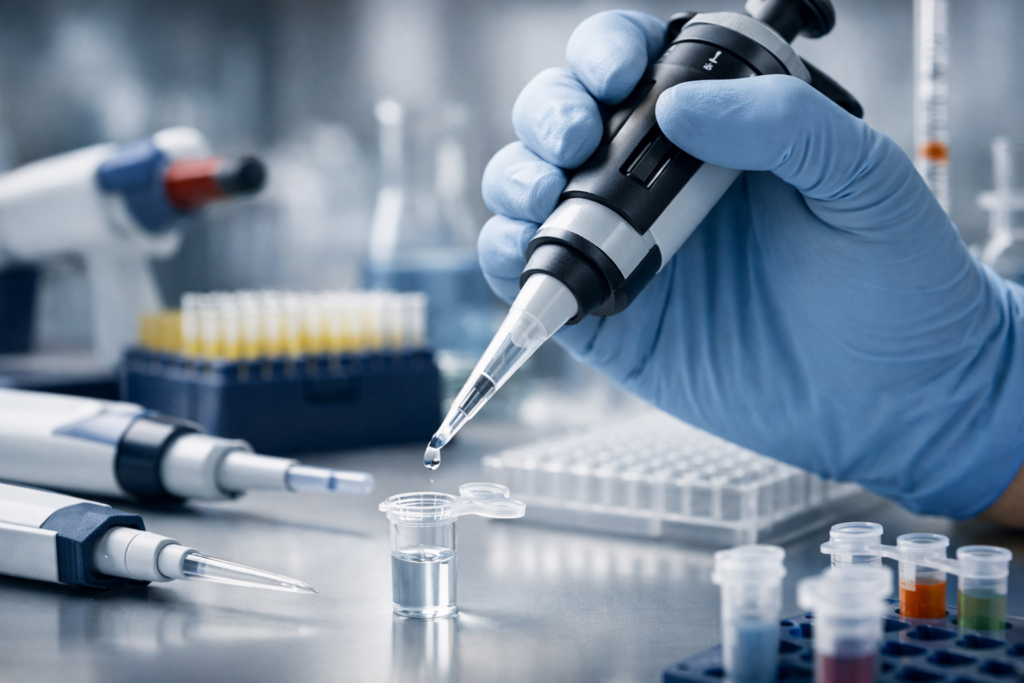
A pipette is a laboratory instrument used to measure and transfer precise volumes of liquid. While the device itself is simple in concept, choosing the right pipette and using the correct technique dictates the accuracy, reproducibility, and ultimate success of an experiment. Technique often affects accuracy more than the equipment itself, with improper angles or inconsistent speeds ruining otherwise perfect calibrations.
Quick Answer
1. What Is a Pipette?
A pipette is a specialized liquid handling tool engineered to aspirate (draw up) and dispense a highly accurate, predetermined volume of fluid. It is essential in laboratory work because modern science relies on exact concentrations, ratios, and reproducible conditions. Without precise liquid transfer, assays fail, standard curves skew, and diagnostic tests yield false results.
Pipettes are foundational tools across multiple disciplines:
- Biology: For DNA, RNA, and protein handling in PCR and cell culture.
- Chemistry: For preparing standard solutions and performing titrations.
- Diagnostics: For blood, serum, and urine aliquoting in clinical tests.
- Pharma: For drug formulation and quality control testing.
- Food & Environmental Labs: For contaminant testing and water quality analysis.
- Education: For training students in fundamental gravimetric and volumetric techniques.
Terminology Differences
- Pipette vs. Pipet: These terms are interchangeable. “Pipette” is the preferred international and European spelling, while “pipet” is traditionally favored in some American institutions.
- Micropipette: A specific category of pipette designed to handle microliter (μL) volumes, typically ranging from 0.1 μL to 1,000 μL (1 mL).
- Transfer Pipette: A simple, uncalibrated disposable plastic bulb used for rough liquid movement where exact volume does not matter.
2. How a Pipette Works
Most modern pipettes rely on a piston mechanism. When you depress the plunger, the piston moves downward, expelling air or fluid. As you release the plunger, the piston moves upward, creating a vacuum that aspirates the liquid into the tip.
Air Displacement vs Positive Displacement
This is the most critical mechanical distinction in liquid handling.
Air Displacement Principle:
An air cushion separates the liquid in the tip from the piston inside the pipette body. When the piston moves up, the air cushion expands, pulling liquid into the tip. Because the air cushion is elastic and sensitive to temperature and atmospheric pressure, these pipettes are highly accurate for aqueous (water-based) liquids at room temperature, but struggle with problem liquids.
Positive Displacement Principle:
There is no air cushion. The piston is integrated directly into the disposable capillary tip and makes direct, physical contact with the liquid. Because there is no compressible air gap, positive displacement pipettes physically sweep the liquid in and out.
| Feature | Air Displacement | Positive Displacement |
|---|---|---|
| Mechanism | Air cushion between piston and liquid | Piston directly contacts the liquid |
| Best For | Aqueous liquids, buffers, dilute solutions | Viscous (glycerol), volatile (ethanol), dense, or foaming liquids |
| Pros | Cheaper tips, highly accurate for standard liquids, widely available | Unaffected by vapor pressure or viscosity; zero aerosol contamination |
| Cons | Air cushion expands/contracts with temperature; bad for volatile solvents | Tips (capillary pistons) are much more expensive and bulky |
| Cost | Low operating cost (standard tips) | High operating cost (specialized tips) |
3. Main Types of Pipettes
3.1 Micropipettes
- What it is: A precision instrument for microliter volumes (0.1 μL to 10 mL).
- How it works: Usually an air displacement piston mechanism.
- Best use cases: PCR, ELISA, DNA extraction, and general molecular biology.
- Not ideal for: Volumes above 10 mL or highly viscous liquids (without reverse pipetting).
- Who should use it: Almost all life science researchers and lab technicians.
- Common mistakes: Using a micropipette outside its optimal range (e.g., using a 1000 μL pipette to measure 50 μL).
3.2 Air Displacement Pipettes
- What it is: The standard laboratory pipette relying on an air cushion.
- Strengths: Highly versatile, ergonomic, and compatible with inexpensive universal tips.
- Weaknesses: Volatile liquids evaporate into the air cushion, causing the pipette to drip. Cold or warm liquids alter the air volume, skewing accuracy.
3.3 Positive Displacement Pipettes
- What it is: A specialized pipette where a disposable piston makes direct contact with the sample.
- Best use cases: 100% glycerol, concentrated ethanol, Tween, cosmetics, heavy oils, and radioactive materials where aerosol contamination is unacceptable.
- Not ideal for: High-throughput aqueous workflows due to tip expense.
3.4 Manual Pipettes
- What it is: Traditional pipettes driven purely by the user’s thumb force.
- Pros / Cons: Highly reliable, cheaper to buy, and easy to calibrate. However, they cause thumb fatigue during prolonged use and are subject to user-to-user variability.
- When they are enough: Small labs, academic teaching, and low-throughput daily workflows.
3.5 Electronic Pipettes
- What it is: Motorized pipettes with digital interfaces.
- Pros / Cons: They eliminate human error in aspiration/dispensing speed, drastically reduce repetitive strain injuries, and allow custom programming. They are heavier and require charging.
- Repeatability: Exceptional, as the internal motor controls the piston speed identically every time.
- Throughput advantages: They often feature multi-dispensing (aliquoting) functions, turning one aspiration into multiple micro-dispenses.
3.6 Single Channel Pipettes
- Best use cases: Moving liquid between microcentrifuge tubes, setting up individual reactions, and performing intricate analytical chemistry preparations.
3.7 Multichannel Pipettes
- What it is: An air displacement pipette with 8, 12, 16, or even 24 channels operating simultaneously.
- Best use cases: 96-well and 384-well plate work, ELISA assays, PCR screening, and cell culture seeding.
- Common mistakes: Failing to secure tips evenly across all channels, resulting in uneven liquid aspiration.
3.8 Adjustable Volume Pipettes
- What it is: A pipette that allows the user to dial in a specific volume within a designated range.
- Flexibility: The backbone of daily lab work, replacing the need for dozens of fixed-volume tools.
3.9 Fixed Volume Pipettes
- What it is: A pipette locked to a single, unchangeable volume (e.g., exactly 100 μL).
- Where they shine: Routine QA/QC environments, clinical diagnostics, and high-turnover labs where avoiding volume-setting errors is critical.
3.10 Serological Pipettes
- What it is: Long, graduated glass or plastic tubes used with an electronic or manual pipette controller.
- Common sizes: 1 mL to 50 mL.
- Best use cases: Cell culture media transfer, layering gradients, and larger-volume reagent aliquoting.
3.11 Volumetric Pipettes
- What it is: A glass pipette with a large bulb and a single calibration mark.
- Analytical precision: Designed for extreme accuracy of a single fixed volume (e.g., exactly 25.00 mL).
- Best use cases: Analytical chemistry, standard curve creation, and titrations.
3.12 Graduated Pipettes
- What makes them different: Straight glass tubes with volume markings along the side (Mohr or serological styles).
- General liquid transfer: Good for moving variable volumes of non-critical liquids in chemistry settings.
3.13 Pasteur Pipettes
- What it is: Uncalibrated glass tubes drawn to a fine point, used with a rubber bulb.
- Simple transfer use cases: Removing supernatant, adding dropwise indicators, or transferring small volumes where precision is irrelevant.
- Not for: Any precision quantitative work.
3.14 Repeater / Stepper Pipettes
- What it is: A specialized positive displacement syringe dispenser.
- Repetitive dispensing: You aspirate once (e.g., 5 mL) and dispense multiple times (e.g., fifty 100 μL aliquots) with a single thumb click per well.
- Best use cases: Fast reagent addition across multiple tubes or plates.
3.15 Transfer Pipettes / Disposable Pipettes
- What it is: Single-piece molded plastic (polyethylene) bulbs.
- Basic use cases: Moving pH buffers, discarding waste, or loading gels.
- Limitations: Completely uncalibrated and useless for exact measurements.
4. Pipette Volume Ranges Explained
Pipettes are built to perform optimally within specific volume bands. Volumes are typically measured in microliters (μL) for micropipettes and milliliters (mL) for serological or volumetric pipettes (1 mL = 1000 μL).
Choosing the right range is essential for accuracy. A pipette is always most accurate at its maximum capacity. Using a 1000 μL pipette to measure 50 μL introduces massive mechanical error. Rule of thumb: Always select the smallest pipette capable of handling your target volume.
| Common Pipette Size | Typical Working Range | Best Use Case |
|---|---|---|
| P2 / P10 | 0.1 μL – 10 μL | PCR templates, enzymes, RNA quantification |
| P20 | 2 μL – 20 μL | DNA loading, small reagent additions |
| P200 | 20 μL – 200 μL | ELISA reagents, serial dilutions, buffer prep |
| P1000 | 100 μL – 1000 μL | Media aliquoting, sample resuspension |
| Serological Sizes | 1 mL – 50 mL | Cell culture media, buffer preparation |
| Volumetric Sizes | 1 mL – 100 mL (Fixed) | Analytical chemistry standard solutions |
5. How to Choose the Right Pipette
Selecting the optimal pipette requires balancing the physical properties of the liquid with the demands of the workflow.
Decision Logic Framework
- Liquid Type: Is it aqueous? (Air displacement). Is it viscous, dense, or volatile? (Positive displacement).
- Volume Needed: Select a pipette where the target volume is 50-100% of the nominal capacity.
- Throughput: Moving <10 samples? (Manual single channel). Loading a 96-well plate? (Multichannel). Doing repetitive aliquoting? (Electronic or Repeater).
- Contamination Risk: Handling RNase-free or radioactive samples? (Filter tips or positive displacement).
Best Pipette by Application
- PCR Setup: P10 or P20 manual air displacement with filter tips to prevent nucleic acid aerosolization.
- ELISA Plates: 8-channel or 12-channel electronic pipettes for perfectly timed, identical reagent additions.
- Cell Culture: Electronic pipette controller with disposable 10 mL / 25 mL serological pipettes.
- Analytical Chemistry: Glass volumetric pipettes for standards; positive displacement for organic solvents.
- Viscous Reagents (e.g., Glycerol): Positive displacement pipettes or repeater pipettes.
- Routine QC Testing: Fixed volume pipettes to eliminate user adjustment errors.
6. Parts of a Pipette
Understanding the anatomy of an air displacement micropipette helps with troubleshooting and maintenance:
- Plunger: The top button pressed to aspirate and dispense. It has two “stops” (resistance points).
- Volume Adjustment Dial: A wheel or knob turned to set the target volume.
- Display Window: Indicates the selected volume.
- Tip Ejector: A separate button and sleeve mechanism that slides down to strip the used tip off the cone.
- Shaft: The lower housing that contains the internal mechanics.
- Tip Cone: The very bottom tip of the shaft where the disposable plastic tip attaches.
- Piston / Seal: The internal rod and O-ring that create the vacuum. This is the heart of the pipette’s accuracy.
7. How to Use a Pipette Correctly
Proper technique separates reliable data from failed experiments.
General Step-by-Step Workflow
- Set Volume: Dial slightly past the target volume, then dial back down to it. This prevents mechanical backlash.
- Select Tip: Firmly press the pipette into the tip box. Do not bang or hammer it; this damages the shaft.
- Pre-wetting: Aspirate and dispense the liquid 3 times back into the source container. This humidifies the internal air cushion, preventing evaporation and dripping.
- Angle: Hold the pipette absolutely vertical (90 degrees) during aspiration. Tilting causes the pipette to draw too much liquid.
- Immersion Depth: Submerge the tip just under the meniscus (1-3 mm for small volumes, 3-6 mm for larger). Plunging too deep forces extra liquid up the outside of the tip.
- Aspiration Speed: Release the plunger smoothly and slowly. Snapping it back causes liquid to splash into the internal shaft, causing contamination.
- Dispensing: Touch the tip against the sidewall of the receiving vessel at a 45-degree angle. This draws the liquid out via capillary action.
How to do Forward Pipetting
Best for standard aqueous liquids (buffers, water, diluted DNA).
- Press the plunger to the first stop.
- Submerge the tip and slowly release the plunger to aspirate.
- Move to the receiving vessel, touch the sidewall.
- Press the plunger to the first stop to dispense.
- Press past the first stop to the second stop (blow-out) to expel the last drop.
- Remove the tip from the vessel, then release the plunger.
How to do Reverse Pipetting
Best for viscous liquids (glycerol, serum), foaming liquids (detergents, proteins), and small sample volumes.
- Press the plunger all the way to the second stop.
- Submerge the tip and slowly release the plunger. (You will aspirate more liquid than your set volume).
- Move to the receiving vessel, touch the sidewall.
- Press the plunger ONLY to the first stop. This dispenses the exact target volume.
- Liquid will remain in the tip. Discard this excess back into the source container or waste.
8. Common Pipetting Mistakes and How to Avoid Them
| Mistake | What Happens | How to Fix It |
|---|---|---|
| Inconsistent plunger speed | Fast aspiration pulls in air bubbles or splashes liquid into the shaft. | Release the plunger smoothly to a slow, internal rhythm. |
| Holding pipette at an angle | The hydrostatic pressure changes, drawing in up to 0.5% excess liquid. | Hold the pipette perfectly vertical (90°) when aspirating. |
| Not pre-wetting the tip | The dry air cushion absorbs liquid vapor, causing the tip to drip and delivering a lower volume. | Aspirate and dispense 3 times before taking the actual sample. |
| Incorrect immersion depth | Plunging too deep coats the outside of the tip; staying too shallow pulls in air. | Keep the tip 2–5 mm below the surface of the liquid. |
| Temperature mismatch | Cold liquids expand the air cushion (under-delivery); hot liquids shrink it (over-delivery). | Allow all liquids and equipment to reach room temperature before work. |
9. Pipetting Accuracy vs Precision
Beginners often confuse these terms, but they measure two entirely different things.
- Accuracy is how close your dispensed volume is to the target volume. If you set the pipette to 100 μL, does it actually dispense 100 μL?
- Precision (Reproducibility) is how close your repeated dispenses are to each other. If you dispense 10 times, are all the droplets the exact same size, regardless of whether they are exactly 100 μL?
What affects them:
- Accuracy is primarily affected by calibration status, pipette seal condition, liquid density, and atmospheric temperature.
- Precision is primarily affected by user technique (plunger rhythm, angle, immersion depth) and tip quality.
10. Pipette Tips Explained
A premium pipette paired with cheap tips will perform poorly. Tips are an integral part of the measurement system. Under ISO 8655:2022 standards, calibration results are only officially valid for the specific tip type used during the calibration process.
- Standard Tips: Non-sterile, general-purpose tips for basic aqueous transfers.
- Filter Tips: Contain a hydrophobic barrier that prevents aerosols from reaching the pipette shaft. Essential for PCR, microbiology, and radioactive work to prevent cross-contamination.
- Low-Retention Tips: Made from ultra-hydrophobic polymers that prevent viscous liquids, detergents, and proteins from sticking to the inside of the tip.
- Sterile Tips: Pre-sterilized and certified free of RNase, DNase, and pyrogens. Used for cell culture and molecular biology.
- Wide-Bore Tips: Feature a wider opening to prevent shearing forces from damaging fragile cells or genomic DNA.
11. Pipette Maintenance, Cleaning, Calibration, and Storage
Proper maintenance extends the life of a pipette and ensures reliable data.
- Routine Cleaning: Wipe the exterior with 70% ethanol or isopropanol.
- Safe Storage: Always store pipettes vertically on a dedicated stand. Laying them flat allows liquid trapped in the tip cone to flow into the internal piston chamber, causing corrosion.
- Calibration Intervals: ISO 8655 standards mandate that pipettes be calibrated at least once a year, though labs can dictate shorter intervals based on usage and acceptable error limits. Strict gravimetric testing using 5-place or 6-place analytical balances is now required for low volumes.
Signs Your Pipette May Be Inaccurate
- Dripping: Indicates a blown internal seal, a scratched piston, or a loose tip fit.
- Plunger resistance: If the plunger feels stiff or sticky, the internal grease has dried out or the shaft is contaminated.
- Loose tip fit: Worn tip cones prevent an airtight seal, leading to erratic volumes.
12. Pipette Applications by Lab Type
- Molecular Biology: Heavily relies on P10 to P1000 air displacement micropipettes with filter tips to handle DNA/RNA without cross-contamination. Electronic multichannel pipettes are standard for nucleic acid quantification.
- Cell Culture: Primarily uses motorized serological pipette controllers for handling bulk media, alongside sterile micropipettes for cell seeding.
- Analytical Chemistry: Relies on glass volumetric pipettes for high-accuracy gravimetric testing and standard prep, plus positive displacement pipettes for handling volatile organic solvents like methanol or chloroform.
- Diagnostics / Clinical QC: Fixed-volume pipettes and automated liquid handlers are prioritized to standardize workflows, minimize human error, and meet strict regulatory compliance.
13. Beginner Pipetting Tips
Good liquid handling is a physical skill built on muscle memory.
- Anchor your arms: Keep your elbow resting on the bench to stabilize your hand and minimize shaking.
- Practice with water or dye: Before running a high-stakes assay, practice pipetting colored water onto a piece of parafilm to visually check if your droplet sizes are consistent.
- Don’t rush the plunger: Releasing the plunger too quickly is the number one cause of inaccuracy for beginners. Slow down.
- Beware of thumb fatigue: If you are processing hundreds of samples manually, your technique will degrade over time. Take breaks, or ask to use an electronic pipette.
14. Pipette Buying Guide
When procuring liquid handling equipment, you must evaluate long-term value, ergonomic safety, and workflow compatibility, rather than just upfront cost.
Key Evaluation Criteria:
- Ergonomics: Look for low plunger force and light tip ejection force to prevent repetitive strain injury (RSI).
- Tip Compatibility: Some pipettes require proprietary tips, which locks your lab into expensive consumables. Universal tip compatibility is usually preferred.
- Autoclavability: Ensure the lower half (or the entire unit) can be autoclaved if you work in microbiology.
Who Should Buy What:
- Teaching Lab: Robust, budget-friendly manual single-channel pipettes that can survive drops and mishandling.
- Startup Biotech Lab: Ergonomic manual pipettes with a mix of multi-channel options for early-stage assay development.
- High-Throughput / QA Lab: Electronic pipettes and repeater pipettes to ensure method standardization, high speed, and tracked compliance.
15. FAQ
What is the difference between a pipette and a micropipette?
A pipette is a broad term for any liquid transfer device (including large glass tubes). A micropipette is a specific precision tool designed to handle micro-volumes (under 1 mL).
Which pipette is most accurate?
Glass volumetric pipettes are the most accurate for fixed macro-volumes. For micro-volumes, well-maintained positive displacement pipettes offer the highest accuracy across varied liquid types.
What is the difference between serological and volumetric pipettes?
Serological pipettes are graduated along the side to dispense variable volumes, whereas volumetric pipettes have a single mark and dispense one highly precise, fixed volume.
When should I use positive displacement pipettes?
Use them when handling viscous liquids (glycerol), volatile solvents (ethanol), dense liquids, or foaming reagents like detergents.
Why is pipetting accuracy important?
Inaccurate pipetting skews concentrations, ruins standard curves, causes assays to fail, and leads to irreproducible science.
What is reverse pipetting used for?
Reverse pipetting is used to accurately dispense viscous, foaming, or very small volume liquids by bypassing the air cushion’s limitations and leaving a discardable excess in the tip.
Can you use the same tip twice?
Only if you are pipetting the exact same liquid into a clean vessel or waste. You must change tips between different samples or reagents to prevent cross-contamination.
Why does liquid remain in the tip?
Liquid remains due to surface tension. Using low-retention tips or the reverse pipetting technique will solve this issue for tricky liquids.
How often should pipettes be calibrated?
According to ISO 8655 guidelines, pipettes must be calibrated at least once a year, though high-use or highly regulated labs calibrate every 3 to 6 months.
Which pipette is best for PCR?
A manual or electronic air-displacement micropipette paired with sterile filter tips is best to prevent nucleic acid aerosolization.
Which pipette is best for viscous liquids?
A positive displacement pipette is best, as the piston physically sweeps the thick liquid out of the capillary tip.
What happens if you use the wrong volume range?
If you measure a small volume in a large-capacity pipette, the massive air cushion creates severe mechanical inaccuracy and poor precision.
Are electronic pipettes worth it?
Yes, if you perform high-throughput workflows like ELISA or plate screening. They drastically reduce thumb injury and guarantee identical dispense speeds every time.
What is a Pasteur pipette used for?
It is an uncalibrated glass tube used for the simple, non-precise transfer of bulk liquids, such as removing supernatant or adding drops of indicator.
How do I know if my pipette is inaccurate?
Common signs include liquid dripping from the tip, a sticky plunger, inconsistent droplet sizes, or failing a routine gravimetric check on an analytical balance.
How do you clean a contaminated pipette?
Wipe the exterior with 70% ethanol. If liquid entered the shaft, it must be opened, the piston cleaned, the O-ring inspected, and the unit recalibrated.
What does blowing out mean?
Pressing the plunger to the second stop forces a final puff of air through the tip, expelling the last remaining drop of aqueous liquid.
Do atmospheric conditions affect pipettes?
Yes. Air displacement pipettes are calibrated at room temperature. Cold liquids cause under-delivery, and warm environments or liquids cause over-delivery.
What are filter tips?
Tips with a porous hydrophobic barrier inside that blocks aerosols from entering and contaminating the pipette shaft.
Can I hold the pipette at an angle while aspirating?
No. Holding the pipette at an angle alters the hydrostatic pressure of the fluid, pulling more liquid into the tip and causing over-delivery. Always aspirate vertically.
16. Final Conclusion
Mastering liquid handling requires more than just knowing what a pipette is; it requires understanding the fluid mechanics at play inside the tip. By matching the right instrument—whether air displacement, positive displacement, manual, or electronic—to the specific physical properties of your liquid and your lab’s workflow, you eliminate the largest sources of experimental error.
Remember that a perfectly calibrated pipette is only as good as the user’s technique. Slow down, prioritize consistency, always pre-wet your tips, and utilize techniques like reverse pipetting when faced with challenging reagents. You now understand not just what pipettes are, but how to choose and use them properly to improve confidence and reproducibility in every aspect of your laboratory work.