
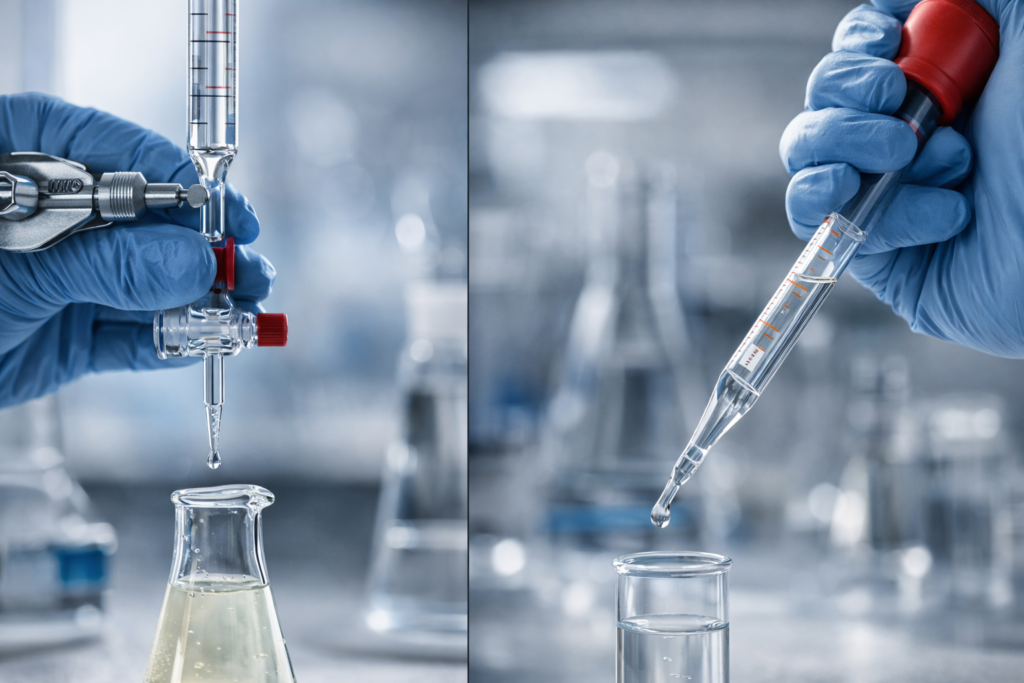
In quantitative chemistry, your data is only as good as the glassware you use. While both a burette and a pipette are fundamental volumetric tools designed to measure and transfer liquids, confusing them—or assuming they are interchangeable—is a classic beginner mistake that leads to failed assays.
Quick Answer
1. What Is a Burette?
A burette (or buret) is a highly precise piece of volumetric glassware designed for the slow, controlled delivery of variable liquid volumes. It consists of a long, narrow graduated tube with a valve at the bottom called a stopcock.
Because it must be perfectly vertical to read the meniscus accurately and free up the user’s hands to manipulate the stopcock and swirl a flask simultaneously, a burette is always clamped securely to a stand. The graduation marks typically read from the top down (0 mL at the top). The user determines the amount of liquid dispensed by subtracting the initial volume reading from the final volume reading. Burettes are most commonly made of borosilicate glass (with PTFE or glass stopcocks) and are heavily utilized in titration and volumetric analysis. Typical capacities are 10 mL, 25 mL, and 50 mL.
2. What Is a Pipette?
A pipette is a laboratory tool designed to safely aspirate (draw up) and transfer a known volume of liquid from one vessel to another.
Unlike a burette, the word “pipette” does not refer to a single, specific design. It is a broad category that includes large glass volumetric pipettes (for fixed volumes), graduated and serological pipettes (for variable volumes), and modern mechanical micropipettes (for microliter-scale work). Most pipettes are hand-held and rely on external suction—provided by a rubber pipette bulb, an electronic pump, or an internal mechanical plunger—to pull liquid into the tube. They are the workhorses of both chemistry and biology labs for moving exact amounts of reagents.
3. Burette vs Pipette: The Core Difference
The functional difference between a burette and a pipette comes down to control, purpose, and delivery style.
A burette is designed for dispensing an unknown, variable volume until a specific chemical reaction occurs. A pipette is designed for transferring a known, predetermined volume.
| Feature | Burette | Pipette |
|---|---|---|
| Primary Purpose | Dispense a variable volume to find an endpoint (Titration) | Transfer a predetermined volume (Aliquoting, prep) |
| Volume Control | Stopcock valve (highly controlled, dropwise) | Suction bulb, pump, or mechanical plunger |
| Typical Setup | Clamped vertically to a metal stand | Hand-held by the user |
| How Liquid is Released | Gravity-fed, controlled by turning the valve | Drained or actively pushed out via plunger |
| Measurement Style | Initial reading minus final reading = volume dispensed | Fill to a specific mark, then empty entirely |
| Best Use Case | Adding titrant to an analyte | Transferring exact analyte volumes, making dilutions |
4. Which Is More Accurate or More Precise?
Asking whether a burette or a pipette is “more accurate” is a trick question, because the answer depends entirely on the type of pipette and the task being performed.
- For a single, fixed-volume transfer: A Class A volumetric pipette is generally more accurate and more precise than a burette. Because a volumetric pipette has only one narrow calibration mark, the margin for human error when reading the meniscus is incredibly small.
- For variable-volume delivery: A burette is vastly superior. If you need to deliver exactly 17.45 mL, you cannot do that easily or accurately with a volumetric pipette. A burette’s detailed scale and stopcock allow for extreme precision in variable delivery.
Accuracy vs Control: A micropipette might be incredibly accurate, but it lacks the dropwise control of a burette. Titration requires control over the flow rate just as much as it requires accuracy of the final measurement.
5. Why Burettes Are Used in Titration
Titration is an analytical technique where a solution of known concentration (the titrant) is used to determine the concentration of an unknown solution (the analyte).
This process requires the user to add the titrant continuously until a color change indicates the endpoint has been reached. A volumetric pipette cannot replace a burette in titration. If you use a pipette, you must dispense the entire volume at once. If the endpoint actually required 12.3 mL, but your pipette dispensed 15 mL, you have overshot the reaction and ruined the analysis.
A burette’s stopcock allows the user to add liquid rapidly at first, then slow down to a drop-by-drop pace as the endpoint approaches. Once the exact color change occurs, the user closes the stopcock instantly and reads the scale to see exactly how much titrant was used.
6. When to Use a Pipette Instead
You should use a pipette when you know exactly how much liquid you need to move before you move it.
- Transferring the Analyte: Before starting a titration, you must place an exact, known volume of the unknown solution into your flask. This is always done with a volumetric pipette.
- Preparing Standards and Dilutions: When making a standard curve or diluting a stock solution, you need to move exact chunks of volume (e.g., 5.0 mL into 50 mL of water).
- Routine Transfer: If you simply need to move 10 mL of buffer from a bottle to a beaker, a graduated or serological pipette is fast and efficient. Setting up a burette for this task would be a massive waste of time.
7. Burette vs Pipette by Pipette Type
Because “pipette” is a broad category, comparing a burette to specific pipettes clarifies their lab roles:
| Instrument | vs. Burette Comparison | Best Use Case |
|---|---|---|
| Burette | The only tool suitable for controlled, dropwise addition. | Titration titrant delivery. |
| Volumetric Pipette | Has no stopcock; delivers one fixed volume with higher accuracy than a burette. | Placing the analyte in the flask before titration. |
| Graduated / Serological Pipette | Also measures variable volumes, but lacks dropwise control and is generally less accurate than a burette. | Fast, routine transfers of variable media or buffers. |
| Micropipette | Operates on the microliter scale (μL) using disposable tips. Burettes operate on the milliliter scale (mL). | DNA, PCR, biochemistry, and micro-volume assays. |
8. How They Work Mechanically
Burette Mechanics:
A burette relies entirely on gravity. The tube is filled from the top. The stopcock at the bottom acts as a physical gate. When the stopcock is parallel to the tube, liquid flows freely. When turned perpendicular, the flow stops completely. This mechanical simplicity provides unmatched manual control over the flow rate.
Pipette Mechanics:
Pipettes rely on vacuum and pressure. For glass pipettes, a rubber bulb or thumb-wheel pump creates suction to pull liquid up against gravity, and the user releases that suction to let the liquid drain. Micropipettes use a complex internal piston and an elastic air cushion to draw and expel highly precise micro-volumes.
9. Advantages and Limitations of Each
Burette Advantages:
- Offers unmatched dropwise control for variable delivery.
- Allows the user to read exactly how much liquid has been dispensed at any moment.
- Hands-free operation (via stand clamp) allows for simultaneous flask swirling.
Burette Limitations:
- Very slow to set up, fill, and clean.
- Difficult to handle due to its length and fragility.
- Unnecessary for simple volume transfers.
Pipette Advantages:
- Extremely fast and versatile for moving liquids.
- Volumetric pipettes offer the highest possible accuracy for single, fixed volumes.
- Micropipettes allow for the handling of microscopic quantities safely.
Pipette Limitations:
- Cannot be used effectively to find an unknown chemical endpoint.
- Limited control during the actual delivery phase (it usually drains all at once).
10. Common Mistakes and Misconceptions
| Mistake | What Goes Wrong | How to Avoid It |
|---|---|---|
| Using a pipette for titration | You overshoot the endpoint because you cannot stop the flow fast enough. | Always use a burette to deliver the titrant. |
| Treating all pipettes as equals | Using a serological pipette when a protocol requires the strict accuracy of a volumetric pipette ruins the assay concentration. | Understand the accuracy limits of graduated vs volumetric pipettes. |
| Ignoring meniscus reading rules | Looking down at a burette scale causes parallax error, making you record the wrong volume. | Always crouch so your eye is perfectly level with the bottom of the meniscus. |
| Not clearing the burette tip | An air bubble trapped below the stopcock will dispense as “volume” during the titration, skewing the final math. | Open the stopcock rapidly over a waste beaker to flush all air out of the tip before starting. |
11. How to Choose the Right Tool
Choosing between a burette and a pipette is not a matter of preference; it is dictated by the procedure. Use this decision logic:
- Are you trying to find a chemical endpoint via dropwise addition?
Choice: Burette. - Do you need to transfer exactly 25.00 mL of a sample to a flask with maximum analytical accuracy?
Choice: Volumetric Pipette. - Do you need to quickly move 7 mL of a non-critical buffer?
Choice: Graduated or Serological Pipette. - Are you working with volumes under 1 mL (e.g., 50 µL)?
Choice: Micropipette.
12. Safety, Cleaning, and Calibration Basics
Both burettes and pipettes are precise analytical tools; contamination ruins their accuracy.
- Cleaning: Glassware must be perfectly clean. If water droplets cling to the inside walls of a burette or volumetric pipette instead of draining in a smooth sheet, the glass is dirty, and the dispensed volume will be inaccurate.
- Rinsing: Always rinse a burette or pipette with the solution you are about to measure before filling it. If you rinse only with distilled water, the residual water will dilute your standard solution.
- Calibration: Glassware is calibrated either TD (To Deliver) or TC (To Contain). Almost all burettes and pipettes are TD, meaning they are designed to leave a tiny film of liquid inside the glass; never blow out this residual liquid unless specifically using a blow-out serological pipette.
13. FAQ
What is the difference between a burette and a pipette?
A burette uses a valve to slowly dispense variable amounts of liquid (ideal for titration). A pipette uses suction to quickly transfer a specific, predetermined amount of liquid.
Is a burette the same as a pipette?
No. While both measure liquid volume, their designs, delivery mechanisms, and laboratory applications are completely different.
Which is more accurate, a burette or a pipette?
For dispensing variable amounts, a burette is highly precise. For transferring a single fixed amount, a volumetric pipette is generally more accurate.
Why are burettes used in titration?
Because their stopcock allows for drop-by-drop control of the liquid flow, which is necessary to hit an exact chemical endpoint without overshooting it.
Can a pipette replace a burette?
No. A pipette cannot safely and easily dispense liquid drop-by-drop while calculating the total variable volume dispensed.
Can a burette replace a pipette?
Technically yes, but it is highly inefficient. Setting up a stand and burette just to transfer 10 mL of liquid wastes time.
What is the function of a burette?
To accurately deliver and measure variable volumes of a liquid, primarily titrants in analytical chemistry.
What is the function of a pipette?
To aspirate and transport a known volume of liquid from one container to another.
Why does a burette have a stopcock?
The stopcock acts as a manual valve to stop, start, and perfectly control the flow rate of the liquid.
Is a volumetric pipette more precise than a burette?
Yes, for its single calibrated volume. Because it has only one mark on a narrow neck, it removes the variable user error associated with reading a wide burette scale.
What type of pipette is used for exact fixed volumes?
A volumetric (or bulb) pipette.
Are micropipettes comparable to burettes?
No. Micropipettes handle microliter-scale volumes and are used in biology and genetics, whereas burettes handle milliliter-scale volumes for chemistry.
Why is a burette clamped to a stand?
It must be perfectly vertical to ensure accurate meniscus readings, and clamping it frees the user’s hands to manipulate the stopcock and swirl the receiving flask.
What is the difference between a graduated pipette and a burette?
Both have graduation marks, but a graduated pipette is hand-held and relies on a pump/bulb for delivery, whereas a burette is stand-mounted and uses a gravity-fed stopcock.
How do you choose between a burette and a pipette?
Use a burette when you do not know the final volume you will need (titration). Use a pipette when you know exactly how much volume you need to move.
14. Conclusion
Both the burette and the pipette are indispensable tools for volumetric analysis, but they serve two distinct halves of the analytical workflow. The pipette shines in preparation—allowing scientists to accurately measure and transfer exact amounts of analytes, buffers, and standards. The burette shines in execution—offering the meticulous, dropwise control required to drive a titration to its precise chemical endpoint.
Understanding that a pipette is not a single instrument, but a broad category of transfer tools, is key to proper lab practice. By matching the correct mechanical tool to your specific volumetric task, you minimize human error, ensure protocol compliance, and guarantee the accuracy of your experimental data.