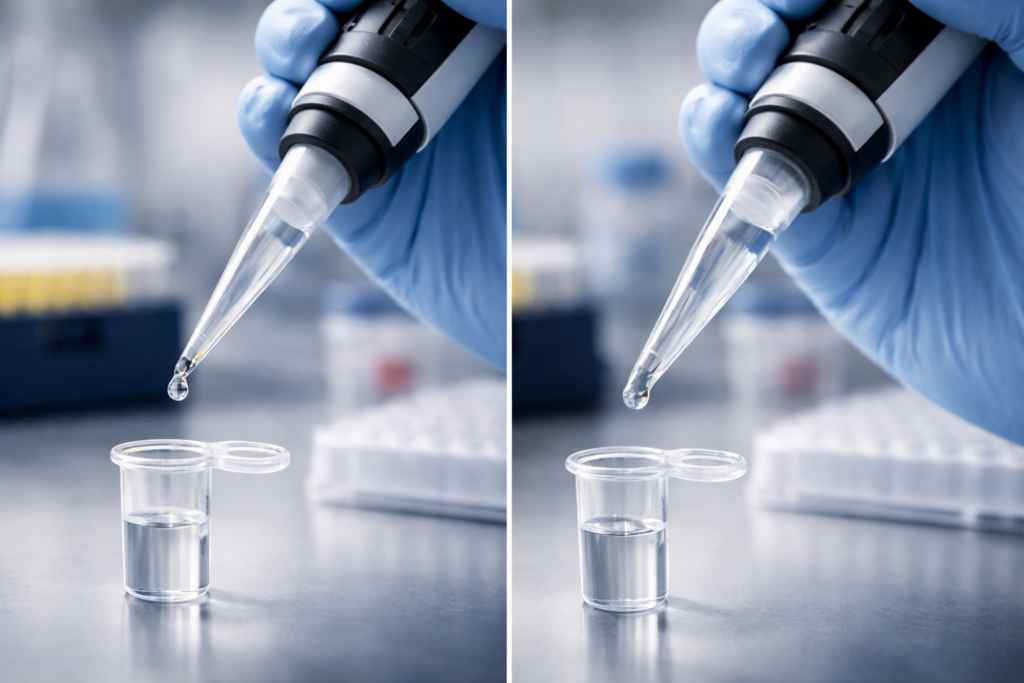
Pipetting technique affects your experimental results just as much as—if not more than—the quality of your pipette. While a perfectly calibrated air displacement pipette is designed for maximum accuracy, its performance depends entirely on how the liquid inside the tip behaves.
Understanding when and why to use each method is one of the most fundamental skills for any researcher, QA technician, or lab student.
Quick Answer
1. What Is Forward Pipetting?
Forward pipetting (often called standard pipetting) is the default liquid handling technique taught in every laboratory. It is designed specifically for aqueous solutions—liquids that behave similarly to water, such as dilute buffers, saline, and dilute acids or bases.
It works by utilizing the two resistance points (stops) of a pipette plunger. In forward mode, the user presses the plunger to the first stop to draw up the exact calibrated volume. When dispensing into the receiving vessel, the user presses past the first stop all the way down to the second stop. This final push is called the blowout, which forces a burst of air through the tip to expel the last remaining droplet of liquid.
Because water does not cling stubbornly to the plastic tip, this method delivers the target volume with exceptionally high accuracy, minimal waste, and no need for excess aspiration.
Step-by-Step Summary:
- Press to the 1st stop.
- Aspirate liquid.
- Dispense to the 1st stop, then press to the 2nd stop to blow out the tip.
2. What Is Reverse Pipetting?
Reverse pipetting is a specialized technique designed to conquer difficult liquids. It acts as a mechanical workaround for the limitations of an air displacement pipette when handling fluids that are highly viscous (thick), volatile (fast-evaporating), or prone to foaming.
Instead of aspirating the exact volume, reverse pipetting deliberately over-aspirates the sample. The user presses the plunger all the way to the second stop before placing the tip into the liquid. As the plunger is released, it draws up the target volume plus an extra “sacrificial” volume.
To deliver the sample, the user presses the plunger only to the first stop. This dispenses the exact intended volume, but leaves the extra aspirated liquid safely trapped inside the tip as residual liquid. Because the blowout step is completely skipped, no air is forced through the sample, preventing bubbles and ensuring that any liquid film clinging to the tip does not reduce the dispensed volume.
Step-by-Step Summary:
- Press to the 2nd stop.
- Aspirate liquid (target + excess).
- Dispense ONLY to the 1st stop.
- Discard the residual liquid left in the tip.
3. Forward vs Reverse Pipetting: The Core Difference
The mechanical difference between these two pipetting techniques revolves entirely around how you use the pipette’s internal air cushion and when you engage the second stop.
| Feature | Forward Pipetting | Reverse Pipetting |
|---|---|---|
| Aspiration Stop | First stop | Second stop |
| Dispense Stop | Second stop (Blowout) | First stop |
| Blowout Behavior | Tip is emptied completely with a burst of air | Blowout is skipped; no air passes through the liquid |
| Residual Liquid in Tip | None | Yes (discarded with tip) |
| Best Liquid Type | Aqueous (water, PBS, dilute DNA) | Viscous, foaming, dense, or volatile liquids |
| Main Advantage | Conserves reagent; highly accurate for water | Prevents bubbles and compensates for tip adhesion |
| Main Limitation | Causes under-delivery with thick liquids; causes bubbles in detergents | Wastes a small amount of sample |
| Typical Lab Use Case | Routine buffer transfer, general aliquoting | PCR master mix setup, serum transfer, adding Tween 20 |
4. Which Technique Is More Accurate?
A common misconception is that one technique is inherently “better” or more accurate than the other. In reality, accuracy depends entirely on the physical properties of the liquid being measured.
- For water and aqueous buffers: Forward pipetting is statistically more accurate. Reverse pipetting water introduces unnecessary mechanical variables and wastes reagent.
- For challenging liquids (e.g., glycerol or ethanol): Forward pipetting will cause severe under-delivery (poor accuracy) and terrible sample-to-sample repeatability (poor precision). In these cases, reverse pipetting restores both accuracy and precision.
Theoretical Accuracy vs Practical Repeatability
In a perfect environment with distilled water, forward pipetting yields the best accuracy during a gravimetric calibration check. However, in a real lab handling a sticky protein assay, pipetting precision (the ability to dispense the exact same amount repeatedly) matters just as much. Reverse pipetting drastically improves repeatability for difficult liquids because it standardizes the amount of liquid left adhering to the tip.
Small Volumes
When working with very small volumes (under 2 µL), reverse pipetting is sometimes preferred even for aqueous liquids, as the blowout step in forward pipetting can cause micro-splashing or aerosolization in small PCR tubes.
5. When to Use Forward Pipetting
Forward pipetting should be your default method for roughly 80% of routine laboratory tasks.
Best Use Cases:
- Water-like solutions (distilled water, TE buffer, PBS).
- Diluted reagents and standard nucleic acid (DNA/RNA) preparations.
- Applications where the sample is highly precious and minimal waste is critical.
- Routine gravity-fed or general liquid transfers.
When forward pipetting performs poorly:
Do not use forward pipetting for heavy glycerol, serum, whole blood, or detergent-containing solutions (like Triton X-100). The final blowout step will inject air into detergents, creating a massive foam head that ruins optical plate readings. Furthermore, thick liquids will coat the inside of the tip, meaning the blowout will fail to empty it, resulting in less volume delivered than intended.
6. When to Use Reverse Pipetting
Reverse pipetting is the necessary choice when the fluid dynamics of the sample fight against the pipette’s air cushion.
Best Use Cases:
- Viscous liquids: Glycerol, heavy oils, cosmetics, and dense buffers. The excess liquid aspirated compensates for the thick film that sticks to the inner walls of the pipette tip.
- Foaming liquids: Surfactants, detergents, and concentrated proteins (BSA). Because you never blow out air through the sample, bubbles and foam are completely eliminated.
- Volatile liquids: Ethanol, methanol, acetone. Solvents evaporate instantly, expanding the internal air cushion and causing the tip to drip. The excess aspirated liquid acts as a buffer against this pressure change, keeping the target volume intact.
- Workflows requiring high repeatability: such as qPCR master mix aliquoting, where identical well volumes are more critical than saving 2 µL of reagent.
When reverse pipetting is unnecessary or inefficient:
Reverse pipetting is inefficient for standard water transfers, as it slows down the workflow and wastes sample for absolutely no accuracy benefit.
7. Step-by-Step: How Forward Pipetting Works
- Set the desired volume: Adjust the dial on your pipette.
- Attach the correct tip: Press firmly to ensure an airtight seal.
- Press to the first stop: Do this in the air.
- Immerse tip correctly: Hold the pipette vertically (90 degrees) and submerge the tip 2–5 mm into the liquid.
- Release plunger smoothly: Allow the liquid to flow into the tip.
- Move to receiving vessel: Touch the tip against the inner wall at a 45-degree angle.
- Dispense to the first stop: Press down smoothly to deliver the liquid.
- Press to the second stop for blowout: Push completely down to expel the final droplet.
- Remove and eject tip: Slide the tip up the vessel wall before releasing your thumb, then eject the tip into waste.
8. Step-by-Step: How Reverse Pipetting Works
- Set the desired volume: Adjust the dial.
- Attach the correct tip: Ensure a tight fit.
- Press to the second stop before aspiration: Push the plunger all the way down while still in the air.
- Immerse the tip properly: Keep the pipette perfectly vertical.
- Release plunger slowly: Allow the liquid to enter. Pause for 1–2 seconds to let thick liquids finish rising.
- Move to receiving vessel: Touch the sidewall of the tube.
- Dispense ONLY to the first stop: Press down to the first resistance point to deliver the exact target volume.
- Leave excess liquid in the tip: Do not perform a blowout.
- Discard the remaining liquid: Either eject the tip with the liquid inside into a waste bin, or dispense the residual liquid back into the source container.
9. Forward vs Reverse Pipetting by Liquid Type
| Liquid Category | Example | Best Technique | Why? |
|---|---|---|---|
| Aqueous Solutions | Water, PBS, Saline | Forward | Best accuracy, empties tip completely, zero sample waste. |
| Viscous Liquids | Glycerol, Serum | Reverse | Compensates for the thick liquid film that clings to the plastic tip. |
| Foaming Liquids | Tween 20, SDS | Reverse | Eliminates the blowout step, preventing bubble and foam formation. |
| Volatile Liquids | Ethanol, Chloroform | Reverse | The excess aspirated volume buffers against vapor pressure expansion and dripping. |
| Precious / Rare Samples | Patient biopsies, low-yield DNA | Forward | Ensures 100% of the aspirated sample is delivered to the assay without waste. |
10. Common Mistakes When Choosing the Wrong Technique
Using forward pipetting for viscous liquids
- What goes wrong: You deliver significantly less volume than intended.
- Why it happens: Thick liquids stick to the inside of the tip. The standard blowout is not strong enough to push this heavy film out.
- How to fix it: Switch to reverse pipetting to compensate for the liquid film, or use a positive displacement pipette.
Confusing first stop and second stop during reverse pipetting
- What goes wrong: You severely over-deliver the reagent.
- Why it happens: Muscle memory takes over, and the user accidentally blows out the tip (pressing to the second stop) instead of stopping at the first stop.
- How to fix it: Slow down and consciously feel for the mechanical resistance of the first stop.
Assuming reverse pipetting is automatically more accurate
- What goes wrong: You waste time and expensive reagents on basic water transfers.
- Why it happens: Users mistakenly believe reverse pipetting is a “premium” or “expert” mode for all situations.
- How to fix it: Reserve the reverse technique strictly for problematic liquid behaviors or sub-microliter volumes.
Ignoring pipette tips and tip fit
- What goes wrong: The pipette drips or aspirates inconsistently regardless of the technique used.
- Why it happens: Poor-quality tips create micro-leaks in the air cushion.
- How to fix it: Always use high-quality, properly fitting tips. For highly viscous liquids, pairing reverse pipetting with low-retention tips yields the best results.
11. Efficiency, Waste, and Workflow Trade-Offs
When deciding between the two methods, lab managers must balance accuracy against workflow efficiency.
- Speed: Forward pipetting is faster and more rhythm-friendly for high-throughput manual work. Reverse pipetting requires a slower, more deliberate plunger release, especially when waiting for thick liquids to climb into the tip.
- Reagent Waste: Forward pipetting is highly efficient, utilizing 100% of the drawn liquid. Reverse pipetting is inherently wasteful because the residual liquid must be discarded or carefully reclaimed.
- Ease for Beginners: Forward pipetting is highly intuitive. Reverse pipetting can confuse beginners, leading to catastrophic over-dispensing if they accidentally hit the blowout step.
12. Practical Decision Guide
If you are unsure which technique to use, follow this logic:
- If your liquid behaves like water → Use forward pipetting.
- If your sample foams easily or bubbles ruin your assay → Use reverse pipetting.
- If your sample clings to the inside of the tip → Use reverse pipetting (and consider low-retention tips).
- If the liquid is highly volatile and drips constantly → Pre-wet the tip 3 times, then use reverse pipetting.
- If accuracy is still poor even with reverse pipetting → The liquid is likely too thick or too hazardous for an air displacement pipette. Switch to a positive displacement pipette.
13. FAQ
What is the difference between forward and reverse pipetting?
Forward pipetting aspirates the exact volume and uses a blowout (second stop) to empty the tip. Reverse pipetting over-aspirates (starting at the second stop) and dispenses only the exact volume (stopping at the first stop), leaving residual liquid in the tip.
Which is more accurate, forward or reverse pipetting?
Forward pipetting is more accurate for water and aqueous solutions. Reverse pipetting is more accurate for viscous, foaming, or volatile liquids.
Why does reverse pipetting leave liquid in the tip?
Because the final blowout step is skipped. This residual liquid acts as a buffer, preventing bubbles and compensating for liquid that clings to the inside of the tip.
When should reverse pipetting be used?
Whenever you are handling challenging liquids like glycerol, serum, ethanol, or detergents.
Is forward pipetting the standard method?
Yes. It is the default method for the vast majority of routine laboratory liquid handling involving aqueous buffers and solutions.
Why is reverse pipetting better for viscous liquids?
Thick liquids leave a heavy film on the inside of the tip. Reverse pipetting draws extra liquid, so the exact target volume is delivered while the remaining film is supplied by the excess residual liquid.
Can reverse pipetting improve repeatability?
Yes. By eliminating the unpredictable blowout step, reverse pipetting ensures that replicate wells in an assay (like qPCR) receive the exact same volume of difficult master mixes.
Is reverse pipetting good for small volumes?
Yes. For volumes under 2 µL, reverse pipetting can prevent micro-bubbles and splashing caused by the blowout blast of forward pipetting.
Does reverse pipetting waste reagent?
Yes. The residual liquid left in the tip must be discarded, making it less ideal for highly limited, precious samples.
Which technique is better for aqueous solutions?
Forward pipetting. It is perfectly accurate for water and does not waste any sample.
What is the role of the second stop?
In forward pipetting, it acts as a blowout to empty the tip. In reverse pipetting, it is used before entering the liquid to draw up an excess volume.
Can beginners use reverse pipetting?
Yes, but it requires conscious practice. Beginners often forget they are in reverse mode and accidentally blow out the residual liquid, ruining their sample volume.
Why do bubbles form during pipetting?
Bubbles form when air is blown out through a protein or detergent solution (forward pipetting). Reverse pipetting entirely prevents this.
Can the wrong pipetting technique affect assay results?
Absolutely. Using forward pipetting for heavy glycerol will cause under-delivery, altering enzyme concentrations and causing PCR or ELISA assays to fail.
Do pipette tips affect performance?
Yes. Regardless of the technique, poor-fitting tips compromise the air vacuum. For difficult liquids, low-retention tips combined with reverse pipetting offer the highest accuracy.
14. Conclusion
There is no single “best” way to pipette; there is only the right technique for the specific liquid you are handling. Forward pipetting remains the undisputed standard for routine, aqueous laboratory work due to its high accuracy, simplicity, and lack of sample waste. However, the moment you encounter a reagent that is thick, fast-evaporating, or prone to foaming, relying on forward pipetting will introduce massive, unseen errors into your data.
By understanding the mechanical difference between the first and second stops, you can confidently switch to reverse pipetting to conquer challenging fluids. Choosing the correct method is a foundational laboratory skill that immediately improves your liquid handling results, assay consistency, and overall confidence at the bench.