
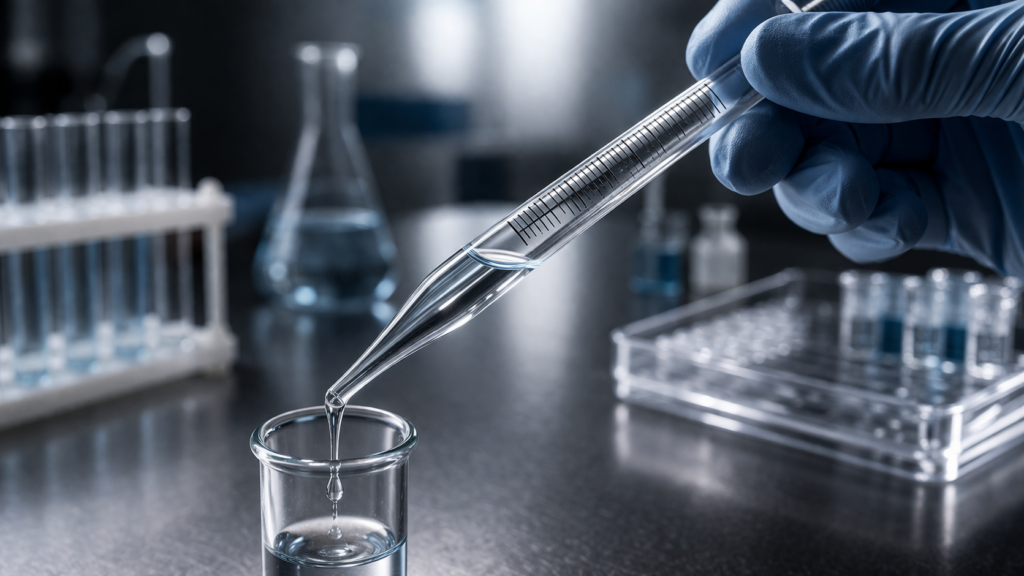
In any laboratory setting, the ability to transfer exact volumes of liquid safely and accurately is foundational to reliable science. While modern digital pipettes dominate micro-volume work, glass and plastic manual pipettes remain essential for transferring larger volumes. Among these, the graduated pipette is one of the most common and versatile tools found in chemistry and biology labs alike.
Quick Answer
1. What Is a Graduated Pipette?
A graduated pipette (also known as a measuring pipette) is a laboratory instrument used to transport a measured volume of liquid. The term “graduated” simply means that the tube is marked with a scale of uniformly spaced lines—similar to a ruler or a measuring cup.
Because the scale covers a range of volumes, a single 10 mL graduated pipette can be used to deliver 1 mL, 5.5 mL, or the full 10 mL, depending on the user’s needs. This makes them incredibly flexible. They are traditionally made of highly durable borosilicate glass for chemical resistance and easy sterilization, though sterile, disposable plastic versions are now the standard in biological and tissue culture labs. Typical capacities range from 1 mL up to 50 mL.
2. How a Graduated Pipette Works
A graduated pipette consists of a long, narrow straight-walled tube that tapers to a fine tip at the bottom. Liquid is never drawn by mouth; instead, a mechanical pipette bulb or motorized pipette pump is attached to the top end.
The user creates a vacuum to draw liquid up past the desired calibration mark, then carefully releases the suction to lower the liquid level exactly to the target mark. To measure accurately, the user must look at the meniscus—the slight curve formed at the surface of the liquid due to surface tension. The measurement is always taken at the absolute bottom of this curve at eye level. By controlling the release of liquid from a starting mark to an ending mark, the user determines the exact volume delivered.
3. Main Types of Graduated Pipettes
Graduated pipettes are categorized based on where the scale ends and how the liquid is intended to be dispensed.
3.1 Mohr Pipette
A Mohr pipette is designed so that the graduation marks stop well before the tapered tip.
- How it is read: You draw liquid up to the zero mark and dispense only down to the final graduation line.
- How it is delivered: It is strictly a “drain-out” pipette. The liquid remaining in the tip below the final mark is not part of the measured volume and must never be dispensed into the receiving vessel.
- Common uses: Because the narrow stem allows for fine control, Mohr pipettes are often used in chemistry when absolute precision in dispensing partial volumes is paramount.
3.2 Serological Pipettes
Serological pipettes are technically a subcategory of graduated pipettes, but they are uniquely designed with graduation marks that continue all the way down to the very tip.
- Blow-out behavior: To deliver the full stated volume of a serological pipette, the user must dispense all the liquid and then actively “blow out” the final remaining drop from the tip.
- Common lab use cases: They are the workhorses of biological sciences, particularly in tissue culture, for rapidly making media, serial dilutions, and larger liquid transfers where extreme analytical precision is not required.
Mohr vs Serological Pipettes
| Feature | Mohr Pipette | Serological Pipette |
|---|---|---|
| Graduation Marks | Stop before the tip | Extend all the way to the tip |
| Delivery Method | Drain out only (stop at last mark) | Drain out, then blow out the last drop |
| Accuracy | Generally more accurate for small partial volumes | Less accurate, but faster and easier for total volumes |
| Common Material | Glass | Glass or disposable plastic |
| Primary Field | Chemistry | Biology / Tissue Culture |
4. Graduated Pipette vs Volumetric Pipette
Understanding when to choose a graduated pipette over a volumetric pipette is a core laboratory skill.
A volumetric pipette has a large central bulb and only one single calibration mark. It is engineered to deliver exactly one fixed volume (e.g., exactly 25.00 mL) with extreme analytical precision. A graduated pipette has straight walls and multiple marks, offering variable-volume flexibility at the cost of slight accuracy.
| Feature | Graduated Pipette | Volumetric Pipette |
|---|---|---|
| Volume Type | Variable (multiple marks) | Fixed (single mark) |
| Precision | Moderate | Very High |
| Flexibility | High (can dispense various amounts) | Low (can only dispense one specific amount) |
| Best Use Case | Aliquoting media, general buffer prep | Standard solutions, analytical titrations |
Decision logic: If a protocol demands tight tolerances (like analytical titration prep), use a volumetric pipette. If you need to repeatedly dispense different volumes (like 1 mL, then 2 mL) without switching tools, use a graduated pipette.
5. How to Read a Graduated Pipette Correctly
Reading the scale incorrectly is the most common source of error.
- Identify the scale direction: Most graduated pipettes read from the top down. The “0” mark is at the top, and the numbers increase as you move down. Some pipettes have dual scales (one reading up, one reading down) to make calculating dispensed volume easier.
- Hold perfectly vertical: The pipette must be straight up and down. Tilting it skews the liquid level.
- Read at eye level: You must lower your head so your eyes are perfectly level with the liquid. If you look down from above or up from below, an optical illusion called parallax error will cause you to misread the volume.
- Read the meniscus: Aqueous liquids curve downward in glass and plastic. Always align the graduation mark with the exact bottom of this curve.
6. How to Use a Graduated Pipette
Proper technique ensures safety and accuracy.
- Select the correct size: Use the smallest pipette capable of handling your target volume.
- Inspect the tool: Ensure the glass is not chipped at the tip and is perfectly clean.
- Attach a bulb or pump: Securely attach a mechanical pipette pump to the top. Never use mouth pipetting, as drawing toxic chemicals or biological pathogens by mouth is highly dangerous and violates all modern lab safety rules.
- Aspirate liquid: Draw the liquid slightly above the desired starting zero mark.
- Adjust the meniscus: Slowly release the pressure on the pump until the bottom of the meniscus rests exactly on the starting mark.
- Transfer: Move the pipette to the receiving vessel.
- Deliver the liquid: Touch the tip to the inner wall of the receiving vessel at a slight angle. Release the liquid down to your final target mark (for Mohr) or drain completely (for serological).
- Blow-out (if applicable): If using a serological pipette designed for blow-out, forcefully expel the final drop. If using a Mohr pipette, leave the liquid below the final mark inside the tip.
7. Accuracy, Precision, and Calibration Terms
To build trust in your measurements, you must understand the calibration markings printed on the upper neck of the pipette.
- Class A vs Class B: Glassware is graded by accuracy. Class A pipettes offer the highest precision, manufactured to strict tolerances (e.g., ±0.03 mL), making them ideal for research and analytical work. Class B pipettes have error limits twice as wide as Class A (e.g., ±0.06 mL) and are suitable for general educational or preparatory lab use.
- TD (To Deliver) vs TC (To Contain): Almost all graduated pipettes are marked TD (or EX in Europe), meaning they are calibrated to deliver the stated volume out of the tip. (TC pipettes hold an exact volume but will not deliver it all due to liquid clinging to the glass).
- Waiting Time: Highly accurate Class A pipettes may have a specified waiting time (e.g., “Wait 5s”). After the liquid drains, you must wait 5 seconds before removing the tip from the vessel wall to allow the liquid film inside the glass to finish flowing down.
- Blow-Out Rings: Serological pipettes that require the final drop to be blown out are clearly marked with one or two frosted bands/rings etched around the very top of the pipette.
8. Common Uses of Graduated Pipettes
Graduated pipettes are ubiquitous across various scientific disciplines:
- Analytical Chemistry: Used for stepwise reagent addition while observing an endpoint, or for general solvent transfers where extreme exactness is less critical than controlled adjustment.
- Tissue Culture & Biology: Plastic, sterile serological pipettes are heavily used to aliquot cell culture media, layer gradients, and feed cells.
- Environmental Testing: Used to measure varying volumes of water samples for contamination testing.
- Pharmaceutical Research: Used in formulation stages to add non-critical variable volumes of liquid excipients.
9. Common Mistakes and How to Avoid Them
| Mistake | What Goes Wrong | How to Fix It |
|---|---|---|
| Misreading the meniscus | Looking from above causes parallax error, leading to over-delivery. | Always crouch down to align your eyes exactly level with the liquid. |
| Confusing Mohr and Serological delivery | Blowing out a Mohr pipette delivers excess liquid; failing to blow out a serological pipette leaves the volume short. | Look for the graduation marks. If they stop before the tip, stop at the line. If they go to the tip, blow it out. |
| Ignoring waiting time | Removing the pipette too quickly leaves residual liquid inside, under-delivering the target volume. | Pause for 3–5 seconds after draining Class A pipettes before pulling away from the vessel wall. |
| Using the wrong size | Measuring 1 mL in a 25 mL pipette is highly inaccurate due to wide scale divisions. | Always choose the smallest pipette that accommodates your target volume. |
10. Advantages and Limitations
Advantages:
- Flexibility: A single tool can measure and deliver almost infinite variable volumes within its range.
- Speed: Faster for setting up multiple different aliquots compared to switching volumetric pipettes.
- Versatility: Available in reusable chemical-grade glass or sterile disposable plastic.
Limitations:
- Lower Precision: The straight, wide bore means a small error in reading the meniscus translates to a larger volume error compared to the narrow neck of a volumetric pipette.
- Technique Sensitivity: Accuracy relies heavily on the user’s ability to smoothly operate the pipette pump and visually judge the meniscus.
- Confusion Risk: Users often mix up TD/TC or Mohr/Serological standards, leading to systemic delivery errors.
11. How to Choose the Right Graduated Pipette
When setting up an experiment, use this decision framework:
- Based on required precision: If you are doing quantitative analytical chemistry, use a Class A glass Mohr pipette. If you are doing general high-throughput biology, use a Class B plastic serological pipette.
- Based on volume: Select a pipette where your target volume is greater than 50% of the maximum capacity. Do not use a 10 mL pipette to measure 0.5 mL.
- Based on workflow speed: If you need to drain the entire contents rapidly into a flask, a serological (blow-out) pipette is faster than carefully stopping at the final line of a Mohr pipette.
12. FAQ
What is a graduated pipette?
It is a slender glass or plastic tube with evenly spaced measurement marks, used to accurately transfer variable volumes of liquid.
What is the difference between a graduated pipette and a volumetric pipette?
A graduated pipette has multiple marks for measuring different volumes, while a volumetric pipette has a single mark and measures only one exact fixed volume with higher accuracy.
Are serological pipettes graduated pipettes?
Yes. Serological pipettes are a type of graduated pipette where the measurement marks extend all the way down to the tip.
What is the difference between Mohr and serological pipettes?
Mohr pipettes have marks that stop before the tip and are drained only to the last mark. Serological pipettes have marks to the tip and require the final drop to be blown out.
How accurate is a graduated pipette?
They are moderately accurate. Class A versions have very tight tolerances (e.g., ±0.03 mL for a 10 mL pipette), while Class B versions have wider tolerances.
What does TD mean on a pipette?
TD stands for “To Deliver.” It means the pipette is calibrated to dispense the exact volume marked, accounting for liquid that naturally clings to the glass.
What does EX mean?
EX is the European equivalent of TD (To Deliver).
Why is the meniscus important?
Liquid curves inside a tube. Reading the exact bottom of this curve (the meniscus) ensures consistent, accurate volume measurements.
Do you blow out a graduated pipette?
Only if it is a serological pipette (indicated by frosted rings at the top and marks to the tip). You do not blow out a Mohr pipette.
Why is a graduated pipette less precise than a volumetric pipette?
Because the straight, wide tube of a graduated pipette makes small visual errors at the meniscus translate into larger volume variations.
What are graduated pipettes used for?
They are used for general laboratory liquid transfers, preparing cell culture media, buffer adjustments, and making serial dilutions.
How do you read a graduated pipette?
Hold it perfectly vertical, bring your eyes level with the liquid, and read the calibration mark that aligns with the bottom of the meniscus.
What is Class A vs Class B?
Class A glassware is manufactured to the highest accuracy standards with tight error limits. Class B is standard-grade glassware with wider error limits, used for general work.
Can graduated pipettes be made of plastic?
Yes. Sterile, disposable plastic graduated pipettes (usually serological) are the standard in biological and cell culture labs.
Why should you never mouth pipette?
Mouth pipetting risks accidental ingestion or inhalation of toxic chemicals, corrosive acids, or biological pathogens. Always use a mechanical pump or bulb.
What is a measuring pipette?
“Measuring pipette” is simply another name for a graduated pipette.
When should I choose a graduated pipette?
Choose it when you need to repeatedly dispense different volumes of liquid or when the workflow does not require the extreme analytical precision of a volumetric pipette.
Is a serological pipette the same as a Mohr pipette?
No. Both are graduated, but they differ in scale placement and delivery method (blow-out vs. drain-out).
13. Conclusion
A graduated pipette is one of the most flexible and essential measuring tools in any laboratory, allowing scientists to handle variable liquid volumes with a single device. However, this flexibility requires knowledge. Understanding the difference between Mohr and serological designs, recognizing Class A versus Class B tolerances, and mastering the physical technique of reading the meniscus and controlling delivery are what separate rough estimates from reliable scientific data.
Whether you are performing chemical preparations or tissue culture work, choosing the correct graduated pipette—and knowing when a volumetric pipette is actually required—ensures your liquid handling is both safe and analytically sound.