
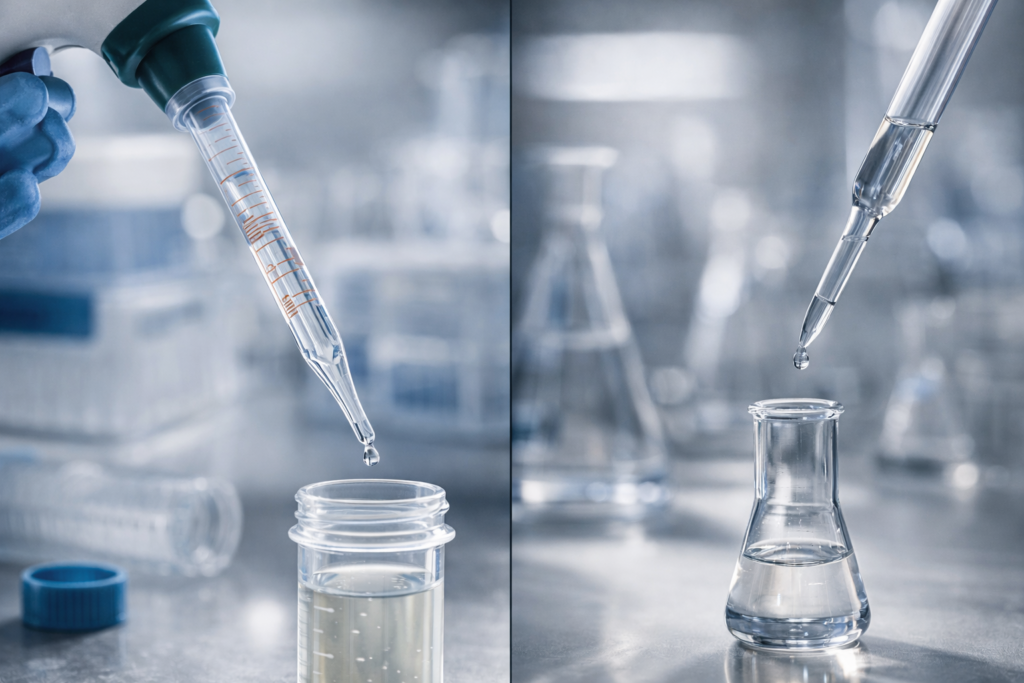
A micropipette is only as accurate as the tip attached to it. While it is tempting to view micropipette tips as nothing more than interchangeable plastic cones, they are actually precision-engineered components that directly dictate liquid handling accuracy, sample recovery, and contamination control.
Quick Answer
1. What Are Micropipette Tips?
Micropipette tips are single-use, disposable molded plastic attachments designed to fit over the tip cone of a micropipette. They act as the temporary liquid reservoir during aspiration and dispensing.
Because micropipettes operate on the air-displacement principle—using an internal air cushion to pull liquid up—the tip must form a perfectly airtight seal with the pipette shaft. They are overwhelmingly manufactured from high-quality virgin polypropylene, which is naturally hydrophobic, chemically resistant, and capable of withstanding autoclave temperatures. The quality of the tip’s molding, its internal surface properties, and its geometric shape directly determine how accurately the pipette performs.
2. Micropipette Tip Sizes and Volume Ranges
Micropipette tips are grouped into size categories that correspond to the volume ranges of standard pipettes. A common industry standard uses a color-coding system to help researchers quickly match the tip to the pipette.
Using the correct tip size is critical. The rule of thumb is to use the smallest tip that comfortably fits your target volume. A small air cushion is highly responsive and precise. If you use a 1000 µL tip to pipette 10 µL, the massive pocket of air inside the tip acts like a weak, sluggish spring, severely degrading precision.
| Tip Size Category | Typical Volume Range | Common Color Code | Typical Use Case |
|---|---|---|---|
| Ultra-Micro / Low Volume | 0.1 – 10 µL (or 20 µL) | Clear / White | qPCR, molecular biology, sensitive enzyme additions |
| Standard Micro / Mid-Volume | 20 – 200 µL | Yellow | General lab work, assay setup, ELISA |
| Macro / High-Volume | 100 – 1000 µL | Blue | Reagent aliquoting, media preparation, extraction |
| Extra Large Volume | 1 mL – 10 mL | Clear | Large-scale chemical transfers, bulk media |
3. Why Fit Matters: Universal vs Brand-Specific Tips
A tip must form a flawless seal on the pipette cone. If the fit is compromised, microscopic amounts of air will leak during aspiration, causing the pipette to draw up less liquid than dialed and allowing liquid to drip from the tip during transit.
Universal Fit:
“Universal” tips are designed with flexible collars intended to stretch over the cones of many different pipette brands. While highly cost-effective, they are a compromise. To achieve an airtight seal on a mismatched cone, the user often has to “hammer” the pipette into the tip rack. This requires high mounting force and results in dangerously high ejection force, which is the leading cause of repetitive strain injuries (RSI) in labs.
Brand-Specific (System) Fit:
Many premium pipette manufacturers (e.g., Eppendorf, Sartorius, Gilson) design proprietary tips engineered exclusively for their pipette cones. These tips seat perfectly with a gentle click. The sealing is flawless, and the ejection force is minimal.
| Feature | Universal Fit Tips | Brand-Specific Tips |
|---|---|---|
| Compatibility | Fits most major brands | Fits only the manufacturer’s specific pipettes |
| Cost | Generally lower | Generally higher |
| Sealing Quality | Good, but varies by pipette brand | Flawless, airtight seal every time |
| Ergonomics (Force) | Often requires high mounting/ejection force | Very low mounting/ejection force |
| Multichannel Work | Risk of uneven sealing across 8 or 12 channels | Perfect, even sealing across all channels |
Note on Multichannel Pipettes: Brand-specific tips are highly recommended for multichannel pipettes. If a universal tip rack requires heavy pounding to seal all 8 channels, the middle channels often seal tighter than the outer channels, leading to disastrously inconsistent volumes across a 96-well plate.
4. Main Types of Micropipette Tips
4.1 Standard Non-Filter Tips
- What it is: Basic, un-filtered polypropylene tips.
- When to use it: Routine aqueous lab work, buffer preparation, and general analytical chemistry.
- Main limitations: Offers zero protection against aerosol contamination.
4.2 Filter Tips (Aerosol Barrier Tips)
- What it is: Tips containing a porous polyethylene filter near the top.
- When to use it: PCR, qPCR, RNA workflows, microbiology, and handling radioactive or infectious samples.
- Main strengths: The filter physically blocks liquid aerosols and vapors from entering the pipette shaft, preventing sample-to-sample cross-contamination.
4.3 Low-Retention Tips
- What it is: Tips manufactured with a highly hydrophobic polymer blend or special silicone coating.
- When to use it: Handling viscous liquids (glycerol), detergents (Triton X-100, Tween), and protein-rich samples (BSA, serum).
- Main strengths: Standard tips trap a thin liquid film of viscous samples, causing under-delivery. Low-retention tips repel the liquid, allowing up to 90% better sample recovery and vastly improving assay accuracy.
4.4 Wide-Bore Tips
- What it is: Tips with an enlarged distal orifice (opening).
- When to use it: Transferring fragile mammalian cells, macrophages, or long-strand high-molecular-weight genomic DNA.
- Main strengths: Standard narrow tips create immense mechanical shear stress that can rupture cell membranes or snap long DNA strands. Wide-bore tips allow these sensitive samples to flow smoothly without shearing.
4.5 Extended-Length Tips
- What it is: Extra-long, narrow tips.
- When to use it: Reaching the bottom of 15 mL conical tubes, deep block plates, or narrow volumetric flasks.
- Main strengths: Prevents the pipette shaft from touching the sides of deep vessels, eliminating cross-contamination.
4.6 Gel-Loading / Fine Tips
- What it is: Tips drawn out to an extremely thin, capillary-like point.
- When to use it: Loading DNA/RNA samples into narrow agarose or polyacrylamide gel wells.
5. How to Choose the Right Tip for Your Application
Matching the tip to the fluid dynamics of your sample is the hallmark of expert liquid handling.
| Application / Sample Type | Best Tip Type | Why It Works | Common Mistake to Avoid |
|---|---|---|---|
| Routine Buffers & Water | Standard Non-Filter | Cost-effective and highly accurate for simple aqueous solutions. | Wasting expensive filter tips on basic buffer transfers. |
| PCR / qPCR Setup | Filter Tips (Sterile) | Blocks DNA aerosols from contaminating the pipette shaft and ruining future reactions. | Using non-filter tips, resulting in false-positive PCR amplification. |
| Proteins, Enzymes, Glycerol | Low-Retention Tips | Prevents thick or sticky liquids from clinging to the inner wall, ensuring full volume delivery. | Using standard tips, which causes severe under-delivery of expensive enzymes. |
| Genomic DNA & Cells | Wide-Bore Tips | The wide opening eliminates shear forces, keeping cells viable and DNA strands intact. | Forcing cells through standard tips, causing fragmentation and cell death. |
6. Micropipette Tips and Cell Culture
The term “cell culture” encompasses many workflows, and micropipette tips are essential for specific parts of it.
- Where they excel: Micropipette tips are necessary for adding small volumes of growth factors, antibiotics, or specific reagents to media, and for setting up cell-based assays in 96-well plates. Wide-bore tips are heavily utilized when transferring cell suspensions to avoid shearing forces that compromise cell viability.
- Where they fall short: For transferring large bulk volumes of sterile media (e.g., 10 mL to 50 mL), using a 1000 µL micropipette repeatedly is slow, exhausting, and increases contamination risk. These tasks are better served by disposable serological pipettes and motorized controllers.
- Contamination Control: Any tip used in cell culture must be pre-sterilized and preferably filter-equipped to prevent mycoplasma or bacterial aerosols from entering the pipette body and infecting subsequent cultures.
7. Sterility, Purity, and Contamination Control
Not all clean tips are equal. Labs often overspend on purity grades they don’t need, or underspend and ruin their assays.
- Non-Sterile: Shipped in bulk bags or standard racks. Fine for general chemistry, teaching labs, and non-sensitive analytical work.
- Sterile: Subjected to gamma irradiation or autoclaving to kill living microorganisms (bacteria, fungi). Necessary for cell culture and microbiology.
- RNase/DNase-Free: Certified completely free of nucleases (enzymes that degrade RNA and DNA). Mandatory for all molecular biology and PCR work. A tip can be sterile (no living bacteria) but still have dead bacterial RNase on it, which will destroy an RNA sample.
- Pyrogen/Endotoxin-Free: Certified free of bacterial structural remnants that trigger immune responses. Necessary for live-cell assays, drug formulation, and clinical diagnostics.
Decision logic: Match the purity to the risk. If you are doing basic pH titrations, standard non-sterile tips are fine. If you are doing qPCR, you absolutely require sterile, RNase/DNase-free filter tips.
8. Materials, Manufacturing Quality, and Performance
The difference between a cheap tip and a premium tip lies in the manufacturing mold.
High-quality tips are made from virgin polypropylene using highly polished diamond molds. This ensures that the tip is perfectly straight, the orifice is completely smooth, and the plastic is highly transparent. Cheap tips often have microscopic plastic burrs (flash) on the inside of the tip orifice. When liquid flows past these burrs, it creates turbulence, causing the liquid to spray unpredictably rather than form a perfect drop, destroying assay precision.
Additionally, premium tips often feature graduation marks molded into the side, allowing users to visually confirm that the aspirated volume is correct before dispensing.
9. Common Mistakes When Choosing or Using Pipette Tips
10. Best Practices for Accurate Pipetting with the Right Tip
Even the best tip will fail if used with poor technique.
- Seat the tip correctly: Apply firm, vertical pressure. Never rock the pipette side-to-side to wedge the tip on, as this bends the tip and wears out the pipette’s O-rings.
- Pre-wetting: Always aspirate and dispense the liquid back into the source container 3 times before taking your actual sample. This humidifies the tip, preventing volatile liquids from dripping and standardizing the liquid film on the plastic walls.
- Immersion depth: Submerge the tip just 2–5 mm below the meniscus. Plunging the tip to the bottom of the tube forces liquid up the outside of the tip, leading to sample carryover.
- Change tips frequently: Change your tip between every different reagent, every different patient sample, and every well in a sensitive assay to prevent cross-contamination.
11. How to Build a Smart Tip Selection Strategy for a Lab
For lab managers and buyers, standardizing tip procurement saves money and reduces errors.
- Audit the Pipette Fleet: If your lab uses five different brands of pipettes, universal tips might seem appealing, but they will likely cause ergonomic issues. Consider standardizing your lab’s pipettes to one or two premium brands to utilize their specific, high-performance tip systems.
- Standardize SKUs: Do not overwhelm your lab with 20 different tip types. Most life science labs can operate perfectly with three SKUs per size: a standard non-filter tip (for buffers), a sterile filter tip (for PCR/cells), and a low-retention filter tip (for enzymes/viscous samples).
- Validate before bulk buying: Before committing to a massive order of universal tips, buy one rack. Test them for leaks, check the ejection force, and run a gravimetric test using a balance to ensure they yield the expected precision with your pipettes.
12. FAQ
What are micropipette tips?
They are disposable plastic attachments that fit onto micropipettes to aspirate and dispense small, precise volumes of liquid.
What size pipette tip should I use?
Always use the smallest tip that accommodates your required volume. For 10 µL, use a 10 µL or 20 µL tip, not a 200 µL tip.
Do universal pipette tips fit all pipettes?
They fit most standard pipettes, but the quality of the seal varies. They often require more force to mount and eject than brand-specific tips.
What is the difference between filter and non-filter tips?
Filter tips contain a physical barrier that prevents aerosols and liquid vapors from entering and contaminating the pipette shaft. Non-filter tips do not.
Are filter tips more accurate?
No, they do not inherently improve volume accuracy. They exist purely to prevent cross-contamination.
When should I use low-retention tips?
Use them when pipetting viscous liquids (like glycerol), detergents, proteins, and enzymes that normally cling to standard plastic.
What are wide-bore tips used for?
They are used to handle fragile genomic DNA, macrophages, and cellular suspensions without subjecting them to damaging shear forces.
Why does pipette tip fit matter?
A poor fit allows air to escape, compromising the vacuum and causing the pipette to under-deliver or drip.
Are sterile tips necessary for PCR?
Yes. For PCR, tips must be sterile and certified free of RNase and DNase to prevent the degradation of nucleic acids.
What are RNase-free and DNase-free tips?
They are tips certified to be free of nucleases, which are enzymes that destroy RNA and DNA.
Can I use the same tip twice?
Only if you are pipetting the exact same liquid into a clean vessel or waste. Never reuse a tip between different samples or reagents.
Why do my pipette tips leak?
The tip may be a poor fit for your pipette, or the liquid may be highly volatile (like ethanol) and requires pre-wetting to stabilize the internal air pressure.
Are cheap pipette tips worth it?
Rarely. Cheap tips often have microscopic burrs, poor straightness, and inconsistent sealing, which destroys the accuracy of a high-end pipette.
Which pipette tips are best for cell culture?
Sterile, pyrogen-free tips. Wide-bore tips are also excellent for transferring sensitive cells without damage.
Which tips are best for protein samples?
Low-retention tips, as proteins tend to stick to standard polypropylene.
What tips are best for multichannel pipettes?
Brand-specific tips or highly engineered universal tips, as all 8 or 12 channels must seal with identical force to ensure even pipetting.
How do I know if a tip is compatible with my pipette?
Check the manufacturer’s compatibility chart, or test a rack in the lab to ensure it mounts easily, ejects easily, and holds liquid without dripping.
What is the best material for micropipette tips?
Virgin polypropylene, because it is naturally hydrophobic, chemically resistant, and does not interact with biological samples.
13. Conclusion
Micropipette tips are not just passive plastic accessories; they are the active interface between your high-precision instrument and your critical samples. The nominal size of the tip is only the first consideration. Understanding how tip fit impacts the air seal, when to deploy aerosol filters for contamination control, and why fluid dynamics demand low-retention or wide-bore solutions will fundamentally change your laboratory success rate.
By standardizing your lab with high-quality tips matched perfectly to your pipette fleet and your specific applications, you protect your instruments, safeguard your samples, and ensure that every microliter dispensed translates into reproducible, publication-quality data.