
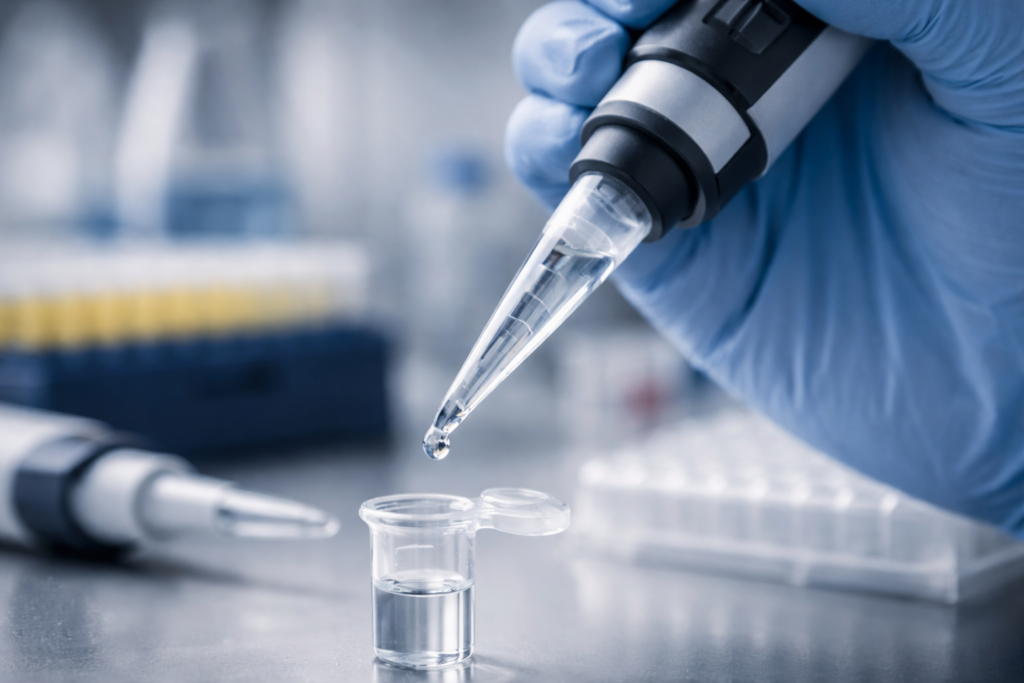
Most pipetting errors do not stem from uncalibrated equipment, but from using the wrong liquid handling technique for the sample at hand. While standard forward pipetting works perfectly for water and dilute buffers, it often fails when handling challenging fluids like heavy glycerol, volatile solvents, or foaming detergents. Under-delivery, sample carryover, and dripping tips can instantly ruin standard curves and assay reproducibility.
What is reverse pipetting?
1. What Is Reverse Pipetting?
Reverse pipetting is a liquid handling technique designed to accurately aspirate and dispense difficult liquids using a standard air displacement pipette.
Unlike standard pipetting, where you aspirate the exact volume and blow out every drop, reverse pipetting intentionally over-aspirates the sample. By drawing in extra liquid, the technique compensates for the physical liquid film that clings to the inside of the pipette tip and counteracts the vapor pressure fluctuations caused by volatile solvents. When dispensing, only the exact predetermined volume is released, leaving a protective volume of residual liquid in the tip. This residual liquid is then safely discarded or returned to the source container, ensuring perfect delivery of the target volume without bubbles or shortfalls.
2. How Reverse Pipetting Works
To understand how reverse pipetting works, you must understand the two physical “stops” of a pipette plunger:
- The First Stop: The point of initial resistance. This corresponds directly to the exact volume set on the pipette dial.
- The Second Stop: The final point of resistance (the “blow-out” position), which pushes additional air through the tip to expel any remaining droplets.
The Mechanics of Reverse Mode:
In proper pipetting using the reverse technique, the user presses the plunger all the way to the second stop before entering the liquid. As the plunger is released, the pipette draws up the target volume plus the extra blow-out volume.
When moving to the receiving vessel, the user depresses the plunger only to the first stop. This pushes out the exact calibrated volume. The extra liquid aspirated initially remains trapped in the tip. Because the user never pushes the final blowout air through the liquid, bubbles and foam are prevented, and the liquid film left on the inner wall of the tip is accounted for by the excess residual liquid.
3. Reverse Pipetting vs Forward Pipetting
Forward pipetting is the default method taught in laboratories, but it is not universally applicable. Choosing between forward and reverse pipetting depends entirely on the physical properties of the liquid being handled.
| Feature | Forward Pipetting | Reverse Pipetting |
|---|---|---|
| Aspiration Stop | First stop | Second stop |
| Dispense Stop | Second stop (Blow-out) | First stop |
| Best Liquid Type | Aqueous (water, dilute DNA, PBS) | Difficult liquids (viscous, volatile, foaming) |
| Residual Liquid | None (tip is emptied) | Yes (excess liquid remains in tip) |
| Main Advantage | Conserves reagent, perfect for water | High accuracy for thick, fast-evaporating, or bubbly samples |
| Main Limitation | Fails with glycerol, ethanol, and detergents | Wastes a small amount of sample in the tip |
4. When to Use Reverse Pipetting
Reverse pipetting is the smart choice whenever the sample refuses to behave like water.
4.1 Viscous Liquids
Examples: Glycerol, blood serum, heavy oils, and dense running buffers.
Viscous liquids flow slowly and cling stubbornly to the inner walls of pipette tips. In forward pipetting, this high surface adhesion causes severe under-delivery, as a thick liquid film remains trapped inside the tip after the blow-out. Reverse pipetting aspirates excess volume so that even when the liquid film clings to the plastic, the exact target volume is successfully pushed out.
4.2 Volatile Liquids
Examples: Ethanol, acetone, methanol, and chloroform.
Volatile solvents evaporate instantly into the pipette’s air cushion. This expands the internal air pressure, forcing liquid to drip out of the tip prematurely. By using reverse pipetting, the excess aspirated liquid acts as a buffer. Even if a small amount evaporates or drips, the primary target volume remains intact when you dispense to the first stop.
4.3 Foaming Liquids
Examples: Detergents (Triton X-100, Tween 20), surfactant-containing buffers, and concentrated protein solutions (BSA).
Blowing out air through a protein or detergent solution creates bubbles and foam, which destroys assay volume accuracy and ruins optical plate readings. Because reverse pipetting never uses the second stop during dispensing, no air is forced through the liquid, completely preventing bubble formation.
4.4 Small-Volume Work
When pipetting sub-microliter volumes (<2 µL), aqueous liquids can sometimes hang on the outside of the tip or form micro-bubbles. Reverse pipetting can improve repeatability at these extremely low volumes by ensuring a steady, solid column of liquid is delivered without the violent disruption of the blowout air.
4.5 PCR / qPCR / Assay Setup
During PCR setup, you frequently handle master mixes containing Taq polymerase and glycerol, as well as protein-rich templates. These components are viscous and prone to foaming. Reverse pipetting ensures that replicate wells in a 96-well plate receive identical volumes of master mix, drastically tightening your quantification cycle (Cq) values in qPCR.
When Reverse Pipetting is Usually Not Necessary
Standard aqueous solutions—like water, diluted acids/bases, and simple saline buffers—are best handled with forward pipetting. Using reverse pipetting for water is unnecessary and wastes reagents, as aqueous solutions do not coat the tip or evaporate fast enough to require the technique.
5. Reverse Pipetting with Air Displacement Pipettes
An air displacement pipette utilizes a compressible pocket of air between the internal piston and the liquid in the tip. When you move the plunger, this air cushion expands or contracts, acting as an invisible spring that pulls or pushes the liquid.
The limitation: Because air is elastic, its volume changes based on the temperature, vapor pressure, and density of the sample. This makes air displacement pipettes vulnerable when handling difficult liquids. Reverse pipetting is an ingenious behavioral workaround—a technique that forces an air displacement pipette to handle liquids it inherently struggles with.
When a Positive Displacement Pipette is the Better Option:
While reverse pipetting is highly effective, it has limits. For extremely viscous liquids (like 100% glycerol) or highly volatile, hazardous solvents (like radioactive mixtures), a positive displacement pipette is superior. Positive displacement pipettes use specialized capillary tips with built-in pistons that physically make contact with the liquid, eliminating the elastic air cushion entirely. If reverse pipetting still yields inconsistent results, switching to positive displacement is the ultimate corrective step.
6. Step-by-Step Reverse Pipetting Technique
Follow this exact protocol to execute proper pipetting in reverse mode:
- Choose the right pipette and volume range: Ensure your target volume falls within the middle-to-top range of the pipette’s capacity.
- Attach the correct pipette tip: Press firmly for an airtight seal without hammering the tip.
- Press the plunger to the second stop: Do this in the air, before touching the sample.
- Immerse the tip correctly: Hold the pipette vertically and submerge the tip 2–5 mm below the surface of the liquid.
- Release the plunger slowly and smoothly: Allow the plunger to glide back to its resting position. Pause for 1–3 seconds to let viscous fluids finish climbing into the tip.
- Move to the receiving vessel: Touch the tip against the inner sidewall of the tube or well at a 45-degree angle.
- Dispense ONLY to the first stop: Press the plunger down to the first point of resistance. This delivers the exact target volume.
- Leave the residual liquid in the tip: Do not blow out the remaining liquid.
- Discard the remaining liquid: Withdraw the pipette and either dispense the residual liquid back into the source container or eject it into a waste bin.
- Eject the tip safely: Discard the used tip to prevent cross-contamination.
7. Best Practices for Proper Reverse Pipetting
To achieve maximum accuracy and precision, incorporate this checklist into your liquid handling workflow:
- Hold the pipette vertically: Always aspirate at a strict 90-degree angle. Tilting alters hydrostatic pressure and causes over-aspiration.
- Correct immersion depth: Submerging too deep coats the outside of the tip, leading to sample carryover. Keep it just below the meniscus.
- Smooth plunger motion: Never let the plunger snap back. Guide it up with your thumb to prevent aerosols and splashing inside the shaft.
- Pause timing: Viscous liquids take longer to flow. Pause for up to 3 seconds after releasing the plunger to allow the tip to fully fill.
- Pre-wetting: Aspirate and dispense back into the source vessel 3 times before your actual transfer. This saturates the internal air cushion with vapor, stabilizing the pressure.
- Proper tip fit: Use high-quality tips designed specifically for your pipette brand to prevent microscopic air leaks.
- Consistent rhythm: Maintain the exact same speed and timing for every sample in a batch to ensure high reproducibility.
8. Common Mistakes in Reverse Pipetting
Even experienced researchers make mistakes when switching techniques. Avoid these common errors:
Dispensing to the second stop instead of the first
- What you did: You pushed the plunger all the way down while dispensing.
- Why it causes error: You just delivered the target volume plus the excess residual volume, drastically over-delivering the reagent.
- How to fix it: Stop firmly at the first point of resistance.
Pressing to the first stop during aspiration
- What you did: You aspirated like a forward pipette, but dispensed like a reverse pipette.
- Why it causes error: You did not draw up the required excess volume, resulting in severe under-delivery.
- How to fix it: Always start by pressing to the second stop in the air before entering the liquid.
Aspirating too quickly
- What you did: You let the plunger snap upward.
- Why it causes error: For viscous liquids, this pulls an air bubble into the tip. For volatile liquids, it causes splashing into the internal filter or shaft.
- How to fix it: Guide the plunger upward slowly with your thumb.
Skipping the pause
- What you did: You pulled the tip out of the liquid the exact millisecond the plunger reached the top.
- Why it causes error: Thick liquids haven’t finished flowing into the tip, leaving you with a short volume and an air bubble at the bottom.
- How to fix it: Count to two before withdrawing the tip from the source vessel.
Using reverse pipetting to “fix” an uncalibrated pipette
- What you did: You noticed your pipette is inaccurate, so you used reverse pipetting to try and force a better result.
- Why it causes error: Technique cannot overcome damaged internal seals or worn O-rings.
- How to fix it: Send the pipette out for professional ISO-compliant calibration.
9. Why Reverse Pipetting Improves Accuracy for Difficult Liquids
The science behind this technique comes down to fluid dynamics and thermodynamics.
When you aspirate a thick protein solution, a microscopic liquid film permanently coats the inner wall of the plastic tip due to strong adhesion forces. If you use forward pipetting, the volume trapped in this film is subtracted from your final dispensed volume. By over-aspirating during reverse pipetting, you create a sacrificial liquid volume. The target volume is pushed out smoothly, and the liquid that stays behind as a film is drawn from the excess residual liquid, leaving your target volume mathematically intact.
For volatile solvents, the issue is vapor pressure. Solvents evaporate aggressively, increasing the air pressure inside the tip and pushing liquid out as a drip. The excess volume aspirated in reverse mode acts as a buffer against this pressure expansion, ensuring that even if a tiny droplet is lost, the core calibrated volume remains ready to dispense at the first stop.
Finally, by completely eliminating the blow-out step, reverse pipetting prevents mechanical bubble formation. Bubbles in an ELISA well or qPCR plate refract light and displace volume, ruining both spectrophotometric readings and enzymatic reactions.
10. Reverse Pipetting Limitations and Disadvantages
While powerful, reverse pipetting is not a universal cure-all. Understanding its limitations is key to expert liquid handling.
What are the disadvantages of reverse pipetting?
- Sample Waste: Because it requires aspirating excess volume, it is not ideal when handling extremely precious, limited-volume samples (unless you can safely recover the residual liquid).
- User Confusion: In multi-user labs, rapidly switching between forward and reverse modes can lead to muscle-memory mistakes, resulting in catastrophic over-dispensing.
- Cannot fix bad tips: If your pipette tips are low quality, have burrs, or fit poorly, reverse pipetting will not restore your precision.
- Maximum Volume Limits: Because you must press to the second stop, the total volume pulled into the tip is greater than the set volume. If you set the pipette to its absolute maximum capacity, reverse pipetting might draw liquid dangerously close to the internal shaft filter.
11. Pipette Tips and Tip Fit
The accuracy of the reverse pipetting technique is entirely dependent on the quality of the pipette tips. A displacement pipette is a two-part system: the instrument and the tip.
Poor tip fit causes microscopic air leaks, disrupting the air cushion and making reverse aspiration erratic. Furthermore, for highly viscous or sticky biological liquids, pairing reverse pipetting with low-retention tips yields the best possible results. Low-retention tips are manufactured with ultra-hydrophobic polymers that repel liquid films, ensuring the sample glides cleanly out of the plastic.
When reverse pipetting hazardous or infectious foaming liquids, always use filter tips to ensure that aerosols generated during the heavy aspiration phase do not carry over into the pipette shaft.
12. Troubleshooting Reverse Pipetting Problems
Why is liquid still remaining in the tip?
That is exactly what is supposed to happen. The core mechanism of reverse pipetting requires leaving residual liquid in the tip after dispensing to the first stop.
Why am I getting bubbles during aspiration?
You are either releasing the plunger too quickly, pulling the tip out of the liquid before the viscous sample has finished rising, or you didn’t submerge the tip deep enough below the meniscus.
Why are my volumes still inconsistent?
Check your tip fit. If the tip is loose, the vacuum is compromised. Alternatively, your plunger rhythm might be inconsistent between samples.
Why does the volatile sample still drip?
You likely skipped pre-wetting. You must aspirate and dispense the solvent 3 to 5 times to saturate the air cushion with vapor before taking your actual measurement.
When should I switch to a positive displacement pipette?
If you have optimized your reverse technique, pre-wetted the tip, and used low-retention tips, but your 100% glycerol or cold chloroform still yields poor precision, it is time to abandon air displacement and use a positive displacement pipette.
13. Real Lab Use Cases
qPCR Master Mix Setup
- The Problem: Taq polymerase is stored in 50% glycerol, making the master mix dense, sticky, and prone to bubbling. Forward pipetting causes severe under-delivery, altering primer/probe ratios.
- The Solution: Reverse pipetting perfectly dispenses the thick master mix into the PCR plate while completely avoiding bubbles, leading to tighter technical replicates.
Preparing Lysis Buffers with Detergents
- The Problem: Adding Triton X-100 or SDS to a buffer using forward pipetting creates a massive foam head when the user blows out the tip.
- The Solution: Reverse pipetting dispenses the surfactant smoothly below the surface of the buffer without injecting any blowout air, keeping the solution foam-free.
Aliquoting Blood Serum
- The Problem: Serum is highly viscous and protein-rich, leaving a thick film on the tip wall that causes standard pipettes to under-deliver.
- The Solution: Reverse pipetting compensates for the liquid film, allowing the exact required microliter volume of serum to be transferred for diagnostic testing.
14. FAQ
What is reverse pipetting?
It is a technique where you press the plunger to the second stop to aspirate excess liquid, then dispense only to the first stop, leaving a small amount of residual liquid in the tip.
When should reverse pipetting be used?
Use it when handling difficult liquids that are viscous, volatile, foaming, or dense.
What is the difference between forward and reverse pipetting?
Forward pipetting aspirates exactly the target volume and blows out all liquid using the second stop. Reverse pipetting over-aspirates the volume and dispenses only the target volume using the first stop.
Why does reverse pipetting leave liquid in the tip?
Because the final blowout (second stop) is never used during dispensing. This excess liquid compensates for tip adhesion and prevents bubbles.
Is reverse pipetting more accurate?
It is far more accurate for viscous and volatile liquids. However, for plain water, forward pipetting is equally accurate and more efficient.
Is reverse pipetting only for air displacement pipettes?
Yes. Positive displacement pipettes do not have an elastic air cushion and therefore do not require the reverse pipetting workaround.
Can reverse pipetting be used for qPCR?
Yes. It is highly recommended for preparing qPCR master mixes to ensure precise glycerol transfer and prevent bubble formation in the plate.
What kinds of liquids require reverse pipetting?
Glycerol, serum, whole blood, ethanol, methanol, Tween 20, Triton X-100, and concentrated bovine serum albumin (BSA).
Do I still need to pre-wet the tip?
Yes. Pre-wetting is essential, especially for volatile liquids, to stabilize the humidity and pressure of the internal air cushion before aspirating.
What are the disadvantages of reverse pipetting?
It wastes a small amount of sample in the tip, and it can be confusing for beginners to switch back and forth from forward pipetting.
Can reverse pipetting replace positive displacement pipettes?
For moderate viscosities, yes. But for extreme viscosities (like pure glycerol) or highly corrosive/volatile solvents, positive displacement pipettes are still superior.
Why do I still get bubbles when reverse pipetting?
You are likely aspirating too fast, pulling the tip out of the fluid too soon, or accidentally pushing the plunger past the first stop during dispensing.
What is the most common reverse pipetting mistake?
Dispensing to the second stop. This pushes the target volume and the excess residual volume into the receiving vessel, ruining the assay.
Which pipette tips are best for difficult liquids?
Low-retention tips are the best choice, as their ultra-hydrophobic surfaces prevent viscous liquids from clinging to the inner plastic walls.
How do I know whether to use forward or reverse pipetting?
If the liquid looks and flows like water, use forward pipetting. If the liquid is thick like syrup, evaporates rapidly, or foams easily, use reverse pipetting.
15. Conclusion
Reverse pipetting is not a magic fix for damaged equipment, but rather a mandatory technique for any laboratory handling complex biological or chemical samples. While modern air displacement pipettes are incredibly precise instruments, they rely on an elastic air cushion that inherently struggles with viscous, volatile, and foaming liquids.
By mastering the reverse pipetting technique—intentionally over-aspirating to compensate for liquid films and vapor pressure—you bypass these mechanical limitations. Correct execution matters: understanding your stops, controlling your plunger speed, and utilizing high-quality pipette tips will dramatically improve your liquid handling accuracy. Knowing when to use forward pipetting, when to switch to reverse mode, and when a sample demands positive displacement is the hallmark of a true laboratory professional.