
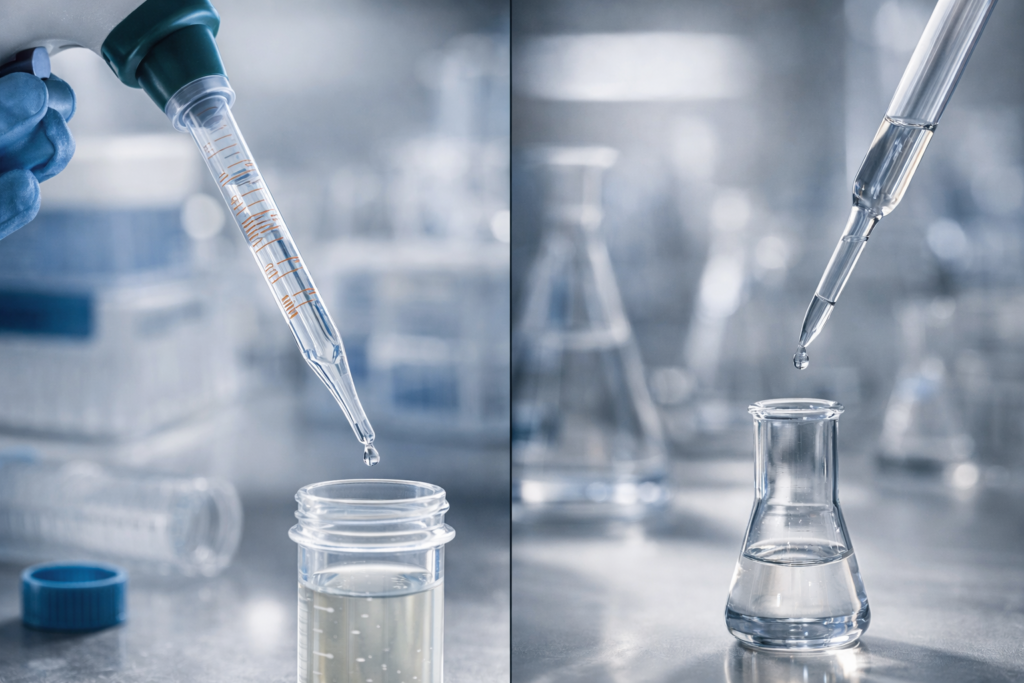
Liquid handling is the foundation of laboratory science, but not all liquids need to be transferred with the same level of exactness. A common point of confusion for students and technicians is deciding between a serological pipette and a volumetric pipette. While both tools consist of a slender tube used to move milliliter volumes of liquid from one vessel to another, their designs dictate entirely different use cases.
Quick Answer
1. What Is a Serological Pipette?
A serological pipette is a type of graduated pipette used for transferring variable volumes of liquid. The term “graduated” means the entire body of the tube is printed with a scale of measurement lines, allowing the user to draw up and dispense different amounts using the same tool.
They typically range in volume from 1 mL up to 50 mL. While glass versions exist, modern laboratories almost exclusively use single-use, sterile, disposable plastic serological pipettes. They are operated using an electronic pipette aid (controller) or a manual bulb. Because they are pre-sterilized and disposable, they are the undisputed workhorse of biological laboratories, microbiology, and tissue culture, where preventing cross-contamination is the absolute highest priority.
2. What Is a Volumetric Pipette?
A volumetric pipette (also known as a bulb pipette) is an analytical instrument designed to deliver one specific, highly exact volume of liquid.
Unlike a serological pipette, it has no graduated scale along its body. Instead, it features a wide central bulb and a narrow neck with a single calibration mark etched into the glass. The user draws liquid exactly to that single line. Because the neck is so narrow, a tiny error in reading the meniscus results in almost zero volume error. They are almost always made of reusable, chemical-grade borosilicate glass. Volumetric pipettes are strictly used when absolute accuracy is required, such as preparing standard solutions or titrants in analytical chemistry.
3. Serological Pipette vs Volumetric Pipette: The Core Difference
The difference between these two pipettes comes down to a trade-off between flexibility and precision.
| Feature | Serological Pipette | Volumetric Pipette |
|---|---|---|
| Calibration Style | Graduated (multiple marks) | Single calibration mark |
| Volume Flexibility | High (can measure variable amounts) | None (measures one fixed amount) |
| Typical Material | Disposable polystyrene plastic | Reusable borosilicate glass |
| Delivery Method | Requires blow-out of the last drop | Gravity drain (do not blow out) |
| Sterility Workflow | Excellent (comes pre-sterilized) | Poor (requires manual autoclaving) |
| Accuracy Level | Moderate (± 0.1 to 0.3 mL for large volumes) | Extremely High (± 0.02 to 0.03 mL) |
| Best Use Case | Aliquoting cell culture media, buffers | Preparing exact analytical standards |
| Main Limitation | Not accurate enough for strict analytical chemistry | Cannot measure partial or variable volumes |
4. Which Is More Accurate?
A volumetric pipette is significantly more accurate and precise than a serological pipette.
To understand why, you must understand the geometry of the tools. A serological pipette has a wide, straight bore. A 1-millimeter visual error when reading the meniscus on a wide tube translates to a relatively large volume error. A volumetric pipette has a wide bulb to hold the volume, but a very narrow upper neck where the calibration line sits. A 1-millimeter visual error on that narrow neck translates to a microscopically small volume error.
For example, a 25 mL Class A volumetric pipette might have a tolerance (error margin) of just ±0.03 mL. A disposable 25 mL serological pipette might have a tolerance of ±0.2 mL to ±0.5 mL.
However, “more accurate” does not mean “always better.” In cell culture, being off by 0.2 mL when adding 10 mL of media to a flask will not affect the cells at all. In that scenario, the serological pipette is perfectly accurate for the workflow.
5. Delivery Method: Blow-Out vs Gravity Drain
Understanding how to physically empty the pipette is where most users make critical errors. Pipettes are usually marked TD (To Deliver), meaning they are calibrated to deliver the stated amount, accounting for the tiny film of liquid that naturally sticks to the inside of the tube.
Volumetric Pipettes (Gravity Drain):
Volumetric pipettes are designed to drain freely by gravity. Once the liquid stops flowing, a tiny drop will remain in the tip. You must leave that drop there. The pipette was calibrated assuming that final drop would stay behind. Forcing it out will over-deliver the liquid and ruin your exact measurement.
Serological Pipettes (Blow-Out):
Most serological pipettes are “blow-out” pipettes. This is indicated by one or two frosted/colored rings printed at the very top of the pipette near the mouthpiece. To deliver the full stated volume, you must let the liquid drain, and then actively use your motorized controller or bulb to push a puff of air through the tube, forcing out the very last drop. If you do not blow it out, you will under-deliver the volume.
6. When to Use a Serological Pipette
Serological pipettes are designed for speed, flexibility, and sterility.
Best Use Cases:
- Cell Culture: Transferring fetal bovine serum (FBS) or aliquoting growth media into flasks.
- Sterile Reagent Transfer: Moving buffers in a biosafety cabinet without risk of cross-contamination.
- Variable-Volume Dispensing: If you need to dispense 2 mL into tube A, 4 mL into tube B, and 3 mL into tube C, you can do it all in one draw using a 10 mL serological pipette.
When it is NOT the best choice:
Never use a serological pipette to prepare analytical standards, titration analytes, or any solution where the exact molar concentration is highly sensitive to a 1% volume error.
7. When to Use a Volumetric Pipette
Volumetric pipettes are designed for uncompromising exactness.
Best Use Cases:
- Analytical Chemistry: Preparing standard curves or quantitative drug ratio analysis.
- Titration Preparation: Transferring the exact volume of the unknown analyte into the receiving flask before beginning a titration.
- High-Precision Dilutions: Making exact 1:10 or 1:100 stock dilutions where accuracy is paramount.
When it is NOT the best choice:
Do not use volumetric pipettes for routine biological work. They are slow to fill, drain slowly by gravity, and cannot measure variable amounts (you cannot measure 7 mL in a 10 mL volumetric pipette).
8. Materials, Sterility, and Reusability
Disposable Plastic (Serological):
In biology, cross-contamination is disastrous. A rogue bacterium will ruin weeks of cell culture work. Therefore, serological pipettes are made of polystyrene plastic, individually wrapped, sterilized by gamma irradiation, and thrown in the biohazard bin immediately after one use. This entirely eliminates the burden of washing and autoclaving glassware.
Reusable Glass (Volumetric):
In chemistry, plastic can melt or leach chemicals into harsh organic solvents. Volumetric pipettes are made of robust borosilicate glass. They must be meticulously washed, rinsed with deionized water, and dried between uses. If water droplets cling to the inside of a volumetric pipette instead of sheeting off smoothly, the glass is dirty, and the calibration is no longer valid.
9. How They Are Used in Real Lab Workflows
- Cell Culture Lab: A technician opens a sterile 25 mL plastic serological pipette, attaches it to an electronic pipette aid, draws up exactly 15 mL of warm media, and rapidly dispenses it into a culture flask. The pipette is discarded.
- Analytical Chemistry Lab: A chemist uses a rubber bulb to draw exactly 10.00 mL of a concentrated acid standard into a glass volumetric pipette. They carefully align the meniscus with the single etch mark, transfer it to a volumetric flask, let it drain by gravity, and leave the final drop in the tip. The pipette is sent to the wash station.
10. Common Mistakes and Misconceptions
11. How to Choose the Right Pipette
Use this simple decision framework when standing at the lab bench:
- Do I need to transfer an exact, single fixed volume with the highest possible accuracy?
Choice: Volumetric Pipette. - Do I need to measure out an odd volume (like 6.5 mL), or dispense multiple different volumes quickly?
Choice: Serological Pipette. - Am I working inside a biosafety cabinet with live cells or sterile media?
Choice: Disposable Serological Pipette. - Am I handling harsh organic solvents that melt plastic?
Choice: Glass Volumetric (or Glass Graduated) Pipette.
12. FAQ
What is the difference between a serological pipette and a volumetric pipette?
A serological pipette is graduated to measure variable volumes and is usually disposable. A volumetric pipette has a single mark to measure one exact fixed volume and is reusable.
Which is more accurate, a serological or volumetric pipette?
A volumetric pipette is vastly more accurate and precise because its narrow neck minimizes visual reading errors.
Are serological pipettes graduated?
Yes, they have measurement marks printed along the entire length of the tube, extending all the way to the tip.
Do serological pipettes require blow-out?
Yes, most do. If they have a frosted or colored band near the top, you must expel the final drop to deliver the full volume.
Why does a volumetric pipette have only one mark?
Because it is calibrated to contain and deliver exactly one specific volume (e.g., 50.00 mL) with extreme analytical precision.
When would you use a serological pipette?
For routine liquid transfers, making buffers, and aliquoting sterile media in cell culture.
When would you use a volumetric pipette?
For preparing chemical standards, titrations, and exact quantitative dilutions.
Are serological pipettes disposable?
Typically, yes. Modern labs use pre-sterilized, individually wrapped polystyrene plastic serological pipettes to prevent contamination.
Are volumetric pipettes reusable?
Yes. They are made of high-quality glass and are designed to be meticulously cleaned and reused.
Can a serological pipette replace a volumetric pipette?
No, not if the protocol requires strict analytical accuracy. A serological pipette’s error margin is too wide.
Can a volumetric pipette replace a serological pipette?
Only if you happen to need the exact volume the volumetric pipette holds, and you do not require a sterile, disposable workflow.
Why are serological pipettes popular in cell culture?
Because they are pre-sterilized, disposable, and allow technicians to rapidly transfer varying amounts of media without washing glassware.
Why are volumetric pipettes preferred in analytical chemistry?
Because chemical analysis relies on exact molar concentrations, which require the extreme volumetric precision that only a bulb-style glass pipette can provide.
What happens if you force out the last drop from a volumetric pipette?
You will add too much liquid to your sample. They are calibrated to leave that drop behind.
Which is better for variable volumes?
The serological pipette. A volumetric pipette cannot measure variable volumes.
13. Conclusion
Serological pipettes and volumetric pipettes both serve the fundamental laboratory need to transfer liquid, but they are engineered for entirely different priorities. The serological pipette is the champion of the biological workflow—offering the flexibility of graduated markings, the speed of electronic controllers, and the safety of sterile disposability. The volumetric pipette is the bedrock of quantitative chemistry—sacrificing speed and flexibility to provide uncompromising, fixed-volume accuracy.
By understanding their differing tolerances and respecting their delivery methods—blowing out the serological tip while allowing the volumetric tip to drain by gravity—you ensure that every liquid transfer you perform is accurate, reproducible, and perfectly suited to the scientific task at hand.