
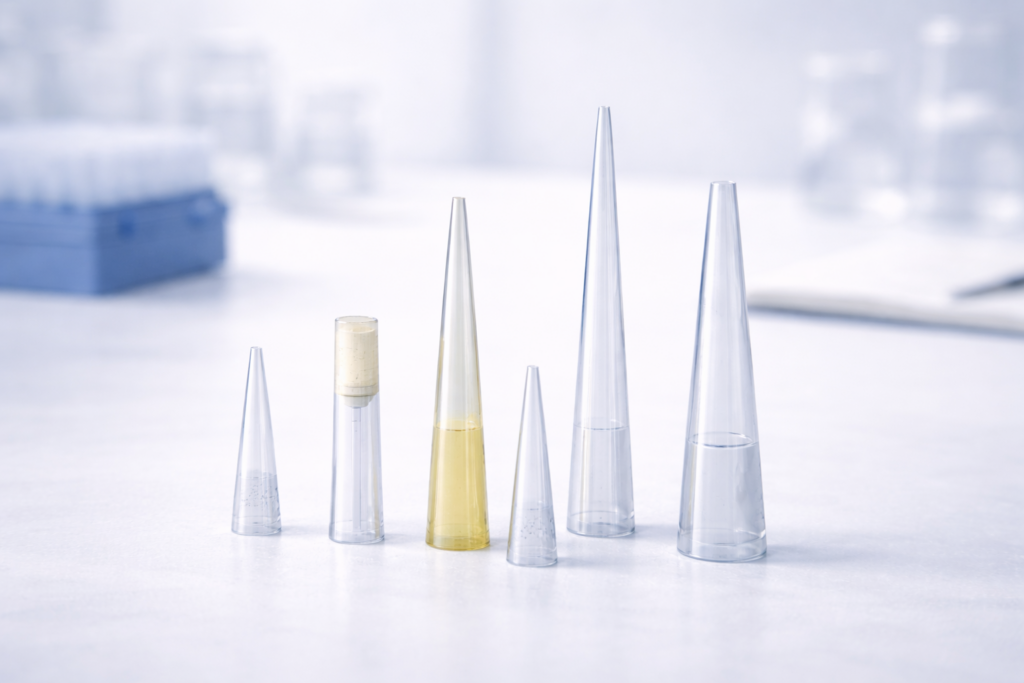
In everyday lab work, pipette tips play a bigger role than many scientists realize. The wrong tip can quietly undermine accuracy, increase contamination risk, or slow your workflow with poor fit and frustrating ejection force. The right tip, by contrast, helps your pipette perform as designed and protects both your samples and your results. This guide explains how different pipette tips affect precision, sterility, and efficiency-and how to choose them confidently. You’ll learn a simple selection method, see practical decision tables, and get a compatibility checklist you can use before ordering. Whether you work in molecular biology, cell culture, or routine QC, this guide is designed to help you make better choices and avoid costly mistakes.
What Are Pipette Tips Used For?
Pipette tips are disposable consumables that attach to a pipette and enable safe, accurate liquid handling. Their main purposes include:
- Accurate liquid transfer
Tips form the seal that allows the pipette’s air cushion to aspirate and dispense precise volumes. - Contamination control
Single-use tips prevent cross-contamination between samples, reagents, and experiments. - Workflow efficiency
Well-fitting tips reduce leaks, minimize rework, and speed up repetitive tasks.
In short, pipette tips are not interchangeable plastic cones-they are functional components of the measurement system.
Pipette Tip Types Explained (with Quick Examples)
Filter vs Non-Filter (Aerosol Barrier)
- Filter tips contain a porous barrier that blocks aerosols from entering the pipette shaft.
Example: PCR, qPCR, or RNA work where carryover contamination is a risk. - Non-filter tips are sufficient for routine liquid transfer where aerosols are not a concern.
Sterile vs Non-Sterile
- Sterile tips are certified free of viable microorganisms.
Example: Cell culture or sterile media preparation. - Non-sterile tips are suitable for general lab work and analytical assays.
Standard vs Low Retention
- Standard tips work for most aqueous solutions.
- Low-retention tips have modified surfaces that reduce liquid sticking to the walls.
Example: Proteins, DNA, enzymes, or detergents.
Standard vs Wide-Bore
- Standard bore tips provide controlled flow for most liquids.
- Wide-bore tips reduce shear stress and improve handling of viscous samples.
Example: Glycerol, cell suspensions, or bead-containing solutions.
Racked vs Bulk vs Reload/Refill Systems
- Racked tips are ready to use and reduce handling.
- Bulk tips lower cost but require manual loading.
- Reload/refill systems balance convenience with reduced plastic waste.
Conductive Tips (Automation)
- Conductive tips enable liquid level sensing in automated systems.
Example: Robotic pipetting platforms in high-throughput labs.
In specialized workflows, extended length tips are useful for reaching the bottom of deep tubes or narrow vessels without contaminating the shaft.
How to Choose the Right Pipette Tips (Decision Table)
| Use case | Recommended tip type | Why | Common mistake |
|---|---|---|---|
| PCR / qPCR | Filter, low retention | Prevents aerosol contamination and sample loss | Using non-filter tips |
| Cell culture | Sterile, low retention | Maintains sterility and consistency | Assuming non-sterile is “clean enough” |
| Volatile solvents | Tight-fitting, low retention | Reduces evaporation and dripping | Using loose “universal” tips |
| Viscous liquids | Wide-bore | Improves accuracy and reduces bubbles | Forcing standard tips |
| Protein/DNA work | Low-retention | Maximizes recovery | Ignoring adsorption losses |
| High-throughput (96-well) | Racked or reload, conductive if automated | Speed and consistency | Mixing tip types mid-run |
This table helps narrow down pipette tips based on what matters most in your application.
Compatibility: “Universal” Tips vs Brand-Specific Fits
Many suppliers label their products as “universal,” but universal does not always mean leak-free. Pipettes vary in cone angle, length, and surface finish. A poor match can lead to leaks, inconsistent volumes, or excessive ejection force.
Why fit matters:
- Seal quality: A weak seal compromises accuracy.
- Cone design: Small geometry differences affect compatibility.
- Ejection force: Poorly matched tips are hard to eject and strain the mechanism.
Compatibility Checklist (Before Ordering)
- Confirm the pipette model and volume range
- Check manufacturer or third-party compatibility charts
- Test for secure seating without excessive force
- Verify leak-free aspiration at maximum volume
- Ensure smooth ejection without sticking
Taking a few minutes to verify compatibility can save hours of troubleshooting later.
Volume Ranges and Tip Sizes (Must-Have Table)
| Pipette range | Typical tip size | Notes (fit/accuracy risks) |
|---|---|---|
| 0.1–2 µL | 10 µL tip | Using oversized tips reduces accuracy |
| 2–20 µL | 20 µL tip | Avoid 200 µL tips for small volumes |
| 20–200 µL | 200 µL tip | Most common lab range |
| 100–1000 µL | 1000 µL tip | Check seal at high volumes |
| 1–5 mL | 5 mL tip | Requires compatible large-volume pipette |
Matching the correct tip size to the pipette range is essential for reliable results with pipette tips.
How Tip Choice Impacts Accuracy and Precision
Accuracy and precision depend on more than pipette calibration. Tip choice directly affects performance:
- Seal and air cushion: Poor seals allow air leaks, reducing aspirated volume.
- Retention: Liquid left behind causes under-dispensing.
- Tip wetting: Pre-wetting the tip improves consistency, especially at low volumes.
- Serial dilutions: Changing tips between steps prevents cumulative errors and contamination.
Even with a well-calibrated pipette, inconsistent tips can introduce significant variability.
Best Practices for Handling and Storage
To get the most from your pipette tips:
- Use sterile tips when sterility matters; don’t assume clean equals sterile.
- Keep racks covered to prevent dust and aerosol exposure.
- Handle tips by the rack or collar, not the shaft.
- Store tips in a clean, dry area away from chemical vapors.
- Consider refill systems to reduce handling and plastic waste.
Good handling practices protect both your samples and your equipment.
Common Problems and Fixes (Troubleshooting Table)
| Problem | Likely cause | Fix | Prevention |
|---|---|---|---|
| Dripping/leaks | Poor fit or damaged tip | Switch to better-fitting tips | Verify compatibility |
| Inconsistent volumes | Retention or air leaks | Use low-retention tips | Match tip size correctly |
| High ejection force | Cone mismatch | Try alternative tip design | Test before bulk ordering |
| Aerosol contamination | No filter barrier | Use filter tips | Apply risk-based selection |
| Tips falling off | Loose “universal” fit | Use compatible tips | Avoid mixing suppliers |
FAQ
1) What are pipette tips used for?
They enable accurate, contamination-free liquid transfer by forming a disposable interface between the pipette and the sample.
2) What are the different types of pipette tips?
Common types include filter and non-filter, sterile and non-sterile, low-retention, wide-bore, conductive, racked, and bulk tips.
3) Do I need filter pipette tips?
Use filter tips when aerosols or cross-contamination could affect results, such as PCR or RNA work.
4) Are universal pipette tips really universal?
Not always. “Universal” tips may fit many pipettes but still leak or eject poorly on some models.
5) Can you reuse pipette tips?
Reusing tips is not recommended. Single-use ensures accuracy, prevents contamination, and protects the pipette.
Key Takeaways
- Choose pipette tips based on application risk, not price alone.
- Filter tips are essential for aerosol-sensitive assays.
- Low-retention tips improve recovery for proteins and nucleic acids.
- Fit and seal quality matter more than the “universal” label.
- Match tip size to pipette range for best accuracy.
- Use wide-bore or extended length designs only when the workflow requires them.
- Good handling and storage prevent hidden contamination.
- Test compatibility before committing to large orders.