
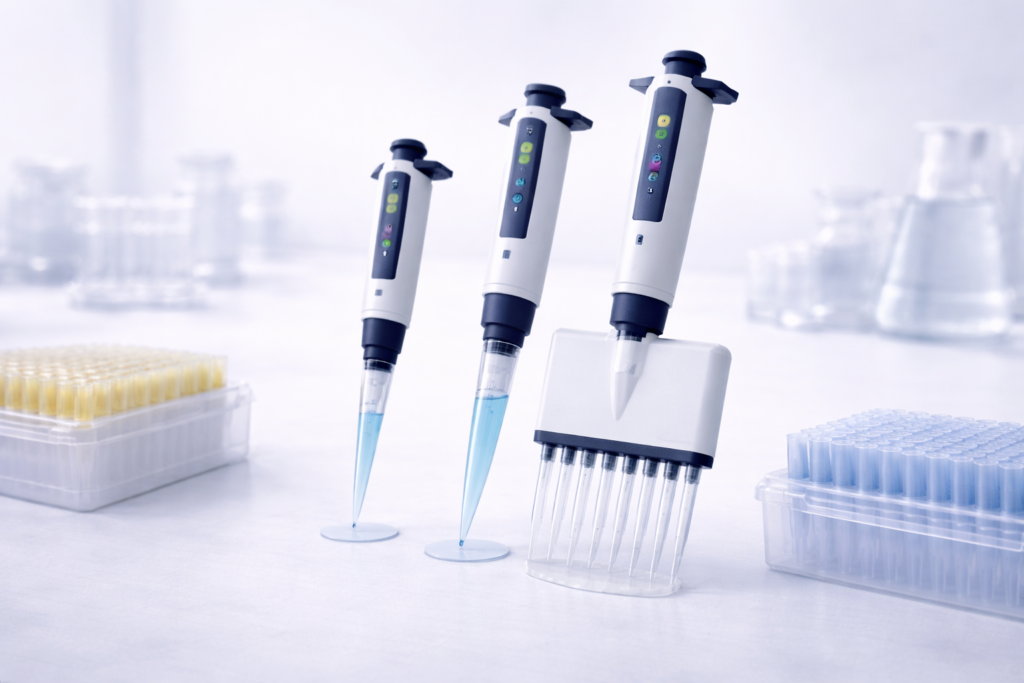
Shopping for pipettes online can be confusing because “pipette” describes several different tools. You might need precision micropipettes (pipettors) for measuring microliters in molecular biology, serological pipettes with controllers for cell culture media, or simple disposable transfer pipettes for basic liquid handling. This guide helps laboratory professionals, educators, and researchers navigate pipette types, volume ranges, and key features so you can buy the right instrument for your work. We’ll cover single-channel and multichannel formats, manual versus electronic models, positive displacement systems, and essential considerations like calibration, ergonomics, and tip compatibility.
What Type of Pipette Do You Need?
Understanding pipette categories prevents costly purchasing mistakes.
Micropipette (pipettor): Precision variable-volume instrument for measuring 0.1–10,000 µL. Uses disposable plastic tips. Available in manual (piston-driven) and electronic versions. Standard for molecular biology, biochemistry, and analytical work requiring accuracy within 1–3%.
Serological pipette + controller: Graduated glass or plastic pipettes (1–50 mL) used with motorized or manual controllers. Common in cell culture for dispensing media and reagents. Lower precision than micropipettes but faster for larger volumes.
Transfer pipette (disposable dropper): One-piece plastic dropper for approximate transfers. Non-sterile or sterile options. Used when precision isn’t critical-think teaching labs, field sampling, or adding small reagent volumes.
Quick Selection Guide
| If you’re doing… | Choose this |
|---|---|
| PCR setup, DNA/RNA quantification, ELISA | Manual or electronic micropipettes (0.1–1000 µL range) |
| Cell culture media preparation and transfer | Serological pipettes (5–25 mL) with motorized controller |
| High-throughput screening or plate filling | Electronic multichannel micropipettes (8- or 12-channel) |
| Viscous samples (glycerol, oils, blood) | Positive displacement micropipettes |
| Repetitive dispensing of same volume | Electronic repeater pipettes or bottle-top dispensers |
| Basic solution transfers in teaching labs | Disposable transfer pipettes |
Not sure? Start with your volume range and sample type-those two factors narrow your choices significantly.
Shop Pipettes by Format
Manual Single-Channel Pipettes
These workhorses represent the most common laboratory pipettes. You set the volume using an adjustment knob, then depress the plunger through two stops to aspirate and dispense liquid.
What to look for: Ergonomic design with low plunger force (critical for repetitive pipetting), clear volume display, autoclavable lower assembly, and compatibility with universal tips. Models with volume locking prevent accidental adjustment during protocols. Expect accuracy within ±1–3% depending on volume range.
Best for: General laboratory work where throughput is moderate and budget is limited. Manual pipettes require no batteries and have minimal maintenance beyond calibration.
Manual Multichannel Pipettes
Eight-channel or 12-channel models fit standard microplate formats (96-well, 384-well). All channels aspirate and dispense simultaneously, multiplying throughput by 8× or 12×.
What to look for: Independent channel suspension (ensures all tips contact liquid even on uneven surfaces), adjustable tip spacing for different plate formats, and balanced weight distribution. Multichannel pipettes are heavier than single-channel models, so ergonomic grip design matters more.
Best for: ELISA assays, PCR plate setup, serial dilutions across plates, and any workflow involving microplates. Consider electronic versions if you process more than five plates daily.
Electronic Single-Channel Pipettes
Battery-powered motors replace manual plunger action. You program aspiration and dispense speeds, volumes, and multi-step protocols. Some models offer mixing, reverse pipetting, and serial dispensing modes.
What to look for: Intuitive interface, rechargeable battery life (8+ hours), programmable protocols, and adjustable aspiration/dispense speeds. Weight matters-electronic models are heavier than manual equivalents. Check if the manufacturer offers tip ejector arm options for reduced thumb strain.
Best for: Repetitive work, users with repetitive strain concerns, protocols requiring consistent pipetting technique, and applications needing precise speed control (viscous samples, gentle cell handling).
Electronic Multichannel Pipettes
Combine multichannel throughput with electronic precision and programmability. High-end models offer individual channel calibration and dynamic tip spacing.
What to look for: Same criteria as electronic single-channel plus: channel-to-channel volume variation (should be <1%), tip ejection system quality (important when ejecting 8–12 tips simultaneously), and protocol memory capacity. Premium models allow saving custom programs for specific assays.
Best for: High-throughput laboratories, core facilities, pharmaceutical QC, and any operation processing dozens of plates weekly. These represent significant investments but reduce repetitive strain injuries and improve data consistency.
Positive Displacement Pipettes
Instead of air cushion displacement (standard pipettes), positive displacement models use a disposable piston that directly contacts the sample. The piston moves inside a capillary tip/piston assembly.
What to look for: Capillary piston compatibility (brand-specific), easy piston ejection mechanism, and chemical resistance specifications. These systems cost more per sample due to disposable pistons, but eliminate common errors.
Best for: Viscous liquids (glycerol, oils, polymers), volatile solvents (hexane, acetone), high-vapor-pressure samples, foam-prone solutions, and radioactive materials. When standard air-displacement pipettes give inconsistent results, positive displacement solves the problem.
Repeater Pipettes and Bottle-Top Dispensers
Repeater pipettes attach to reagent bottles and dispense identical volumes repeatedly (up to 100 dispensing actions from one aspiration). Bottle-top dispensers mount directly on reagent bottles for routine dispensing.
What to look for: Dispensing volume range, syringe compatibility (repeaters use specialized syringes), chemical compatibility with your solvents, and adjustment precision. Digital models display volume clearly; analog versions require careful reading.
Best for: Aliquoting reagents, filling reaction tubes with buffer, preparing culture media, and any task requiring 20+ identical dispenses. These dramatically reduce pipetting fatigue and improve consistency.
Serological Pipettes and Controllers
Serological pipettes are graduated tubes (plastic or glass) used with motorized or manual controllers. Controllers provide suction and dispense control via finger triggers.
What to look for: Motorized controllers with adjustable speed, filter protection (prevents liquid contamination of controller), battery life, and compatibility with different pipette sizes (1–50 mL). Pipettes themselves: graduation clarity, tip style (plug-seal for sterile work), and certification (sterile, non-pyrogenic for cell culture).
Best for: Cell culture, media preparation, solution transfers above 1 mL, and general laboratory liquid handling where pipettor volume ranges are insufficient.
Shop by Volume Range
Matching pipette volume range to your working volumes ensures accuracy and reduces technique errors. Using a pipette at 10–100% of its maximum volume gives best results.
| Volume Range | Typical Pipette Name | Common Applications | Tip Type Notes |
|---|---|---|---|
| 0.1–2 µL | P2, Ultramicro | PCR master mix additions, nanoliter-scale reactions, restriction enzymes | Requires fine-orifice tips; reverse pipetting technique recommended |
| 2–20 µL | P20 | PCR primers, restriction digests, DNA/RNA quantification, sample loading | Standard 10 µL tips; filter tips for sensitive work |
| 20–200 µL | P200 | PCR reactions, ELISA, immunoassays, most molecular biology | Most common size; universal tip compatibility typical |
| 100–1000 µL | P1000 | Buffer additions, dilutions, general reagent transfers | 1000 µL (1 mL) tips; higher risk of aerosol contamination |
| 1–10 mL | P5000/P10000 or serological | Culture media, solution preparation, larger volume transfers | May require extended-length tips or serological pipettes instead |
Buying strategy: Most labs need at least three pipettes covering 2–20 µL, 20–200 µL, and 100–1000 µL ranges. These three handle 90% of molecular biology and biochemistry applications. Add a P2 if you work with nanoliter volumes or a P10 mL if you handle larger solution preparation.
How to Choose the Right Pipette (Buyer Checklist)
Work through these considerations before purchasing:
- Accuracy and precision requirements: Check manufacturer specifications. Research-grade work typically needs ±1–2% accuracy; teaching labs can accept ±3–5%. Confirm whether specs meet ISO 8655 or ASTM standards if regulatory compliance matters
- Ergonomics: Test plunger force, grip diameter, and weight if possible. Electronic pipettes reduce strain but add weight. Users with small hands may struggle with standard-diameter barrels. Repetitive pipetting (>200 cycles/day) justifies ergonomic or electronic models
- Sample type: Aqueous solutions work with standard air-displacement models. Viscous samples, organic solvents, or volatile liquids require positive displacement or specialized techniques. High-salt or high-protein buffers may need low-retention tips
- Throughput needs: Single-channel suffices for occasional use. Process 5+ microplates weekly? Multichannel becomes cost-effective through time savings and reduced errors
- Tip compatibility: Universal tip systems (many manufacturers make compatible tips) reduce long-term costs. Proprietary tip systems may offer performance advantages but lock you into one supplier. Verify tip availability and pricing before committing
- Certification and traceability: Academic research may accept manufacturer calibration certificates. FDA-regulated work, clinical diagnostics, or GMP environments require traceable calibration to national standards (NIST in the US). Factor in annual calibration costs
- Budget and total cost of ownership: Initial purchase price represents 30–40% of five-year costs. Tips, calibration, service, and potential replacement parts add up. Electronic pipettes cost 3–5× more initially but may reduce tip costs through better technique consistency
New vs Used Pipettes Online
Used pipettes can deliver 40–60% cost savings, but require careful evaluation.
When used makes sense: Teaching laboratories, budget-constrained startups, backup instruments, and non-critical applications. Well-maintained manual pipettes from reputable manufacturers often have 10+ year lifespans. Electronic pipettes are riskier due to battery degradation and electronic component wear.
What to verify before buying:
- Service history documentation showing regular calibration
- Recent calibration certificate (within 12 months) with test data
- Physical inspection for cracks, damaged seals, or worn o-rings
- Functionality test at multiple volumes across the range
- Manufacturer and model identification (avoid obsolete models with discontinued parts)
- Seller warranty or return policy (30-day minimum recommended)
Common risks: Hidden damage to internal seals causing accuracy drift, electronic failures shortly after purchase, missing or incompatible accessories, and calibration certificates that don’t reflect actual performance. Reputable sellers of used laboratory equipment provide calibration services and warranties; individual sellers on auction sites present higher risk.
Risk reduction: Buy from sellers offering calibration services, request videos demonstrating functionality, verify parts availability for the specific model, and budget for immediate professional calibration upon receipt.
Calibration, Maintenance, and Compliance
Pipettes drift out of calibration through normal use, affecting accuracy and data quality.
Why calibration matters: Seal wear, spring fatigue, and mechanical drift cause volume delivery errors. Uncalibrated pipettes can deviate 5–10% from specification within 12 months of heavy use. This introduces systematic errors into experiments, quality control, and clinical testing. Regular calibration catches problems before they compromise results.
Typical intervals: ISO 8655 and most quality systems recommend annual calibration. High-use laboratories (>500 pipetting cycles weekly) may calibrate quarterly or semi-annually. Dropped pipettes require immediate recalibration regardless of schedule. New pipettes arrive with factory calibration certificates but should enter your calibration schedule immediately.
What buyers need: Factory calibration certificate for new pipettes showing test data at three points across the volume range (typically 10%, 50%, and 100% of maximum volume). Certificates should include: pipette serial number, test date, technician identification, equipment traceability, ambient conditions (temperature, humidity), and pass/fail status against specifications. Regulated laboratories require NIST-traceable or equivalent national standards documentation.
Basic maintenance: Clean external surfaces with isopropanol or ethanol (never immerse pipettes in liquid). Autoclave only if manufacturer specifies autoclaving instructions. Inspect tip cones for damage before each use. Replace seals annually or when you notice increased pipetting force. Store pipettes vertically on stands to prevent seal deformation. Lubricate o-rings according to manufacturer schedules (typically annually).
Popular Use Cases and Workflows
PCR and Molecular Biology
Best format: Manual single-channel pipettes (P2, P20, P200) for low throughput; electronic multichannel for plate-scale reactions.
Nice-to-have features: Volume locking to prevent accidental adjustment, autoclavable tip cones for contamination control, and adjustable tip ejection force. Electronic models with reverse pipetting mode improve accuracy with viscous master mixes.
Cell Culture
Best format: Serological pipettes (5, 10, 25 mL) with motorized controller for media work; P200 and P1000 micropipettes for trypsin and reagent additions.
Nice-to-have features: Controllers with adjustable speed (gentle aspiration prevents cell damage), blow-out function for complete dispensing, and HEPA-filtered exhaust. Sterile serological pipettes with cotton plugs prevent contamination.
Analytical Chemistry
Best format: Depends on sample volume-typically P100, P200, or P1000 for chromatography sample prep; positive displacement for organic solvents.
Nice-to-have features: Chemical-resistant materials, precise volume adjustment (analytical work often uses specific volumes like 250 µL), and excellent repeatability (<0.5% CV). Glass capillary positive displacement systems for aggressive solvents.
Teaching Laboratories
Best format: Manual single-channel pipettes (P20, P200, P1000 cover most exercises); disposable transfer pipettes for non-quantitative work.
Nice-to-have features: Durable construction, simple maintenance, intuitive volume adjustment, and lower-cost replacement parts. Consider buying educational-grade models designed for student use rather than premium research instruments.
High-Throughput Screening
Best format: Electronic multichannel pipettes (12-channel or 16-channel for 384-well plates) with protocol programming; automated liquid handlers for extreme throughput.
Nice-to-have features: Multi-dispense programs, adjustable aspiration/dispense speeds, tip touch-off, and integration with plate reader workflows. Some facilities use 96-channel or 384-channel pipetting heads for ultimate speed.
FAQs
Why are pipettes so expensive?
Precision manufacturing tolerates microns-level variations in piston fit, spring tension, and seal geometry. High-quality pipettes achieve ±1% accuracy through precise machining, careful material selection (chemical resistance, dimensional stability), and extensive quality testing. Research-grade pipettes undergo individual calibration and certification. Development costs for ergonomic designs and electronic systems also factor into pricing. Budget models sacrifice some precision and durability but serve less demanding applications adequately.
What’s the difference between a pipette and a dropper?
Terminology confusion exists because “pipette” historically described any liquid transfer tube. Modern laboratory usage distinguishes: micropipettes (precision variable-volume instruments with disposable tips), serological pipettes (graduated tubes), and transfer pipettes/droppers (disposable one-piece tools for approximate transfers). When researchers say “pipette,” they typically mean micropipette/pipettor. Medical or educational contexts might mean dropper. Online searches for “buy pipettes” mostly surface micropipettes, but clarifying which type prevents mismatched purchases.
Manual vs electronic: which should I buy?
Start with manual pipettes unless specific needs justify electronic models. Manual pipettes cost less, require no batteries, need minimal maintenance, and handle most laboratory work excellently. Choose electronic when: you perform highly repetitive pipetting (reduces strain), need exact technique consistency across users, work with difficult samples requiring precise speed control, or want programmable multi-step protocols. Electronic pipettes demand higher initial investment, battery management, and more complex servicing but deliver those benefits through improved ergonomics and consistency.
Do I need filter tips?
Filter tips contain hydrophobic membrane barriers preventing aerosol contamination of pipette barrels and cross-contamination between samples. Use filter tips when: working with PCR/qPCR (prevents amplicon contamination), handling infectious or toxic materials, pipetting radioactive samples, or performing sensitive assays where contamination ruins experiments. General buffer and media work doesn’t require filter tips. Filter tips cost 2–3× more than standard tips, so selective use balances safety and budget.
How do I pick pipette tips?
Match tip volume rating to your pipette range-1000 µL tips for P1000 pipettes, 200 µL tips for P200, etc. Verify compatibility: universal tips fit most brands, but some pipettes require brand-specific tips. Consider: standard vs filter (discussed above), sterility (cell culture and molecular biology), certified DNase/RNase-free status (molecular work), low-retention coating (viscous samples, proteins), and tip rack format (automation compatibility). Buying tips in bulk (960-count cases) reduces cost by 30–50% versus small packs.
What warranty and calibration documentation should I expect?
New pipettes should include: manufacturer warranty (typically 1–3 years covering defects), factory calibration certificate with test data, instruction manual, and performance specifications. Certificates must show: pipette serial number, calibration date, test equipment traceability, ambient conditions, technician identity, and measured accuracy/precision at multiple volumes. Regulatory laboratories need NIST-traceable or equivalent documentation. Used pipettes may lack original documentation but reputable sellers provide fresh calibration certificates. Reject pipettes without adequate documentation if compliance or quality assurance matters.
Key Takeaways
- Clarify whether you need micropipettes (precision instruments for 0.1–1000 µL), serological pipettes (1–50 mL graduated tubes), or transfer droppers before shopping
- Match pipette volume range to your working volumes-using a pipette at 10–100% of maximum capacity ensures accuracy
- Manual single-channel pipettes handle most laboratory work cost-effectively; electronic and multichannel formats suit high-throughput or ergonomically demanding applications
- Positive displacement pipettes solve problems with viscous, volatile, or foam-prone samples that defeat standard air-displacement models
- Tip compatibility matters long-term-universal tip systems offer flexibility and cost savings versus proprietary systems
- Annual calibration maintains accuracy and meets quality standards; factor calibration costs into total ownership expenses
- Used pipettes can save money but require verification of service history, calibration status, and physical condition
- Volume ranges of 2–20 µL, 20–200 µL, and 100–1000 µL cover the majority of molecular biology and biochemistry applications
- Ergonomics become critical for repetitive pipetting-test grip size, weight, and plunger force if possible before purchasing
- Filter tips, chemical resistance, and certification level depend on your specific applications and regulatory requirements