
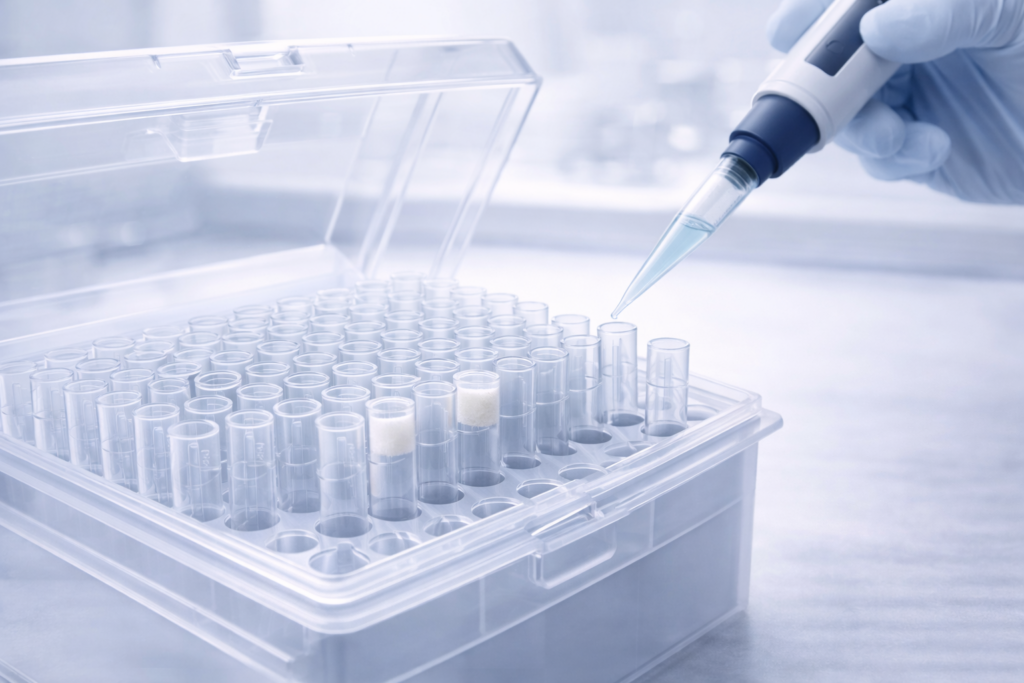
Sterile pipette tips are pre-sterilized disposable tips packaged to maintain sterility until use, helping labs prevent microbial contamination during liquid handling. Labs choose them to protect sensitive samples, avoid false results, and keep workflows compliant with SOPs. In this guide, you’ll learn what “sterile” really means (and what it doesn’t), when sterility matters, how packaging affects risk and cost, and when filters are worth it. You’ll also get a fast decision guide, a buyer checklist, and a troubleshooting section to solve common problems-so you can choose the right pipette tips quickly and confidently.
What Are Sterile Pipette Tips?
“Sterile” generally means the pipette tips have been sterilized (commonly by gamma irradiation or electron beam) and then packaged to keep them free from viable microorganisms until opened.
How sterility is maintained
- Sealed packaging: Individually sealed racks, bags, or refills prevent exposure.
- Controlled handling: Cleanroom assembly and validated sealing reduce contamination risk.
- Lot control: Documentation links each lot to its sterilization process.
Important note: Sterile does not automatically mean RNase/DNase-free or PCR-inhibitor-free. Sterility addresses microbes, while molecular cleanliness addresses enzymes and inhibitors that can ruin nucleic acid work. Many labs need both-but they’re different claims.
Sterile vs Non-Sterile vs “PCR Clean” (Don’t Confuse These)
Different labels solve different problems. Mixing them up can lead to over-spending-or failed experiments.
| Type | What it protects against | Typical uses | What it does not guarantee |
|---|---|---|---|
| Sterile | Viable microbes (bacteria/fungi) | Cell culture, microbiology, clinical prep | RNase/DNase-free unless stated |
| Non-sterile | None (basic cleanliness only) | Routine buffers, washes | No sterility or enzyme control |
| PCR clean / RNase-/DNase-free | Enzymes, inhibitors | PCR/qPCR, RNA/DNA work | Not necessarily sterile |
| Certified + lot traceability | Consistency & auditability | Regulated labs | Performance outside stated claims |
Why certification matters: Lot traceability supports audits, troubleshooting, and reproducibility-especially in regulated or collaborative environments where pipette tips are shared across teams.
When Do You Need Sterile Tips? (Decision Guide)
Use this quick yes/no logic to decide whether sterile pipette tips are required.
Yes-use sterile tips when you handle:
- Cell culture: Any open handling where microbes could compromise viability.
- Microbiology: Transfers, plating, or inoculation.
- Clinical/diagnostic samples: To protect patient samples and results.
- PCR/qPCR & RNA work: Sterile helps, but you also need RNase/DNase-free claims.
Usually no-sterile tips may be optional when you do:
- Routine buffer prep or media dilutions that will be sterilized later (follow your SOP).
- Non-critical transfers with closed containers and low contamination risk.
If your SOP says “sterile,” use sterile pipette tips-consistency matters more than individual judgment.
Do You Need Filtered Sterile Tips?
Filters add an aerosol barrier that protects samples and the pipette. Filtered pipette tips add value when aerosols are likely-think PCR setup, infectious samples, or repetitive aspiration/dispensing that can generate droplets.
Choose filtered pipette tips when:
- You want to prevent aerosol carryover between samples.
- You need to protect the pipette from contamination (and downtime).
- You’re setting up PCR/qPCR or handling volatile or infectious liquids.
Non-filter sterile tips are often enough when:
- Aerosol risk is low and volumes are moderate.
- Speed and cost are priorities in sterile but low-risk tasks.
In practice, many labs standardize filters for high-risk benches and use non-filter sterile pipette tips elsewhere. A filtered pipette setup can also extend pipette service intervals by reducing internal contamination.
What to Look For (Buyer Checklist)
Use this checklist to shortlist pipette tips that fit your workflow:
- Volume range & accuracy: Match tip size to your pipette and typical volumes.
- Fit & compatibility: Universal vs pipette-specific-poor fit causes leaks and variability.
- Sterility assurance: Method stated (e.g., gamma), intact seals, lot documentation.
- Packaging format: Racked, reload/refill, or bulk-balance risk, cost, and speed.
- Low retention option: Helpful for proteins, detergents, or viscous liquids.
- Automation readiness: If used on robots, confirm dimensions, rigidity, and rack format.
- Environmental handling: Easy-open seals, minimal plastic touch points.
- Supply continuity: Consistent lots and clear labeling reduce surprises.
Packaging Options (Racked, Reload, Bulk) and Contamination Risk
| Option | Best for | Pros | Cons | Typical lab areas |
|---|---|---|---|---|
| Racked (sealed) | High-risk work | Fast, minimal handling | Higher cost, more plastic | Cell culture, PCR |
| Reload/Refill | Balanced workflows | Lower waste, good control | Requires careful reloading | Core labs |
| Bulk (bagged) | Cost-sensitive tasks | Lowest cost | Highest handling risk | Prep rooms |
Packaging choice directly affects contamination risk. If multiple users share benches, racked sterile pipette tips reduce variability and errors.
Handling & Storage (Keeping Them Sterile)
- Open smart: Peel seals away from the work area; avoid touching tip openings.
- Bench discipline: Keep racks closed between uses; segregate sterile benches.
- One-way flow: Don’t bring opened racks back into clean storage.
- Discard when in doubt: Broken seals, wet tips, or accidental exposure mean toss them.
Sterility is only as good as your handling. Even the best pipette tips can’t compensate for poor bench habits.
Troubleshooting
| Problem | Likely cause | Fix | Prevention |
|---|---|---|---|
| Contamination in cell culture | Non-sterile handling or packaging breach | Switch to sealed racks; review technique | Dedicated sterile bench |
| Tips not fitting / leaking | Incompatible fit | Choose correct fit type | Standardize pipette tips |
| Wet tips / splashing | Too fast aspiration/dispense | Slow plunger speed | Use appropriate volume range |
| Inconsistent volumes | Poor seal or worn pipette | Check fit; service pipette | Routine calibration |
FAQ
Are sterile pipette tips necessary for cell culture?
Yes. Open handling makes microbial contamination likely without sterile pipette tips.
Can you autoclave pipette tips?
Some non-sterile tips tolerate autoclaving, but sterility and performance aren’t guaranteed unless validated.
Are sterile tips RNase/DNase-free?
Not by default. Look for explicit enzyme-free claims if you do RNA/DNA work.
When should I use filtered sterile tips?
Use them when aerosols or carryover could compromise results; a filtered pipette setup is common for PCR.
Can pipette tips be reused?
Best practice is no. Reuse increases contamination and volume errors; follow SOPs.
Key Takeaways
- “Sterile” addresses microbes-not enzymes or inhibitors.
- Match sterility level to task risk and SOPs.
- Packaging choice affects speed, cost, and contamination risk.
- Filters add protection where aerosols matter.
- Fit and volume range are as important as sterility.
- Handle and store carefully to maintain sterility.
- Standardization reduces errors across teams.
- Document lots and claims for audits and troubleshooting.