
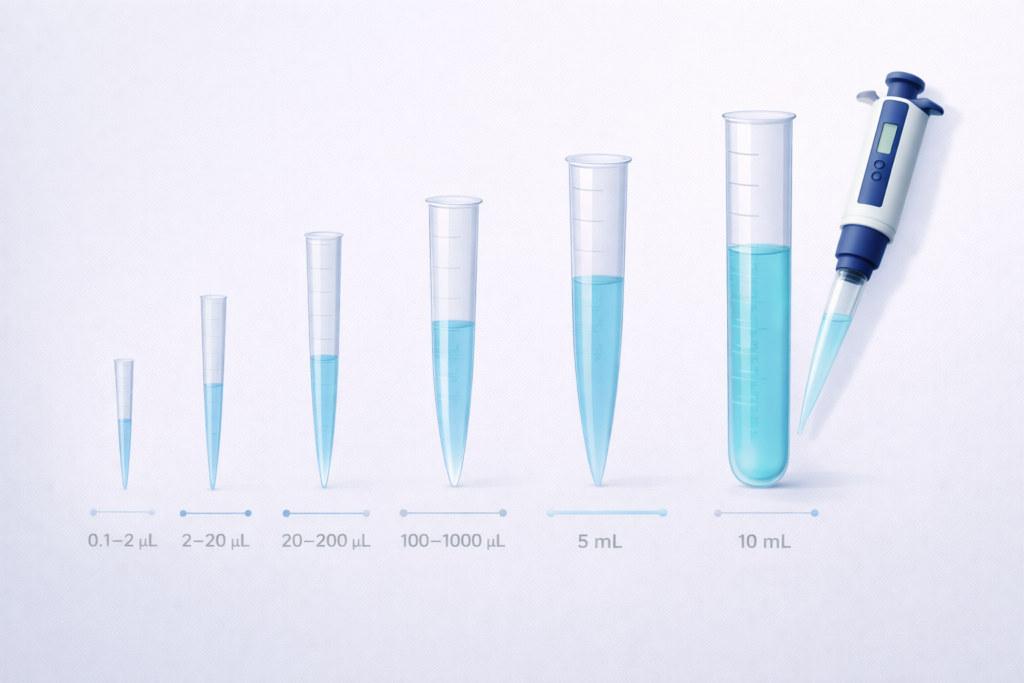
Choosing the right pipette tips starts with volume range-but accuracy, fit, and application matter just as much. A tip that technically “fits” can still leak, retain liquid, or eject poorly if it doesn’t match your pipette and workflow. This guide gives you a fast volume-to-tip chart, a simple 3-step selection method, and practical compatibility tips to prevent common lab headaches. Whether you’re running PCR, routine transfers, or handling larger volumes, you’ll find clear recommendations and quick fixes below.
Quick Volume-to-Tip Size Chart
| Volume range | Common pipette class | Typical tip size label | Best for | Notes (accuracy/handling) |
|---|---|---|---|---|
| 0.1–2 µL | Ultra-micro | 2 µL | qPCR, enzymes | Use slow speeds; pre-wet to improve precision |
| 2–20 µL | P10 / P20 | 10 µL / 20 µL | PCR setup, reagents | Avoid top/bottom extremes for best accuracy |
| 20–200 µL | P100 / P200 | 200 µL | General lab, plates | Most versatile range; watch for static |
| 100–1000 µL | P1000 | 1000 µL | Buffers, media | Ensure full seal to prevent drips |
| 1–5 mL | Large-volume | 5 mL | Media prep | Use matching ejector; steady aspiration |
| 5–10 mL | Large-volume | 10 mL | Bulk transfers | Consider extended length for deep vessels |
How to Choose Tips by Volume (3-Step Method)
Step 1: Stay within the calibrated range.
Work in the middle 35–80% of your pipette’s range when possible. Accuracy drops at the extremes.
Step 2: Choose the correct tip family/fit.
“Universal” labeling helps, but sealing geometry differs. Match the tip family to your pipette model before optimizing anything else.
Step 3: Adjust by application.
Select sterile, filtered, low-retention, or extended-length options as needed. The right pipette tips reduce rework and variability.
Fit & Compatibility (Why Tips Leak or Feel Loose)
“Universal” isn’t truly universal. Small differences in cone angle, wall thickness, and collar height affect sealing and ejection. A poor match can cause micro-leaks, inconsistent volumes, or tips stuck on the shaft.
Why problems happen
- Mismatched cone geometry → weak seal
- Over-tight seating → ejection issues
- Thin walls → flex under aspiration
Mini checklist for fit testing
- Seat with gentle, consistent pressure (no twisting)
- Aspirate water; hold vertically for 10 seconds (no drip)
- Dispense at normal speed; check for bubbles
- Eject cleanly with one press
If issues persist, stick to manufacturer-recommended options-especially for regulated or high-precision work using pipette tips.
Application Add-Ons (When Volume Isn’t Enough)
- Sterile vs non-sterile: Use sterile for cell culture and clinical workflows.
- Filtered tips: Essential for aerosol-sensitive tasks (PCR, infectious samples).
- Low retention: Improves recovery with proteins, detergents, and glycerol.
- Extended length: Reaches deep tubes and avoids contaminating shafts.
- Automation-friendly: Rigid walls and consistent geometry for robots.
Small Volumes (0.1–20 µL) – Accuracy Tips
Small volumes magnify technique errors. Improve results by:
- Pre-wetting the tip 2–3 times
- Reverse pipetting for viscous or volatile liquids
- Slow aspiration/dispense to avoid bubbles
- Vertical aspiration and consistent immersion depth
These habits matter more than brand when working at the low end with pipette tips.
Common Questions (PAA-Style FAQ)
What’s the difference between P20 and P200 tips?
They’re optimized for different volume ranges and pipette cones; don’t interchange.
Can tips be filled above their stated volume?
You can, but accuracy and retention suffer-avoid for quantitative work.
Do I need filtered tips for general lab work?
Not always. Use filters when aerosols or contamination risk matter.
Why does liquid cling to the tip?
Surface tension and static-use low-retention options and control humidity.
How do I know which tip fits my pipette?
Check the fit checklist above and confirm recommended compatibility.
Troubleshooting Table
| Problem | Likely cause | Fix | Prevention |
|---|---|---|---|
| Leaking/dripping | Poor seal | Reseat; change tip family | Match geometry; avoid over-seating |
| Inconsistent volume | Working at extremes | Use mid-range volumes | Choose proper size |
| Wet filter | Over-aspiration | Reduce volume/speed | Stay below max |
| Static cling | Dry air | Ionizer; slower dispense | Low-retention tips |
| Tip won’t eject | Over-tight fit | Switch compatible type | Gentle seating |
Key Takeaways
- Start with volume, then verify fit and application.
- Work mid-range for best accuracy.
- “Universal” fit varies-test sealing and ejection.
- Filters protect PCR and sensitive assays.
- Low-retention improves recovery for sticky liquids.
- Technique matters most at ≤20 µL.
- Large volumes need steady speeds and proper ejectors.
- The right pipette tips save time by preventing repeats.