
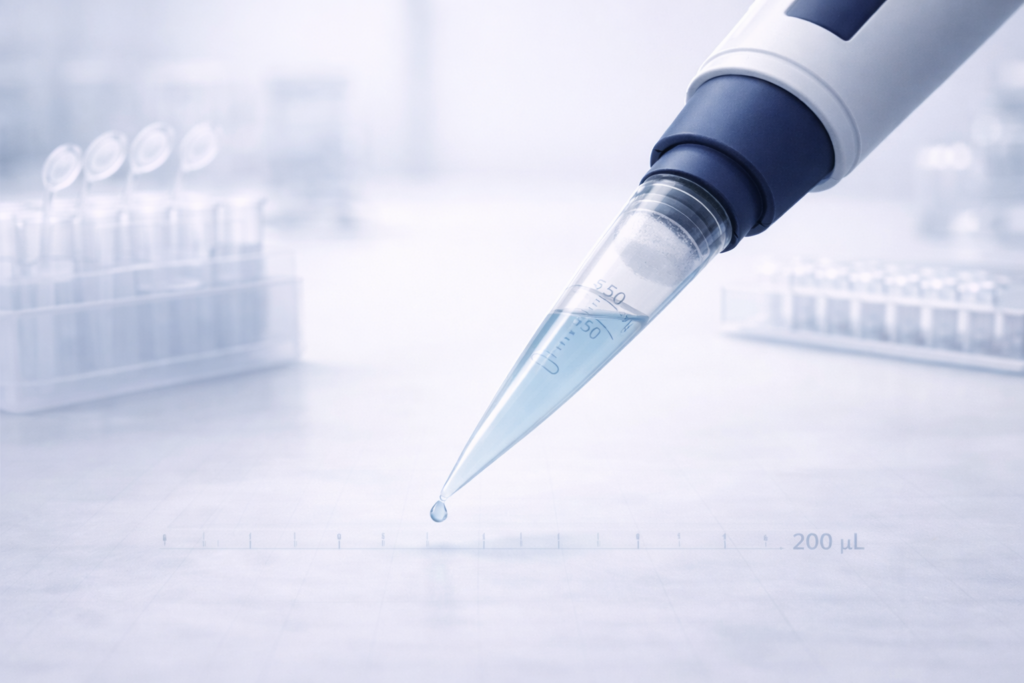
Accurate liquid handling in the 20–200 µL range is a daily task in most laboratories. This volume window is used for PCR setup, ELISA plates, buffer preparation, and routine assays-often hundreds of times per day. While attention usually goes to the pipette, pipette tips play an equally critical role. A poor tip–pipette seal, the wrong tip type, or inconsistent handling can introduce leaks, carryover, or volume bias that adds up quickly.
This guide explains how to select the right 200 µL pipette tips, compare common options, and apply practical techniques to improve accuracy and repeatability. You’ll also find troubleshooting advice for common problems seen at this volume range.
Why 200 µL Pipette Tips Are Critical for Accuracy
The 20–200 µL range sits at the intersection of sensitivity and routine use.
Typical applications
- PCR and qPCR reaction setup
- ELISA sample and reagent dispensing
- Serial dilutions and standards
- Buffer and enzyme handling
Why this range is error-prone
- Small volume deviations have a larger relative impact
- Inconsistent aspiration speed is more noticeable
- Tip deformation or poor sealing shows up faster than at higher volumes
Fit and seal matter
At 200 µL, even a minor air gap between pipette and tip can cause:
- Under-aspiration
- Dripping during dispense
- Poor repeatability between replicates
High-quality pipette tips that seat consistently help stabilize results across runs and users.
Quick Selection Guide for 200 µL Pipette Tips
| Tip type | Best use case | Key advantage | Potential drawbacks |
|---|---|---|---|
| Standard (non-filter) | Buffers, media, general assays | Lowest cost, good accuracy | No aerosol protection |
| Filtered (aerosol barrier) | PCR, RNA/DNA work, infectious samples | Prevents contamination | Higher cost, reduced max volume |
| Sterile | Cell culture, clinical samples | Ready-to-use sterility | Higher price, limited shelf life |
| Low retention | Viscous liquids, enzymes, detergents | Improved dispense accuracy | Slightly more expensive |
| Universal fit | Multi-brand labs | Flexibility across pipettes | Fit may vary by model |
| Brand-specific | Dedicated workflows | Optimized seal and accuracy | Less interchangeable |
| Racked | Clean rooms, high-throughput | Speed and consistency | More storage space |
| Bulk (bagged) | High-volume routine work | Lower cost per tip | Requires manual racking |
Compatibility with P200 Pipettes
Not all pipette tips fit all P200 pipettes equally well.
Universal fit vs optimized fit
- Universal tips aim to work across multiple brands
- Optimized tips are molded for a specific cone angle and sealing depth
A poor fit can lead to:
- Leaks during aspiration
- Tip falling off during dispense
- Inconsistent volumes across channels (for multichannel pipettes)
Simple fit test checklist
- Tip seats firmly with light pressure
- No visible wobble
- Tip does not fall off when tapped gently
- No dripping after aspirating water
- Consistent weight when dispensing repeats
If one of these fails, try a different tip design.
Filtered vs Non-Filtered Tips at 200 µL
When filtered tips are necessary
- PCR and qPCR setup
- RNA/DNA extraction
- Work with infectious or volatile samples
- Shared pipettes across users or labs
Filters protect the pipette shaft from aerosols that can cause cross-contamination.
When filters add cost without benefit
- Simple buffer transfers
- Media preparation
- Non-sensitive colorimetric assays
Common mistakes
- Wet filter: over-aspiration can soak the filter and block airflow
- Maxing out volume: filters reduce usable volume slightly
- Reusing tips: defeats the contamination barrier
Choose filtered pipette tips only where they meaningfully reduce risk.
Improving Accuracy in the 20–200 µL Range
Good technique matters as much as tip selection.
Practical techniques
- Pre-wetting: aspirate and dispense liquid 1–2 times before final draw
- Aspiration speed: slow and steady improves accuracy
- Immersion depth: 2–3 mm below liquid surface is sufficient
- Vertical aspiration: keeps air intake consistent
- Reverse pipetting: helpful for viscous or foamy liquids
- Consistent rhythm: repeat the same motion every time
These habits reduce variability more effectively than changing equipment alone.
Sterility, Purity, and Quality Claims Explained
Many pipette tips list quality attributes. Not all are always needed.
- Sterile: Required for cell culture or clinical samples
- Non-sterile: Fine for most routine chemistry and buffers
- RNase/DNase free: Important for molecular biology
- Pyrogen/endotoxin free: Relevant for cell-based assays
Avoid paying for specifications that don’t match your application.
Common Problems and How to Fix Them
| Problem | Likely cause | Solution | Prevention |
|---|---|---|---|
| Tip leaks or drips | Poor fit or damaged tip | Change tip type | Verify fit before use |
| Inconsistent volumes | Fast aspiration | Slow down plunger | Standardize technique |
| Tip falls off | Loose seating | Press gently but firmly | Use compatible tips |
| Wet filter | Over-aspiration | Reduce volume | Leave headspace |
| Bubbles during dispense | Shallow immersion | Adjust depth | Practice consistent angles |
Frequently Asked Questions
Can I use 200 µL tips on a 1000 µL pipette?
No. They won’t seal correctly and will cause large volume errors.
Are all 200 µL tips universal?
No. “Universal” varies by manufacturer and pipette cone design.
Do I need filtered tips for PCR?
Yes. Filtered pipette tips are strongly recommended for PCR.
Why do tips leak or drip?
Most often due to poor fit, damaged tips, or worn pipette seals.
How often should tips be changed?
After every sample or reagent to prevent carryover and contamination.
Key Takeaways
- The 20–200 µL range is highly sensitive to technique and tip quality
- Tip–pipette fit directly affects accuracy and repeatability
- Filtered tips are essential for PCR and contamination-sensitive work
- Low-retention tips improve results with viscous liquids
- Universal fit does not guarantee optimal sealing
- Pre-wetting and controlled aspiration reduce variability
- Over-aspiration can damage filters and accuracy
- Choose sterility and purity claims based on real needs
- Most pipetting problems are technique-related, not equipment failures