
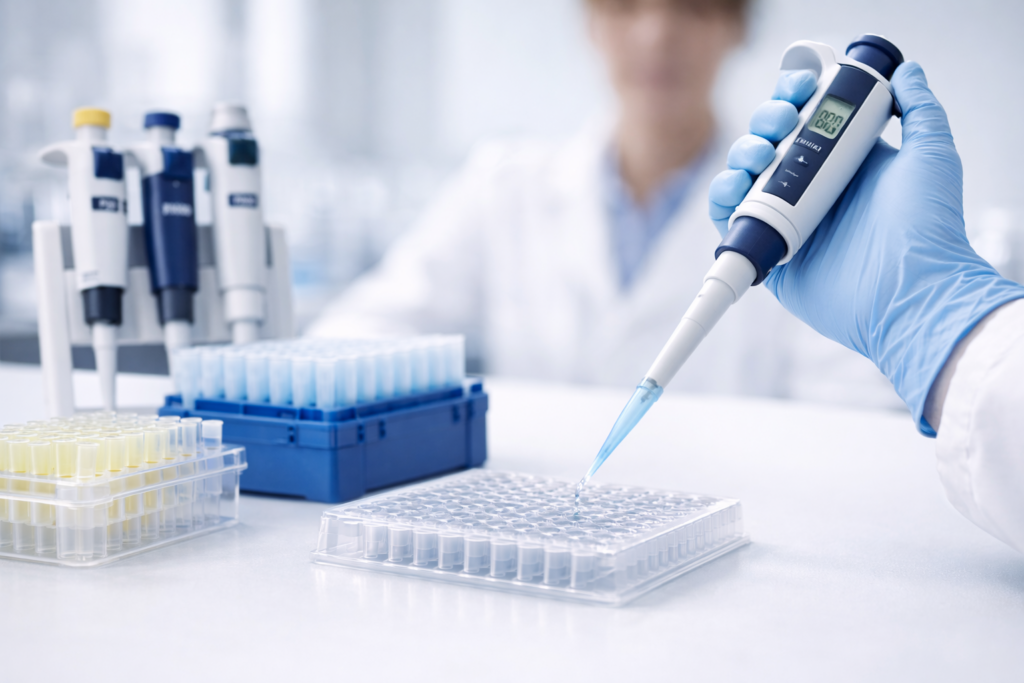
An electronic pipette is a motorized liquid handling instrument that automatically controls piston movement to aspirate and dispense precise liquid volumes. Unlike manual pipettes, which rely on thumb control and operator technique, electronic pipettes use an electric motor and programmable software to eliminate user variability and improve reproducibility. This fundamental difference makes electronic pipettes essential in high-throughput labs, clinical diagnostics, and research environments where consistency and accuracy are non-negotiable. This guide explains how electronic pipettes function, when to invest in them over manual alternatives, and how to select the right model for your laboratory’s needs.
What Is an Electronic Pipette?
An electronic pipette is a piston-driven liquid handling device controlled by a rechargeable battery and microprocessor rather than manual finger pressure. The defining difference from manual pipettes is that the motor automatically moves the piston at programmable speeds, delivering identical volumes across repeated dispenses without operator intervention. Electronic pipettes are used across molecular biology, clinical diagnostics, pharmaceutical development, and analytical chemistry-anywhere precision, speed, and reproducibility are required. Common applications include preparing PCR reactions, filling multi-well plates, serial dilutions, and automated sample preparation for high-throughput screening.
How Electronic Pipettes Work
Motor-Driven Piston Mechanism
Electronic pipettes function via a stepper motor or brushless motor that drives a piston along a precise linear path within a sealed cylinder. When the user presses the activation button, the motor moves the piston upward, creating negative pressure (vacuum) inside the piston chamber. This vacuum draws liquid into the disposable tip via an air-displacement mechanism. The air column between the piston and the liquid isolates the pipette shaft from the sample, preventing cross-contamination. When dispensing, the motor reverses direction, pushing the piston downward and expelling the liquid through the tip.
Software and Preset Modes
The microprocessor coordinates motor speed, stroke distance, and dwell time (pause duration before dispensing). Users typically select preset modes through a digital display:
- Standard mode: Single aspiration and dispense cycle
- Reverse pipetting mode: Pre-aspirates extra liquid to compensate for sample loss in the tip
- Repeat dispense mode: Automatically dispenses the same volume multiple times without re-aspiration
- Mixing mode: Aspirates and dispenses repeatedly to homogenize samples
- Serial dilution mode: Automatically calculates and performs sequential dilutions
These modes adjust motor speed and stroke parameters automatically, reducing the need for manual technique adjustments.
Why Electronic Control Improves Consistency
Electronic pipettes deliver identical piston acceleration, speed, and force across every cycle-eliminating the human variables that affect manual pipetting: hand fatigue, inconsistent thumb pressure, and posture-related errors. Each dispense in repeat mode uses the same motor parameters, ensuring reproducibility within ±2–5% relative standard deviation, typically superior to manual methods. The programmable nature of electronic pipettes also allows laboratories to standardize protocols across multiple users and instruments, reducing operator-to-operator variability that often undermines data reproducibility.
Electronic vs Manual Pipettes: Clear Comparison
| Feature | Manual Pipette | Electronic Pipette |
|---|---|---|
| Accuracy | High (±3–5% at nominal volume) | Superior (±1–3% at nominal volume) |
| Repeatability | Operator-dependent (high variability between users) | Highly consistent (motorized control, minimal user effect) |
| Speed | Moderate (~4–6 cycles/min, user-paced) | Fast (~8–15+ cycles/min, depending on mode) |
| Ergonomics | High repetition strain, thumb/hand fatigue after extended use | Reduced hand strain; minimal button pressure; ideal for high-volume work |
| Cost | $50–$200 per unit | $800–$2,500 per unit |
| Battery Dependence | None | Yes; requires charging every 8–24 hours |
| Training | Minimal; technique-critical | Moderate; requires menu navigation and mode selection |
| Programmability | None | Extensive; preset modes, speed adjustment, protocol storage |
| Maintenance | Simple, few moving parts | More complex; motor, battery, and circuit board require servicing |
| Multi-Channel Availability | Yes (8, 12, 16 channels) | Yes (8, 12, 16, 96+ channels) |
| Best For | Small labs, single-user tasks, budget-conscious settings | High-throughput labs, reproducibility-critical work, multi-user environments |
Electronic pipettes shine in environments requiring repeated dispensing (96-well plate filling, serial dilutions) and where multiple users must produce identical results. Manual pipettes remain valuable in resource-limited labs, for single-transfer tasks, and when portability matters.
Single-Channel vs Multichannel Electronic Pipettes
Electronic pipettes come in two primary configurations based on the number of independent channels (piston-tip pairs):
Single-Channel Electronic Pipettes
A single-channel electronic pipette has one piston and one tip attachment site. Each dispense is independent; the piston cycles once per transfer. Single-channel electronic pipettes are ideal for:
- Trace-level work where cross-contamination is critical
- Variable volumes in a single reaction (adding reagents sequentially to a tube)
- Viscous or foaming samples requiring independent aspiration control
- Small batches where speed from multichannel dispensing offers little advantage
Multichannel Electronic Pipettes
Multichannel pipettes typically feature 8, 12, or 16 independent channels, each with its own piston and motor. All channels dispense simultaneously at identical speeds, making them indispensable for plate-based workflows. A single channel electronic pipette filling a 96-well plate would require 96 individual dispenses; a 12-channel electronic pipette reduces this to 8 dispenses by filling 12 wells per cycle.
Time savings are substantial: filling a 96-well plate with diluent in repeat dispense mode takes ~1 minute with an 8-channel multichannel electronic pipette versus ~15 minutes with manual transfer. Multichannel pipettes also reduce repetitive strain significantly by consolidating hundreds of individual transfers into a single workflow.
When to use multichannel: Plate-based assays, screening campaigns, high-volume sample preparation, and any protocol requiring standardized liquid distribution across multiple wells. When to use single-channel: PCR setups, molecular cloning, trace analysis, and workflows with non-uniform transfer patterns.
Key Advantages of Electronic Pipettes
Reduced User Variability
The motorized piston eliminates differences in hand strength, fatigue, and technique between operators. This standardizes liquid handling across shifts and teams, critical for regulated environments (ISO 17025 accreditation, GLP compliance, clinical labs). A research team using electronic pipettes will produce identical results regardless of who performs the pipetting.
Improved Ergonomics
Manual pipetting requires repetitive thumb pressure for thousands of cycles daily. Studies show that 40% of lab professionals suffer from pipetting-caused disorders, including carpal tunnel syndrome and tendinitis. Electronic pipettes require only light finger pressure to activate the motor, reducing forearm and thumb strain by 60–80%. Lightweight designs and ergonomic handles further minimize repetitive strain injury (RSI) risk during extended use.
Reproducibility in Repetitive Tasks
Repeat dispense mode is transformational for high-throughput work. Once the volume and speed are set, the electronic pipette delivers identical amounts across 50, 100, or even 1,000 dispenses without variation. This is impossible with manual pipettes, where each dispense compounds small errors and operator fatigue.
Advanced Functions
Electronic pipettes offer programmable capabilities unavailable in manual designs:
- Mixing modes that homogenize samples by repeated aspiration-dispense cycles
- Stepper dilution modes that automatically calculate and execute multi-step serial dilutions
- Speed modulation for viscous, foaming, or volatile liquids
- Reverse pipetting to minimize sample loss in low-retention tips
- Protocol memory to store complex workflows for repeated use
Limitations and Trade-Offs
Cost
Electronic pipettes cost $800–$2,500 per unit, compared to $50–$200 for manual models. While cost-per-cycle improves with high-volume use, the initial capital investment is substantial for resource-limited labs. Single-channel manual pipettes remain standard in academic teaching labs and emerging-market settings.
Battery Dependence
Electronic pipettes require regular charging. Lithium-ion batteries typically support 8–24 hours of continuous use before depletion. A dead battery halts work entirely; manual pipettes face no such limitation. Battery life degrades over 2–3 years, requiring replacement ($80–$150 per battery). Laboratories must maintain charging protocols and backup batteries.
Training Requirements
Electronic pipettes require staff training on menu navigation, mode selection, and calibration procedures. Operators must understand when to use reverse pipetting, how to adjust speed for different liquid types, and how to interpret error messages. Manual pipettes require only technique training, reducing onboarding time.
Maintenance and Calibration
Electronic pipettes contain motors, circuit boards, and batteries requiring periodic servicing. Professional calibration is recommended annually per ISO 8655 standards, costing $150–$300 per instrument. Motor or circuit board failures necessitate manufacturer repair. Manual pipettes are inherently simpler and more durable.
Accuracy, Precision & Calibration (ISO 8655)
Accuracy vs Precision: Definitions
- Accuracy measures how close a measurement is to the true value. If you intend to dispense 100 µL and actually dispense 98 µL, you are 2% inaccurate.
- Precision measures reproducibility across multiple measurements. If you dispense 100 µL five times and get 99.8, 100.1, 100.2, 99.9, and 100.0 µL, you are highly precise (standard deviation ~0.15 µL).
Electronic pipettes typically achieve ±1–3% accuracy and ±0.5–2% precision at nominal volumes, compared to ±3–5% accuracy for manual pipettes. This advantage is most pronounced in repeat dispensing, where electronic consistency compounds into significant cumulative accuracy gains.
How Electronics Affect Repeatability
Motorized piston control eliminates the primary source of variability in manual pipetting: operator-dependent aspiration force and speed. In a study comparing operators using the same manual pipette, aspiration force varied by ±30%, causing 5–8% volume deviation. Electronic pipettes reduce this variability to <2% because the motor applies identical force and acceleration each cycle. This is why electronic pipettes are mandatory in clinical diagnostics and pharmaceutical manufacturing.
Calibration Frequency and Best Practices
ISO 8655:2022 (updated April 2022) specifies calibration standards for piston-operated volumetric apparatus. Key recommendations:
- Frequency: Annual calibration for routine lab use; twice-yearly for regulated environments (clinical, pharmaceutical)
- Gravimetric reference method: Pipette multiple aliquots (typically 4 measurements at 10% volume, 4 at 100%, and 4 at 50% nominal volume) into a calibrated balance; compare measured mass to expected volume
- Environmental controls: Calibration must occur at 20 °C ± 2 °C and 45–55% relative humidity per ISO 8655-7
- High-precision balances required: Micro-balances with readability of ±1 µg (six-place balance for volumes <20 µL) per updated ISO 8655 (2022)
- Multichannel validation: Each channel of a multichannel electronic pipette must be tested individually; tip spacing can cause variation between channels
Most manufacturers include software-based calibration routines allowing users to input measured volumes; the electronic pipette’s firmware then adjusts motor parameters. This permits rapid recalibration without returning to a service center.
Pipette Tips & Compatibility
Tip Fit and Sealing
Proper tip sealing is essential for accuracy. Electronic pipettes typically use a friction-fit design; the tip slides onto a conical shaft. Poor fit or worn shafts cause air leakage, reducing aspiration efficiency and delivery volume. Tip manufacturers design tips to fit standard cone angles (typically 10 mm for standard tips), but universal-fit tips now accommodate multiple brands. Verify compatibility with your pipette model; mismatched tips introduce 5–10% volume errors.
Filtered vs Non-Filtered Tips
- Standard tips: Polypropylene, non-sterile or sterile. Suitable for routine liquid handling where contamination risk is low.
- Filtered (aerosol barrier) tips: Incorporate a hydrophobic barrier membrane blocking aerosols and droplets from entering the pipette shaft. Essential for PCR, RNA/DNA work, and cell culture to prevent cross-contamination and pipette shaft fouling. Slightly higher cost (~$0.05–0.10 per tip) justified by contamination prevention.
Low-Retention Tips
Low-retention tips feature hydrophobic polypropylene that reduces the amount of sample adhering to the inner wall after dispensing. For aqueous solutions (water, buffers), standard and low-retention tips perform similarly. For viscous liquids, oils, or proteins, low-retention tips improve recovery by 5–15%, reducing sample loss and improving accuracy. They are cost-justified for expensive reagents or when working with minimal sample volumes.
Contamination Control Considerations
- Use sterile, filtered tips for PCR, qPCR, and molecular work
- Pre-wet tips with sample before aspirating trace metals, proteins, or hormones (reduces surface absorption)
- Discard first and last dispense in repeat mode to account for tip dead volume and accumulated mechanical drift
- Change tips between samples to prevent cross-contamination, even in high-throughput work
- Store tips in sealed, dust-free boxes and verify desiccant sachets remain dry
Best Practices for Using Electronic Pipettes
Setup and Volume Selection
- Power on and calibrate: Most electronic pipettes auto-calibrate upon startup; allow 30 seconds for motor initialization
- Select volume: Use the digital display or rotary dial to set the target volume. Allow 2–5 minutes after adjusting volume for internal springs to stabilize under new tension; accuracy may be compromised if you pipette immediately after volume changes
- Stay within the pipetting range: Electronic pipettes are most accurate between 35% and 100% of their nominal volume. Pipetting below 35% introduces proportionally larger errors. Use a smaller-volume pipette for sub-range work (e.g., use a P20 instead of a P1000 to dispense 5 µL)
- Verify tip attachment: Seat tips firmly to ensure an airtight seal; loose tips cause volume loss
Forward vs Reverse Pipetting
- Forward pipetting (standard mode): Aspirate the target volume, dispense entirely. Suitable for aqueous solutions and most routine work.
- Reverse pipetting (blow-out mode): Aspirate more than the target volume (typically 110–120%), dispense to the first stop, then discard the residual volume. Recommended for viscous, foaming, volatile, or low surface tension liquids (oils, organic solvents, protein solutions). Reverse pipetting compensates for liquid that adheres to the tip’s inner wall and prevents sample loss.
Speed Settings and Dwell Time
- Fast aspiration/slow dispense: Minimizes air bubble formation; suitable for aqueous solutions
- Slow aspiration/fast dispense: Reduces foaming in viscous or protein-rich samples
- Dwell time: Brief pause (0.5–2 seconds) after aspiration before dispensing allows samples to settle and air bubbles to escape. Increases accuracy by 1–2% for sensitive applications
- High viscosity adjustment: Reduce speed by 50% for oils, syrups, or cell suspensions to allow adequate volume intake
Temperature and Evaporation Effects
Temperature is one of the most significant uncontrolled variables in liquid handling:
- Thermal expansion: If a pipette is calibrated at 20 °C but used with a 4 °C sample (e.g., from a refrigerator), the air gap expands as the pipette warms, reducing the effective volume aspirated by 2–5%. Conversely, warm samples (37 °C, cell culture) cause contraction, leading to over-aspiration.
- Evaporation: Low humidity (<30%) increases evaporation inside the pipette tip, particularly for small volumes. Drier labs show 3–8% lower delivery volumes than humid labs. To mitigate: work near a humidity-controlled environment, re-humidify tips in a wet chamber before extended use, or pipette volatile samples last (after the tip has equilibrated with vapors)
- Best practice: Allow samples and pipettes to equilibrate to room temperature (20–25 °C) before critical assays. For trace work, maintain laboratory humidity at 45–55% if possible
Pipette Tips & Compatibility
Common Applications for Electronic Pipettes
PCR Setup
- Use single-channel electronic pipette with filtered tips
- Employ reverse pipetting mode for enzyme master mixes
- Slow aspiration speed to prevent bubble formation in small volumes
96-Well Plate Filling (Serial Dilution)
- Use 12-channel multichannel electronic pipette
- Fill diluent with repeat dispense mode (10 µL pre- and post-dispense to avoid edge effects)
- Use new tips per row to prevent cross-contamination
- Employ 5-, 10-, or 100-fold dilution presets if available
Sample Preparation (Trace Analysis)
- Use low-retention, sterile, filtered tips
- Calibrate electronic pipette for the specific sample matrix (density/viscosity correction via ISO 8655 alternative methods)
- Pre-wet tips with sample to avoid absorption losses
High-Throughput Screening
- Use 96-channel pipetting station (automated liquid handler) or 12-channel multichannel pipette
- Leverage repeat dispense mode to minimize manual steps
- Validate batch accuracy by spot-checking 3–5 wells per plate
Common Problems & Troubleshooting
| Symptom | Likely Cause | Quick Fix | When to Service |
|---|---|---|---|
| Volume consistently low (under-delivery by >3%) | Worn piston seals, tip leak, or motor calibration drift | Check tip fit; inspect piston for visible wear; recalibrate per manual | If problem persists after recalibration and tip replacement |
| Volume inconsistent between dispenses (high CV%) | Air bubbles in tip, evaporation in dry environment, or tip dead volume not compensated | Use reverse pipetting; prewet tip with sample; work in humidity-controlled area | If CV remains >2% after technique adjustment |
| “ERR” or motor error displayed | Battery low or motor control circuit fault | Recharge battery; press reset button; power cycle | If error recurs after recharging and restart |
| Pipette won’t power on | Dead battery or battery not fully seated | Charge battery for 2–3 hours; reseat battery firmly | Replace battery if problem persists (typically after 2–3 years) |
| Tip ejection difficult or stuck | Dried sample in tip seat shaft or shaft corrosion | Wipe shaft with damp cloth; soak in 70% ethanol if necessary; dry thoroughly | Contact manufacturer if mechanical damage suspected |
| Volume high after temperature change | Thermal equilibration lag (pipette still warm, cool sample aspirated) | Allow pipette and sample to reach same temperature (10–15 min at room temp) | Not a service issue; normal behavior |
| Whistle or abnormal noise during aspiration | Air leak in tip or piston chamber | Verify tip is fully seated; inspect O-rings for cracks | Schedule annual service if noise persists despite repair attempts |
| Battery drains rapidly | Battery age or motor overload (e.g., excessive high-viscosity dispensing) | Calibrate battery charge cycles per manual; reduce dispensing speed | Replace battery (~$100–150); consider full service if motor overheating |
FAQ
1) What are electronic pipettes used for?
Electronic pipettes are used for precise, repeatable liquid transfer in any laboratory performing high-volume or accuracy-critical work. Common applications include:
- Preparing PCR reactions and qPCR assays
- Filling multi-well plates in drug screening and immunoassays
- Performing serial dilutions in microbiology
- Transferring samples in clinical diagnostics (blood banking, microbiology)
- Preparing samples for mass spectrometry or HPLC analysis
- Automating repetitive workflows in genomics and proteomics
Their primary value is reducing operator variability and improving reproducibility when the same measurement must be repeated hundreds or thousands of times.
2) Are electronic pipettes more accurate than manual?
Yes, electronic pipettes are more accurate than manual pipettes when used correctly. Electronic pipettes typically deliver ±1–3% accuracy at nominal volumes versus ±3–5% for manual pipettes. The motorized piston eliminates operator-dependent variables (hand strength, fatigue, inconsistent technique), which are the primary sources of error in manual pipetting. However, electronic pipettes are not inherently immune to errors-environmental factors (temperature, humidity), improper tip fit, and operator technique still matter. In controlled conditions (20 °C, 45–55% humidity, correct tip selection), electronic pipettes are significantly more precise and reproducible.
3) Are electronic pipettes worth the money?
Electronic pipettes offer compelling ROI in high-throughput settings but may not be justified for small, single-user labs. Consider electronic pipettes if:
- Your lab performs >50 dispensing steps per day, >3 days/week (RSI prevention value ~$5,000/year per technician in reduced strain injury risk)
- Multiple operators must produce identical results (regulatory compliance, reproducibility requirements)
- You fill multi-well plates or perform serial dilutions regularly (time savings of 2–4 hours/week per technician)
- You work with expensive reagents where the 2–3% accuracy improvement saves $500+ annually
For small labs, budget-conscious settings, or occasional single-transfer work, manual pipettes remain practical and cost-effective.
4) Single-channel or multichannel electronic pipette – which should I choose?
Choose single-channel electronic pipette if:
- You work with individual tubes or non-plate formats
- Sample volumes vary within a single reaction (e.g., sequential reagent addition)
- Cross-contamination risk is critical (trace work, high-value samples)
- You pipette small quantities of different reagents
Choose multichannel electronic pipette if:
- You routinely work with 96-well, 384-well, or other plate formats
- You fill multiple identical volumes across a plate
- You prioritize speed (8–12 channels are 8–12 times faster per dispense cycle than single-channel)
- Your lab performs high-throughput assays or cell-based screening
Practical tip: Many labs maintain both. Single-channel for versatility, multichannel for plate-based workflows. The cost difference (~$500–800) is quickly recouped through time savings and ergonomic benefit.
Key Takeaways
- Electronic pipettes use motorized pistons controlled by microprocessors to deliver precise, repeatable liquid volumes, eliminating operator variability that defines manual pipetting.
- Accuracy and consistency are superior to manual pipettes (±1–3% vs ±3–5%), particularly valuable in high-throughput, regulated, or reproducibility-critical work.
- Ergonomic benefit is substantial: repeated use causes 40% of lab professionals to suffer pipetting-related disorders; electronic pipettes reduce strain by 60–80% and are essential for preventing repetitive strain injuries.
- Multichannel electronic pipettes save 8–12 times as much time per cycle as single-channel models when working with plate-based assays, making them a worthwhile investment for high-volume laboratories.
- Calibration per ISO 8655 is essential; annual recalibration ensures accuracy within specification and detects equipment drift early.
- Reverse pipetting, tip selection (filtered, low-retention), and environmental control (temperature, humidity) are practical techniques that significantly improve accuracy and reduce errors.
- Cost trade-off exists: electronic pipettes ($800–$2,500) are costlier than manual ($50–$200) but deliver ROI through reduced strain, improved accuracy, and time savings in high-volume settings.
- Battery maintenance is critical; rechargeable batteries degrade over 2–3 years and require replacement (~$100–$150) as a consumable.
- Training and maintenance requirements are moderate; staff must learn menu navigation and calibration procedures, and annual professional service is recommended.
- Common problems (low volume, inconsistent delivery, battery failure, tip jamming) are usually resolvable through recalibration, environmental adjustment, or battery replacement; persistent issues warrant professional service.