
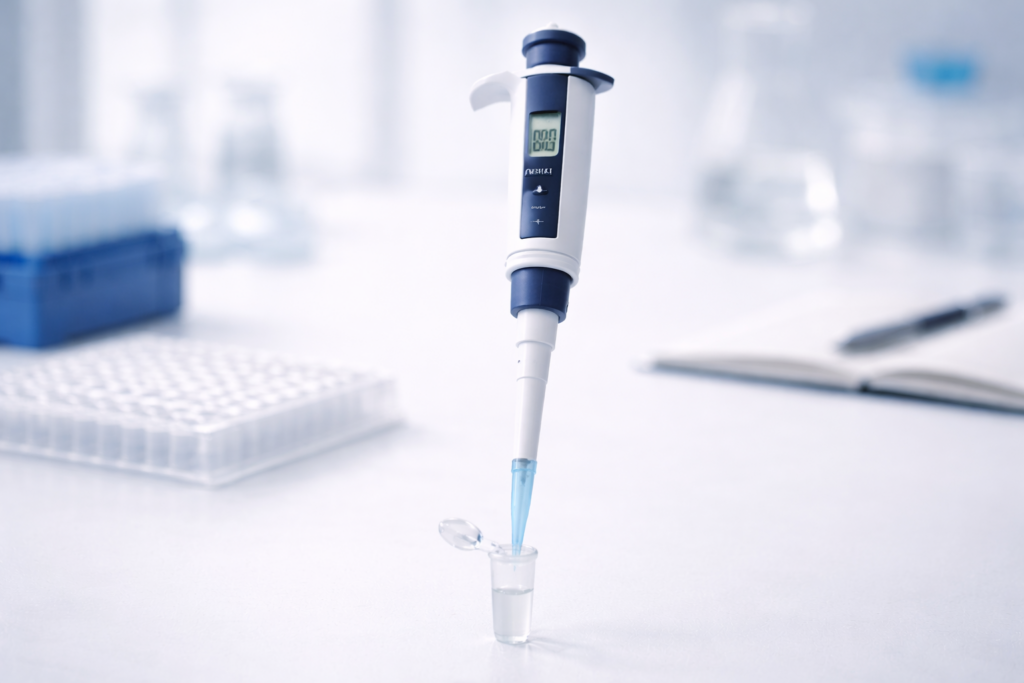
A single channel electronic pipette is a motorized liquid-handling device that automatically controls piston movement to deliver precise, repeatable volumes of liquid from 0.1 µL to 10,000 µL into individual sample tubes, PCR strips, or other containers. Unlike manual pipettes that rely entirely on thumb force, electronic pipettes reduce operator variability by using a stepper motor to maintain consistent aspiration and dispensing speed.
This guide is designed for lab technicians, researchers, students, and procurement managers who need to understand how single channel electronic pipettes work, when they justify investment over manual alternatives, and how to choose the right model for your workflow. Whether you’re setting up a new lab, upgrading your liquid-handling capabilities, or troubleshooting pipetting errors, this article covers the technical and practical considerations that affect accuracy, reproducibility, and long-term cost of ownership.
What Is a Single-Channel Electronic Pipette?
A single channel electronic pipette is a piston-operated device that dispenses one sample at a time with motorized control. The term “electronic” refers to the integrated stepper motor and microprocessor that governs piston speed and volume, eliminating the inconsistency inherent in manual thumb-operated models. Electronic single channel pipettes are equipped with rechargeable batteries, programmable pipetting modes, and on-board data logging-features that make them ideal for high-precision, high-volume, or repetitive work.
Common lab applications include PCR master mix preparation, standard curve generation for quantitative assays (qPCR, HPLC), serial dilutions, immunoassays, and cell culture work. The single channel design is most suitable for workflows involving irregular sample patterns, small numbers of replicates per tube, or applications where operator flexibility is critical.
How It Works (Simple but Accurate)
Electronic pipettes operate via a closed feedback system:
- Stepper Motor Control: When you press the aspirate button, a microprocessor signals a stepper motor to move the piston down at a user-set speed. Each motor step is discrete and calibrated, so the piston travels the exact distance needed to displace the programmed volume.
- Programmable Speed: Unlike manual pipettes (where speed depends on thumb pressure), electronic single channel models allow you to set aspiration/dispensing speed from slow (reduces aeration and sample frothing) to fast (for aqueous solutions). This consistency is why electronic pipettes produce more reproducible results across many replicates.
- Reduced User Variability: Because the motor does the work, differences in hand strength, fatigue, and technique have minimal impact on volume accuracy. A researcher performing 100 pipetting steps will dispense the same volume in the final step as in the first.
- What Still Matters: Technique remains important. The pipette tip must be submerged to the correct depth, the pipette held vertically, and the tip replaced after each draw to avoid cross-contamination. Pre-wetting, reverse pipetting, and proper storage of channel pipettes all still apply.
Key Benefits (When Electronic Single Makes Sense)
Repeatability and Precision in Repetitive Tasks
Electronic single channel pipettes excel when you need identical volumes across dozens or hundreds of samples. In serial dilutions, standard curve preparation, or master mix distribution, the motor eliminates cumulative thumb fatigue that can cause drift in the final replicates. This is especially valuable in qPCR, where precision at low volumes (<5 µL) directly impacts cycle threshold variability.
Ergonomics and Reduced Hand Strain
Manual pipetting over many hours causes repetitive strain injury (RSI), thumb fatigue, and inconsistent technique. Electronic pipettes require minimal thumb force-often just a light button press-making them ideal for high-throughput prep work, teaching labs, and operators with hand mobility restrictions.
Built-In Pipetting Modes
Many electronic single channel models include:
- Multi-Dispense (Repeat): Aspirate once, dispense into multiple wells with pre- and post-dispense waste correction.
- Mixing: Aspirate, dispense, and automatically cycle up and down in-tip (eliminates vortexing for some applications).
- Reverse Pipetting: Automatically overdraw to protect viscous or volatile liquids.
- Serial Dilution Mode: Automate sequential transfer and dilution steps.
These modes save time and reduce setup errors.
Practical Example: PCR Prep
Distributing 98 µL of PCR master mix into 48 tubes by manual pipette takes ~12 minutes and introduces variability. Using electronic single channel multi-dispense mode: aspirate 98 µL, set to dispense into 48 destinations, press start. The pipette automatically refills after each well and adjusts for dead volume. Time: ~3 minutes. Consistency: ±0.5% across all wells.
Limitations and Trade-Offs
Cost and Budgetary Reality
Electronic pipettes cost 3–5× more than manual single-channel models ($1,500–$4,000 versus $200–$600). For labs with occasional pipetting or single-operator use, manual pipettes often remain the practical choice. ROI improves with sample throughput and data-sensitivity requirements.
Battery and Charging Downtime
Most electronic pipettes use rechargeable NiMH batteries (4.8 V, 500 mAh). Charging time is 4–12 hours depending on the model. Depleted batteries mid-run require fallback to manual pipettes. Labs running 24/7 should maintain 2–3 units and stagger charging, or invest in charging carousels that support multiple pipettes simultaneously.
Maintenance and Servicing Complexity
Electronic pipettes contain stepper motors, seals, and electronic components that degrade over time. Regular maintenance includes:
- Cleaning the piston shaft weekly (per manufacturer instructions).
- Lubrication cycles every 6 months.
- Battery replacement every 2–3 years.
- Factory recalibration annually or after 2,000+ hours of use.
In contrast, manual pipettes need occasional O-ring replacement and basic cleaning. Repair costs for electronic pipettes are higher ($300–$800).
Where Manual Pipettes Still Win
- Single-use experiments: One-off assays benefit little from electronic precision.
- Field or mobile labs: No reliable power or charging infrastructure.
- Cost-prohibitive labs: Limited budgets.
- Large-volume work (>1 mL): Manual pipettes are simple and effective; ergonomic burden is lower.
Single Channel vs Multichannel (Channel Pipettes) – Quick Decision
| Workflow Characteristic | Best Choice | Why | Tip Format |
|---|---|---|---|
| Individual tubes, PCR strips, irregular spacing | Single-Channel | Flexibility; no tip misalignment issues; easier on budget | Standard or filtered |
| 96-/384-well plate, repetitive row/column fills | Multichannel (8- or 12-channel) | High throughput; <10% time per sample vs. single-channel | Sterile filter tips recommended |
| Mixed: some plates, some tubes | Single-Channel + occasional multichannel | Dual-instrument approach balances flexibility and speed | Both |
| Large numbers of identical samples | Electronic single-channel with multi-dispense | Automation within single-channel framework | Low-retention tips |
| Precision qPCR standard curves | Electronic single-channel | Accuracy at micro-volumes (1–10 µL) is critical | Calibrated low-retention |
When Multichannel Outperforms Single-Channel
Multichannel (or “channel”) pipettes (8, 12, or 16 tips in parallel) dramatically reduce pipetting steps when filling microtiter plates. For 96-well assays:
- Manual single-channel: 96 individual pipetting steps × 5–10 seconds = 8–16 minutes.
- 12-channel pipette: 8 pipetting steps (fill 8 rows simultaneously) = 1–2 minutes.
However, channel pipettes have drawbacks:
- Tip calibration: All 12 tips must dispense equally; ISO 8655 requires testing each tip individually (360 gravimetric measurements for full UKAS accreditation).
- Tip cost: Multichannel tips are costlier per unit and require matching sets.
- Inflexibility: Cannot easily switch between different volumes or tube spacing without reconfiguration or multiple instrument sets.
Why Single-Channel Remains Preferred for Precision Work
- Flexibility: One pipette handles 0.5 µL to 1,000 µL (depending on model); multichannel range is typically 20–1,200 µL.
- Lower calibration burden: Each single channel electronic pipette requires fewer verification steps (±5% per volume vs. ±5% × 12 channels).
- Cost per sample (for low-throughput work): Single pipette amortized over many experiments can be cheaper than purchasing multiple multichannel units.
Accuracy, Precision & Calibration (ISO 8655)
Accuracy vs. Precision: Quick Definitions
Accuracy = how close your measured volume is to the target volume.
Precision = how consistent repeated measurements are (tightness of distribution).
An electronic pipette might deliver 100 µL ±2 µL (accuracy within 2%) with standard deviation of ±0.8 µL across 10 replicates (high precision). A poorly-maintained manual pipette might deliver 100 ± 4 µL with ±2 µL SD (lower accuracy and precision).
ISO 8655:2022 Overview
ISO 8655 is the international standard for calibration and testing of piston-operated volumetric apparatus (including electronic single channel and channel pipettes, burettes, and dispensers). Key points:
- Gravimetric reference method (ISO 8655-6): Pipette distilled water into pre-weighed containers; measure dispensed mass using calibrated balances. This is the gold standard and legally defensible.
- Testing at multiple volumes: Modern ISO 8655:2022 requires verification at 10%, 50%, and 100% of nominal volume-not just the maximum, as in older standards.
- Stricter balance requirements: Six-place balances for <20 µL pipettes; five-place for 20–199 µL. This tightens measurement uncertainty.
- Environmental controls: Calibration labs must document temperature (±2°C), humidity, and water density to achieve traceable uncertainty budgets.
Simple Verification Routine for Users (Non-Accredited)
Even without sending pipettes to an external lab, you can perform intermediate checks:
Daily (5 minutes):
- Pipette distilled water or buffer three times at 50% of nominal volume into a small beaker.
- Visual check: Does the volume look approximately correct? (Rough volume-to-height ratio.)
- Repeat at 100% and 10% nominal volumes.
- Note any dramatic change (>5% difference from last week).
Weekly (15 minutes):
- Pipette 10 replicates of mid-range volume (e.g., 50 µL from a 100 µL pipette) into pre-weighed vials.
- Weigh on your lab balance (not calibrated for ISO, but consistent).
- Calculate mean volume and coefficient of variation (CV = SD / mean × 100%).
- If CV > 3%, clean and re-check the seal and O-rings.
After Drop or Visible Damage:
- Perform the weekly routine immediately.
- If accuracy/precision degrades >5%, service the pipette before critical experiments.
Annual (Send to Accredited Lab):
- For GLP/GMP compliance or regulatory labs, send to a UKAS (UK) or ISO 17025-accredited calibration service.
- Cost: $50–$200 per pipette.
- Turnover time: 5–10 business days.
- You receive a formal certificate with measured error at 10%, 50%, 100% and conformity statement.
Pipette Tips and Compatibility
Tip Fit and Sealing
The pipette tip is not a passive component-it is part of the instrument system. Per ISO 8655:2022, pipettes and tips are treated as one measurement system. A loose-fitting or defective tip can cause:
- Liquid leakage during aspiration or dispensing.
- Air entry, leading to bubble formation and under-delivery.
- Cross-contamination of subsequent samples.
Best Practice: Use tips recommended or supplied by the pipette manufacturer for your single channel electronic or manual pipette. Universal-fit tips are available but carry higher risk of inconsistent sealing.
Filtered Tips vs. Non-Filtered
Filtered (Barrier) Tips:
- Contain a hydrophobic membrane that blocks aerosols, vapors, and back-contamination.
- Protect the pipette shaft from liquid ingress (especially important for electronic pipettes to avoid motor damage).
- Include additional benefits: DNase-free, RNase-free, pyrogen-free certifications for sensitive molecular work.
- Best for: PCR, RT-PCR, immunoassays, clinical assays, and any sterile or amplification-dependent work.
- Cost: 2–3× more than standard tips.
Non-Filtered (Standard) Tips:
- Cheaper; adequate for routine liquid handling (buffer transfers, dilutions, sample loading).
- Suitable for non-sterile applications.
- Offer no back-contamination protection.
Low-Retention Tips
Low-retention tips are made from modified polypropylene blends (hydrophobic treatment, not silicone coating) that reduce adhesion of viscous or low-surface-tension liquids to the inner wall.
When to Use:
- Viscous solutions (glycerol, PCR master mix, honey-like samples): Ordinary tips retain 0.5–2 µL; low-retention tips reduce this to <0.1 µL.
- Foaming or low-surface-tension liquids (organic solvents, detergent solutions): Standard tips wet and spread; low-retention tips remain hydrophobic.
- Expensive reagents (DNA, antibodies, enzymes): Every microliter counts. Low-retention tips maximize recovery.
Example: Preparing a qPCR standard from a 100 µL extract requires 8 serial dilutions. Using standard tips, you lose ~1 µL per step (8 µL total = 8% of original stock). Low-retention tips reduce loss to <0.1 µL per step (0.8 µL total = <1%). Over 10 replicates, the cost difference is negligible compared to reagent savings.
Contamination Control Best Practices
- Filtered tips are mandatory for molecular biology work (PCR, qPCR, RNA work) and clinical assays. The filter prevents aerosol-borne contamination that would render results invalid.
- One tip per sample (never reuse). Each new aspiration requires a fresh tip.
- Pre-wet tips (for viscous liquids) by drawing and expelling the liquid 2–5 times before the actual sample transfer.
- Vertical pipetting minimizes liquid external to the tip; horizontal tilting causes droplets on the outside to be transferred undetected.
Best Practices (Step-by-Step)
Forward Pipetting (Aqueous Solutions, Buffers, Dilute Samples)
- Insert tip firmly onto the pipette shaft until you hear or feel a click.
- Set volume on the digital display or mechanical scale.
- Prime the tip (optional, but recommended for accuracy): Draw up and expel the liquid being pipetted 2 times to equilibrate the tip surface.
- Lower the pipette vertically into the source container.
- Immerse the tip 2–3 mm below the liquid surface (not too deep; depth depends on tip size and manufacturer guidance).
- Press the aspirate button smoothly to the first stop; release slowly. The vacuum draws liquid up.
- Withdraw the tip vertically and wipe any external liquid on a lint-free wipe.
- Position at the destination vessel vertically.
- Press the dispensing button to the first stop (for forward pipetting, this fully expels programmed volume).
- Optional: Touch-off (dab the tip inside the destination to remove surface drops).
- Eject and discard the tip.
Common mistake: Pressing the button too fast or releasing it abruptly causes suction/back-pressure and introduces air bubbles. Smooth, controlled motion is critical.
Reverse Pipetting (Viscous Liquids, Volatile Samples, Small Volumes <5 µL)
Reverse pipetting overdraws additional liquid (a buffer volume) into the tip before dispensing. On dispensing, only the programmed volume is expelled; the extra buffer remains in the tip. This protects against:
- Evaporation (volatile samples).
- Dripping (high viscosity).
- Inaccuracy (very small volumes where surface tension is significant).
Steps:
- Insert and set volume as above.
- Press the aspirate button to the second stop (typically marked on the plunger). This draws the programmed volume plus a buffer overfill (e.g., if you select 5 µL, it draws 6–7 µL).
- Withdraw from source.
- Position at destination.
- Press dispensing button only to the first stop (expels only the 5 µL you programmed).
- Withdraw without blowing out the remaining buffer in the tip.
- Eject the tip with the buffer still inside.
When to use: qPCR standard curves, enzyme solutions, PCR master mix, volatile organic solvents.
Speed Settings and Dwell Time
Aspiration/Dispensing Speed (slow, medium, fast):
- Slow (1–3 µL/s): Viscous liquids, small volumes, foam-prone samples. Minimizes bubble formation.
- Medium (5–10 µL/s): Most routine work (buffers, dilutions, cell suspensions).
- Fast (15+ µL/s): Large volumes (>500 µL), robust aqueous solutions, high-throughput plate filling.
Dwell Time (pause between aspiration and dispensing):
- Brief delays (0.1–0.5 s) allow pressure equilibration and tip saturation.
- Useful for reverse pipetting to ensure full overfill.
- For routine forward pipetting, dwell time is rarely necessary.
Pre-Wetting for Viscous Samples
Before dispensing PCR master mix, glycerol solutions, or any liquid with protein or detergent:
- Aspirate full tip volume from the source.
- Dispense into waste (to saturate the tip surface).
- Repeat 2–4 times (until no air bubbles form during aspiration).
- Perform the actual sample transfer (now the tip surface is equilibrated and measurement is accurate).
This step reduces systematic underdelivery by 1–3%, which translates to meaningful precision in qPCR.
Temperature and Evaporation for Small Volumes
- Work in cool environments (18–24°C) when pipetting <10 µL volumes. Ambient heat speeds evaporation, especially for volatile solvents.
- Keep source containers covered (use caps or Parafilm) between pipetting steps.
- Work quickly for serial dilutions; don’t leave tips exposed to air for >2 minutes between transfer and final destination.
- Use reverse pipetting for volatile samples to minimize dead air space in the tip.
Troubleshooting (Must Include a Table)
| Symptom | Likely Cause | Quick Fix | When to Service |
|---|---|---|---|
| Volumes drift lower over repeated uses | Worn seal, piston scoring, or calibration loss | Recalibrate; clean piston; check O-ring. | If CV >5% after cleaning, send for factory service. |
| Air bubbles form during aspiration | Tilted pipette, tip too shallow, slow release, or damaged tip | Hold vertical; submerge 2–3 mm; release plunger smoothly. Replace tip and try again. | If bubbles persist with new tip, inspect piston seal for cracks. |
| Liquid drips after dispensing | Viscous liquid; tip too far from surface; poor seal. | Use reverse pipetting; position tip closer to destination; inspect tip fit. | If O-ring is damaged, replace it. |
| Inconsistent aspiration (“stuttering” sound) | Air leak in tip or tip shaft; low battery (electronic pipettes). | Replace tip; check battery charge level; clean the connection point. | Replace battery or have motor inspected if non-electronic. |
| Dispense volume too high or too low | Calibration drift; improper immersion depth; pre-wet not performed. | Perform daily verification; use correct immersion depth per manual; pre-wet viscous liquids 3–5×. | Yearly calibration recommended; if out of spec, factory service. |
| Motor doesn’t respond (electronic pipettes only) | Depleted or faulty battery. | Charge for 30 min–4 hr (depending on charger). If no response after charging, replace battery. | If battery replacement doesn’t work, motor may be damaged-send for repair. |
| Button sticks or responds slowly (electronic pipettes) | Residue buildup on button; battery low. | Clean with damp cloth; ensure full charge. | Disassemble and clean mechanical linkage (or send for service). |
| Tip ejects without force (electronic pipettes) | Spring or ejector mechanism worn. | Verify ejection speed setting; manually inspect spring. | Replace eject spring or send to service. |
| Digital display blank (electronic pipettes) | Battery depleted during storage; display failure. | Charge immediately. If no display after 30 min charging, display may be damaged. | Contact manufacturer; display replacement often requires factory service. |
FAQ
What is an electronic pipette?
An electronic pipette is a motorized liquid-handling device that uses a stepper motor and microprocessor to control piston movement, delivering accurate and repeatable volumes. Unlike manual pipettes, which rely on thumb pressure, electronic pipettes reduce human variability and offer programmable modes (multi-dispense, mixing, reverse pipetting) for complex workflows. They are ideal for high-precision, high-throughput, and repetitive laboratory tasks.
How do electronic pipettes differ from manual pipettes?
Electronic pipettes use motors for consistent aspiration/dispensing speed, eliminating fatigue-related drift and offering programmable pipetting modes. Manual pipettes depend entirely on operator hand strength and consistency, making them cheaper and simpler but less precise for high-volume or critical work. Electronic pipettes cost 3–5× more and require battery maintenance, but deliver superior reproducibility and ergonomic benefits for long workflows.
Are electronic pipettes worth it for routine lab work?
Yes, if your lab routinely performs:
- Serial dilutions or standard curves (qPCR, HPLC, ELISA).
- Repetitive master mix distribution (PCR, next-gen sequencing prep).
- High-sensitivity assays where ±1–2% volume error is unacceptable.
- Extended pipetting sessions (>30 min/day) where RSI is a concern.
For low-frequency, non-critical pipetting, manual pipettes remain cost-effective.
Should I choose single-channel or multichannel?
Single-channel is better for:
- Individual tubes, PCR strips, or irregular sample spacing.
- Flexibility across a wide volume range (0.5–10,000 µL).
- Precision-critical work (small volumes, serial dilutions).
- Lower calibration burden (fewer tips to test).
Multichannel (8, 12, or 16-tip) is better for:
- 96-well microplates or routine high-throughput fills.
- Significantly faster throughput (16 samples per dispense vs. 1 per single-channel).
- Labs with high-volume plate-based assays (immunoassays, screening).
Many labs use both: single-channel for flexibility, multichannel for plates.
Key Takeaways
- Single channel electronic pipettes reduce operator variability through motorized piston control, improving precision in repetitive tasks and reducing ergonomic strain.
- Electronic single channel pipettes offer programmable modes (multi-dispense, reverse pipetting, mixing) that accelerate workflows and improve consistency.
- Channel pipettes (multichannel) excel for microplate workflows, but single-channel pipettes remain superior for flexibility, irregular sample patterns, and precision at micro-volumes.
- ISO 8655:2022 calibration ensures accuracy and regulatory compliance; annual external calibration and weekly intermediate checks are best practice for critical labs.
- Pipette tips (filtered, low-retention, standard) are part of the measurement system; match them to your application and pipette brand to avoid leakage and contamination.
- Forward and reverse pipetting techniques, proper immersion depth, and pre-wetting are essential for accuracy, especially with viscous or volatile liquids.
- Electronic pipettes require battery maintenance, cost 3–5× more than manual models, and demand regular servicing; they are justified by improved precision, throughput, and ergonomics in high-volume labs.
- Multi-dispense mode on electronic single channel pipettes can reduce pipetting steps by 90% when distributing uniform volumes into multiple destinations.
- Common troubleshooting (bubbles, dripping, inconsistent volumes) is often resolved by technique adjustment, tip replacement, or O-ring inspection before sending for service.
- Choose single channel for research, quality control, and academic labs where flexibility and precision matter; choose multichannel (or robots) only for high-throughput, routine, plate-based assays.