
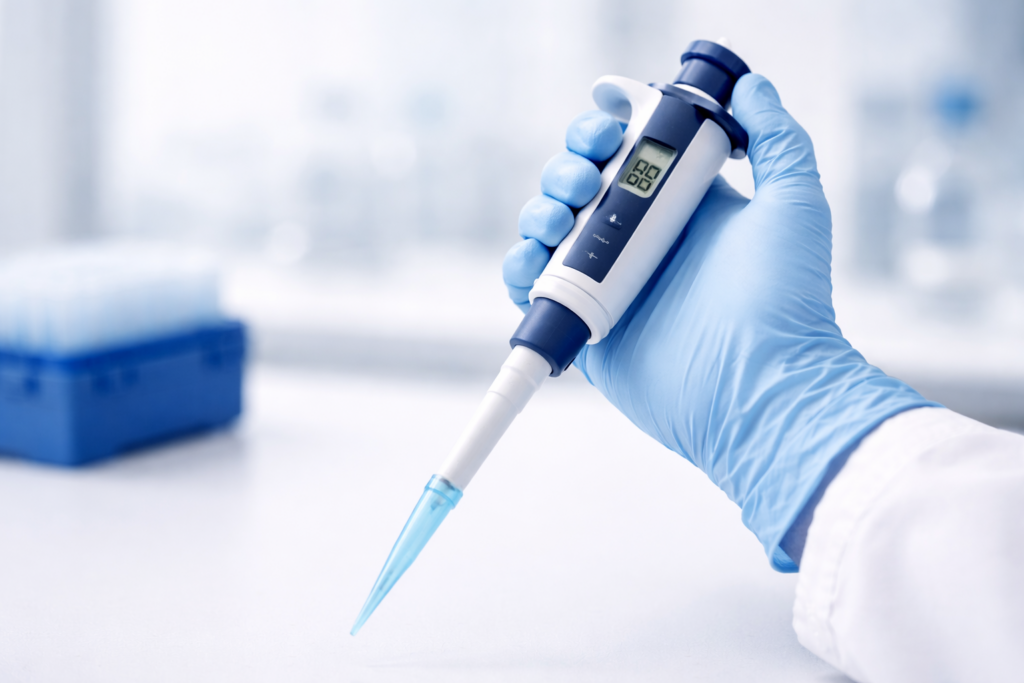
An adjustable volume pipette is a handheld laboratory instrument that draws and dispenses precise, variable volumes of liquid typically in the microliter (µL) range-making it one of the most critical tools in modern lab work. This comprehensive guide is designed for lab technicians, researchers, students, lab managers, and anyone who needs to understand how adjustable volume pipettes work, select the right range for your applications, and master the techniques that ensure repeatable, accurate results. Whether you’re preparing PCR reactions, conducting ELISA assays, or transferring samples in quality control workflows, mastering adjustable volume pipette operation directly impacts data integrity, reproducibility, and experimental success.
What Is an Adjustable Volume Pipette?
An adjustable volume pipette is a mechanically or electronically driven instrument that uses a piston-air displacement system to aspirate and dispense variable liquid volumes between a minimum and maximum setpoint. The user rotates a dial, button, or digital display to set the desired volume, then presses a plunger to draw liquid into a disposable plastic tip and dispense it into a target container.
Adjustable volume pipettes are the workhorse of molecular biology, biochemistry, analytical chemistry, clinical diagnostics, quality control, and pharmaceutical research. They excel in PCR setup, qPCR master mix preparation, ELISA workflows, enzyme assays, cell culture media changes, and general laboratory prep work. Their flexibility-the ability to adjust volume within a defined range-makes them indispensable when experiments require multiple different volumes rather than a single fixed amount.
The range of the pipette (e.g., 2–20 µL, 20–200 µL, or 100–1000 µL) directly affects performance. A critically misunderstood principle: pipette accuracy improves toward the middle and upper portions of its range. Trying to dispense 1 µL with a 200–1000 µL pipette introduces large measurement errors; conversely, using a P20 (2–20 µL) for 15 µL is far more accurate than using a P200 for the same volume. This principle guides every step of selection and technique.
Adjustable vs Fixed-Volume vs Volumetric Pipettes: Clear Comparison
Understanding the distinctions between these three pipette classes clarifies when and why each is used.
| Type | Volume Range & Design | Best For | Strengths | Limitations |
|---|---|---|---|---|
| Adjustable Volume | 1–1000 µL range (dial/button adjustable); disposable plastic tips | PCR, ELISA, molecular biology, mixed-volume workflows | Flexibility; single instrument for multiple volumes; rapid setup | More parts; slightly lower accuracy at extremes; requires maintenance |
| Fixed-Volume | Single, pre-set volume (2–1000 µL); rigid mechanical design; no adjustment | High-throughput identical transfers (e.g., 96-well dispensing); clinical routine assays | Superior accuracy & precision for single volume; simple, robust; fast | Inflexible; need multiple instruments for different volumes; higher total cost |
| Volumetric | Typically 1–50 mL; glass or plastic; single graduation mark; bulb or filler operated | Bulk solution preparation, titrations, educational labs | Highest accuracy when used correctly; cost-effective for large volumes | Only precise at one marked volume; slow; cannot easily adjust; not suitable for small volumes <1 µL |
Key insight: Use an adjustable volume micropipette when your workflow requires flexibility across a 1000x volume range or more. Use a fixed-volume pipette for high-throughput identical transfers where maximum precision for one volume is critical. Use a volumetric pipette for large-volume solution prep where accuracy at a single point is sufficient.
How Adjustable Volume Mechanisms Work
The Piston + Air Cushion (Air-Displacement Principle)
All modern adjustable volume pipettes operate via piston-driven air displacement:
- The piston moves inside an airtight sleeve when the user presses the plunger button. When the plunger is depressed to the first stop, the piston pushes air out of the pipette barrel.
- A vacuum is created in the space left by the descending piston. This partial vacuum draws atmospheric pressure against the liquid surface in the disposable tip.
- Liquid enters the tip as the pressure differential pulls it upward. Critically, a thin air cushion (called “dead volume”) always remains between the piston and the liquid-this is not a flaw but an intentional design feature that isolates the sample from the internal mechanism and prevents cross-contamination.
- When the plunger is released, a spring-loaded return pushes the piston back upward, restoring volume. The user then moves to the dispensing location and presses the plunger to the second stop, which expels all liquid and air from the tip.
Volume Setting and the Setpoint Mechanism
To adjust the adjustable volume output:
- The user rotates a volume dial or presses increment buttons to reposition the piston’s setpoint-the maximum upward position the piston can travel.
- A screw mechanism or electronic motor links dial rotation to piston position.
- Why this matters: If the dial is set to 10 µL, the piston can only retract 10 µL’s worth of distance, limiting aspiration volume to that amount (plus or minus calibration error).
- The volume indicated on the dial must correspond precisely to the physical distance the piston travels. Any mechanical drift-wear on the screw, loose components, or seal degradation-causes the actual delivered volume to deviate from the setpoint.
What Can Drift (Sources of Variability)
Even well-maintained adjustable volume pipettes experience performance drift from:
- Piston seals and O-rings: Wear from repeated use allows air leakage; dried-out or damaged seals introduce inconsistency.
- Mechanical wear: The screw/cam mechanism that translates dial rotation to piston position can wear, causing backlash and volume errors.
- Temperature changes: The air cushion expands or contracts with temperature, shifting the volume of air (and thus liquid) drawn into the tip.
- User technique: Inconsistent plunger speed, angle, or immersion depth causes variation regardless of pipette condition.
- Tip fit: A loose or damaged tip seal prevents consistent pressure, causing leaks or under-delivery.
This is why ISO 8655 calibration standards exist-to establish a baseline of acceptable error and require periodic verification that pipettes remain within specification.
Choosing the Right Volume Range: P20 vs P200 Explained
Selecting the correct pipette range is one of the most common decisions in lab setup. Here’s how to think about it:
Understanding Common Pipette Designations
Micropipette ranges are named by their maximum volume:
- P2 or P10: 0.2–2 µL or 1–10 µL → Ultra-low-volume micro-work
- P20: 2–20 µL → Small reactions, qPCR, PCR setup
- P200: 20–200 µL → Medium-volume transfers, serial dilutions
- P1000: 100–1000 µL (1 mL) → Bulk reagent dispensing
- P5000: 1000–5000 µL → Large-volume transfers
The Critical Principle: Use the Middle of the Range
Here’s the rule that improves accuracy immediately: Pipettes are most accurate in the middle and upper portions of their range. A P20 pipette set to 20 µL is more accurate than a P200 set to 20 µL, even though both deliver 20 µL-because 20 µL is at the top of the P20’s range but at the very bottom of the P200’s range.
| Volume Needed | Best Pipette Choice | Why | Common Mistake |
|---|---|---|---|
| 2–5 µL | P10 (or P20 if P10 unavailable) | In the middle of range; small air cushion | Using P200; volume is 1% of range |
| 10–20 µL | P20 | At or near top of range; excellent accuracy | Using P200; 5–10% error typical |
| 30–100 µL | P100 or P200 | Near middle/top of range | Using P1000; 20% error possible |
| 150–200 µL | P200 | At optimal range | Using P1000; unnecessary error |
| 500–1000 µL | P1000 | At or near top of range | Using P200; multiple aspiration passes needed |
Why the range matters so much:
When you pipette at the minimum (lower end) of a range, the captive air volume is large relative to the liquid volume. Any temperature change, pressure shift, or seal leak has a proportionally larger effect on accuracy. For example:
- A 2 µL pipette (P2) set to 2 µL has minimal captive air → high accuracy.
- A P1000 set to 2 µL has ~1000 µL of captive air affecting just 2 µL of liquid → ~7% error from thermal drift alone in warm conditions.
Answer to the classic question: “What is the difference between P20 and P200 pipettes?”
- P20 (2–20 µL) is for small volumes; use it to deliver 10–20 µL accurately.
- P200 (20–200 µL) is for medium volumes; use it for 100–200 µL accurately.
- If you need to deliver 10 µL, use a P20, not a P200, even though the P200 can technically be set to 10 µL. The P200 will be less accurate because 10 µL is outside its optimal accuracy zone.
Accuracy, Precision & Calibration (ISO 8655)
Micro-Answer: Accuracy vs Precision
Accuracy measures how close your pipetted volume is to the intended volume. Precision measures how consistent your repeated measurements are-whether multiple 10 µL deliveries all give 10 µL or scatter between 9.8 and 10.2 µL. A pipette can be precise (repeatable) but not accurate (consistently off-target), or accurate but imprecise (occasionally hits target but scatters). You need both.
ISO 8655 in Practical Terms
ISO 8655 is the international standard that defines how pipettes are tested, calibrated, and certified. The key points every lab technician should know:
- Parts 1–6: Standards for single-channel micropipettes, multichannel pipettes, burettes, dilutors, and calibration procedures.
- Part 2: Specifies maximum permissible errors (MPE) at 10%, 50%, and 100% of the pipette’s nominal volume-not just at the maximum.
- Part 6: Describes gravimetric calibration (weighing dispensed water, the gold standard) and photometric methods (advanced optical measurement).
- Updated 2022: Stricter balance requirements (six-place balances for <20 µL pipettes), new multichannel guidelines, and higher precision benchmarks.
Error Limits (2022 ISO 8655-2 examples):
| Nominal Volume | At 10% of Range | At 50% of Range | At 100% of Range |
|---|---|---|---|
| <20 µL (e.g., P20) | ±10% | ±8% | ±6% |
| 20–199 µL (e.g., P200) | ±8% | ±6% | ±5% |
| ≥200 µL (e.g., P1000) | ±6% | ±5% | ±4% |
Translation: A P20 pipette must deliver 20 µL ± 1.2 µL (6% of 20 µL) to meet ISO 8655 at maximum volume. At 2 µL (10% of range), it must be ± 0.2 µL-much tighter.
When to Calibrate
Calibration frequency depends on usage intensity, not calendar time alone:
| Scenario | Recommended Frequency |
|---|---|
| Daily, high-volume use (100+ dispenses/day) | Every 3–6 months |
| Moderate use (10–50 dispenses/day) | Every 6–12 months |
| Light/occasional use | Annually or after physical damage |
| After repair or seal replacement | Immediately before use |
| After suspected damage or hard impact | Immediately |
| Before critical experiments (FDA compliance, regulatory work) | Before each run or daily |
Daily/Weekly/After-Event Checklist
✓ Daily (before critical work): Visually inspect piston for smooth movement; check tip fit (should click firmly with slight resistance).
✓ Weekly: Wipe external surfaces; check for cracks or damage; test volume consistency by dispensing 3 replicates into a weighing boat (variation >±2% → service needed).
✓ After drop or hard impact: Perform 5-replicate test; any error >±3% → cease use; send for professional calibration.
✓ After seal/component replacement: Mandatory professional calibration before return to duty.
Pipette Tips & Compatibility: Critical for Accuracy
Why Tip Fit Affects Accuracy and Prevents Leaks
The pipette tip is not optional cosmetics-it is part of the measurement system. A loose or incompatible tip:
- Leaks around the shaft during aspiration, allowing air ingress and reducing delivered volume.
- Introduces air bubbles at the seal, causing explosive dispense or incomplete delivery.
- Changes dead volume if the seal position shifts, altering the effective air cushion.
- Prevents reproducibility because each use of a poor-fitting tip introduces different error.
A properly seated tip should:
- Insert with firm, audible click (not forceful; not loose).
- Sit flush against the pipette tip cone (no gap).
- Require slight pulling force to remove (test by gently tugging once seated).
- Show no liquid leakage at the interface during aspiration of water.
Filtered vs Non-Filtered Tips
| Type | Structure | Protection | When to Use | Cost Impact |
|---|---|---|---|---|
| Non-Filtered | Standard plastic cone | None | General aqueous samples; routine prep | Baseline cost |
| Filtered (aerosol barrier) | Polyethylene hydrophobic barrier ~5 mm from shaft | Prevents aerosol ingress into pipette barrel; protects piston seals and prevents cross-contamination to next sample | DNA/RNA work, PCR, ELISA, infectious material, biological samples | +20–50% cost |
Aerosol risk: When aspirating biological solutions (especially small volumes), the plunger motion can aerosolize particles. Without a filter, these aerosols travel up into the pipette shaft, contaminate the piston, and transfer to your next sample-even if you change tips. Use filtered tips for all molecular biology, diagnostic, and sensitive work.
Low-Retention Tips (For Viscous & Foaming Liquids)
Low-retention tips have hydrophobic inner surfaces that reduce liquid adhesion to the tip walls:
- Benefit: When dispensing viscous solutions, enzymes, or proteins, less liquid “sticks” to the tip interior-improving accuracy and reducing reagent waste.
- Drawback: Slightly higher cost; not necessary for aqueous buffers or simple saline solutions.
- When to use: Viscous samples (glycerol, oil-based), enzyme or protein solutions, foaming liquids, cell culture media with serum.
Sterile, RNase-Free, DNase-Free Tips
For molecular work involving RNA or high-sensitivity assays:
- Sterile: Gamma-irradiated; prevents sample contamination.
- RNase-free / DNase-free: Certified free from these degradative enzymes; critical for gene expression studies, RT-PCR, or transcriptomics.
- Pyrogen-free: For cell culture and endotoxin-sensitive applications.
Note: Do NOT autoclave pre-sterilized tips; autoclaving can introduce contaminants and compromise sterility. If tips must be sterilized in-house, use only non-sterile tips and autoclave at the manufacturer’s specified conditions.
Tip Seating Check (30-Second Test)
- Attach a fresh tip; confirm firm click and flush fit.
- Set pipette to half its maximum volume (e.g., 10 µL for P20).
- Submerge tip ~2–3 mm in distilled water; press plunger to first stop (aspirate only).
- Result: Tip should fill smoothly with no bubbles at the seal interface. If bubbles form or liquid leaks around the shaft, the tip fit is poor-try a different brand/lot or clean the tip cone.
Best Practices: Technique That Improves Repeatability
Forward Pipetting (Standard Technique for Aqueous Solutions)
Use forward pipetting for buffers, dilute acids/alkalis, water, and most standard lab solutions.
Step-by-step forward pipetting:
- Set the volume on the pipette dial to the desired amount.
- Attach a fresh tip by pressing straight down onto the pipette tip cone until you feel a firm click. Do not force; excessive pressure can damage the cone.
- Press the plunger to the first stop (resistance point). This expels air from the pipette.
- Immerse the tip 2–3 mm into the liquid (not deeper; not touching the container wall). Holding the pipette as vertical as possible (within 15° of vertical) ensures consistent pressure and minimizes air ingress.
- Release the plunger slowly and steadily. A 1–2 second smooth release draws liquid into the tip by vacuum. Never jab or release quickly-this introduces air bubbles.
- Wait 1 second with the tip in the liquid to allow equilibration.
- Withdraw the tip slowly from the liquid, moving vertically upward.
- Move to the dispensing location. Touch the tip to the inside wall of the receiving container at a slight angle (10–20°) to guide the liquid.
- Press the plunger to the first stop to dispense the main volume.
- Press to the second stop (blowout) to eject any remaining liquid and the air cushion from the tip.
- Remove the tip using the ejector button. Never reuse tips between samples.
Reverse Pipetting (For Viscous, Volatile, or Foaming Liquids)
Use reverse pipetting for viscous solutions (glycerol >30%), volatile reagents, foaming protein solutions, and expensive or precious samples.
Why reverse pipetting helps: By aspirating more than the target volume and leaving the excess in the tip (discarding it unused), reverse pipetting minimizes the risk of under-delivery from:
- Liquid clinging to the tip interior (viscous samples).
- Evaporation during hold time (volatile reagents).
- Foam collapsing during dispensing (protein solutions).
- Loss from incomplete blowout.
Step-by-step reverse pipetting:
- Set the volume to MORE than the target. If you need to dispense 10 µL, set the pipette to 12–15 µL (20–50% overage depending on sample properties).
- Attach a fresh tip (firm click).
- Press the plunger ALL THE WAY to the second stop. This fully expels air from the pipette, preparing it to aspirate the larger volume.
- Immerse the tip 2–3 mm into the liquid (vertical position).
- Release the plunger smoothly to the starting position. This draws the overage volume into the tip (e.g., 12 µL instead of 10 µL).
- Wait 1 second; withdraw the tip slowly.
- Move to the dispensing location and touch the tip to the receiving container wall.
- Press the plunger to the first stop ONLY. This dispenses the target volume (10 µL of your 12 µL).
- Do NOT press to the second stop. The excess (2 µL) remains in the tip and is discarded with the tip.
- Eject the tip without blowout.
When NOT to use reverse pipetting: Forward pipetting is more accurate for small volumes and aqueous solutions. Reverse pipetting sacrifices precision (~1–2% lower) for reliability with difficult samples. For PCR or qPCR where ±0.5 µL matters, use forward pipetting with aqueous buffers.
Pre-Wetting, Immersion Depth, Speed, and Dwell Time
Pre-wetting: Before the critical dispense, aspirate and dispense the sample 2–3 times (same tip). This:
- Equilibrates temperature between pipette tip and sample.
- Saturates the tip interior to reduce liquid sticking.
- Improves consistency by removing air pockets.
- Especially critical for viscous or low-volume work.
Immersion depth: Always submerge 2–3 mm (roughly one fingernail width). Too deep (>5 mm) risks aspirating air bubbles; too shallow (<1 mm) may miss liquid or cause inconsistent aspiration pressure.
Speed: Release the plunger smoothly over 1–2 seconds. Jerky or rushed plunger motion causes air turbulence and bubbles. Consistent speed = consistent volume.
Dwell time: Wait 1 second after aspirating and before withdrawing the tip. This allows pressure equilibration and liquid settling, reducing errors from hydrostatic pressure variations.
Temperature effects and evaporation: Small-volume pipettes (<20 µL) are sensitive to temperature changes. Best practice: Allow pipettes to equilibrate in the lab environment for at least 30 minutes before use. If you must pipette at non-ambient temperatures (e.g., enzyme solutions at 4°C), note that:
- Cold liquids are denser; the air cushion contracts. Pipettes tend to over-deliver cold samples by 1–2%.
- Warm liquids (37°C, 45°C) cause air expansion; pipettes tend to under-deliver by 3–7% for small volumes.
- Prevention: Use reverse pipetting or a second pipette set to higher volume to compensate. For regulatory work, test and document your correction factors.
Dry lab environments (relative humidity <40%) cause evaporation inside the tip during aspiration, reducing delivered volume by up to 5%. Counter this by using filtered tips with low-retention properties or by increasing lab humidity to >50%.
Troubleshooting: Common Problems & Solutions
| Symptom | Likely Cause(s) | Quick Fix | When to Recalibrate/Repair |
|---|---|---|---|
| Inconsistent volumes (e.g., 10 µL varies 9.2–10.8 µL across replicates) | Poor technique (jerky plunger, variable speed); tip fit issues; temperature fluctuation | Practice smooth, steady plunger control; verify tip clicks firmly; allow pipette to equilibrate 15 min in lab; use reverse pipetting if liquid is viscous. Test again with 5 new dispenses. | If variation persists after technique correction, service needed (seal/piston wear). Recalibrate before next critical use. |
| Dripping / leaking from tip | Damaged or worn tip seal; incompatible tip brand; residue buildup on cone | Replace with fresh, correct-brand tip; gently clean pipette tip cone with lint-free wipe; re-seat tip with firm (not forced) click. | If leaking continues with multiple fresh tips, stop use. Seals need replacement; send for service. |
| Bubbles in the tip during aspiration | Too-rapid plunger release; tip immersed too deep; tilted angle during aspiration; aspirating too quickly | Slow down plunger release to 1–2 seconds; immerse only 2–3 mm; keep pipette vertical (within 15°); use pre-wetting for viscous samples. | If bubbles persist, check tip for micro-cracks (discard). Verify piston movement is smooth (if sticky, lubricant/service needed). |
| Hard or sticky plunger movement | Residue buildup on piston rod; dried-out seals; mechanical wear | Carefully wipe piston rod with lint-free cloth; if piston is very sticky, do not force (risk damage). Apply light lubricant per manufacturer specs (typically silicone grease, not water-based). | Professional cleaning/lubrication or seal replacement. Do not use until serviced. |
| Tip ejects too easily or too hard | Cone wear (too loose) or deformation (too tight) | Slight looseness: acceptable. Excessive looseness: cone needs professional cleaning or replacement. Excessive tightness: try manual cleaning of cone with distilled water and lint-free cloth. | If excessive, service required. Worn cones reduce seal reliability. |
| Suspected loss of accuracy (e.g., dispensed weight consistently 5–10% off target) | Calibration drift; seal wear; temperature effects; mechanical wear (screw/cam) | First: verify technique (smooth, consistent plunger; proper immersion; room-temp liquid). Second: check that you’re using the middle–upper range of the pipette (not the extreme minimum). Third: perform a 5-replicate gravimetric test (weigh dispensed water, calculate mean and SD). | If replicates vary >3% from target: Immediate professional calibration required. If systematic error >5%: Out of specification; cease use until recalibrated. |
FAQ
1) What is an adjustable volume pipette?
An adjustable volume pipette is a piston-driven laboratory instrument that uses an air-displacement mechanism to aspirate and dispense precise, variable volumes of liquid typically in the 1–1000 microliter range. The user sets the desired volume using a dial or digital button, then presses a plunger to draw liquid into a disposable tip and dispense it into a target container. Adjustable volume pipettes are the most commonly used micropipettes in molecular biology, diagnostics, and general lab work because they provide flexibility across a wide volume range in a single instrument, unlike fixed-volume pipettes which dispense only one specific volume.
2) What is the use of an adjustable pipette?
Adjustable volume pipettes are used for any laboratory task requiring flexible, precise liquid transfers in the microliter to milliliter range, including PCR and qPCR master mix preparation, ELISA assay setup, enzyme assays, serial dilutions, cell culture media changes, sample preparation for mass spectrometry, quality control testing, pharmaceutical formulation, and diagnostic sample handling. Their defining strength is versatility: one adjustable pipette can replace multiple fixed-volume pipettes, streamlining lab workflows and reducing equipment cost. They are essential tools across molecular biology, clinical diagnostics, analytical chemistry, biotechnology, pharmaceutical development, and academic research.
3) What is the difference between P20 and P200 pipettes?
The P20 is designed for the 2–20 microliter range, with maximum accuracy and precision when dispensing volumes in the 10–20 µL zone. The P200 is designed for the 20–200 microliter range, with maximum accuracy in the 100–200 µL zone. Although both can technically be set to 10 µL, the P20 will deliver 10 µL far more accurately than the P200 because 10 µL is in the middle of the P20’s range but represents only 5% of the P200’s range. According to ISO 8655 standards, when a pipette operates at the lower extreme of its range, accuracy degrades significantly because the captive air volume becomes disproportionately large relative to the liquid volume, and any temperature or pressure variation has an outsized effect. Rule: Always use the smallest pipette that accommodates your required volume to maximize accuracy. For 10 µL, use a P20; for 100 µL, use a P200.
4) What is the difference between fixed-volume and variable-volume pipettes?
Fixed-volume pipettes are calibrated to dispense one specific, unchangeable volume (e.g., always 50 µL) and are used for high-throughput identical transfers where accuracy and robustness are critical. They have fewer moving parts, superior accuracy for their designated volume, and longer service life. Variable-volume (adjustable volume) pipettes can dispense any volume within a defined range (e.g., 2–20 µL) by adjusting a dial or button, providing flexibility for diverse experimental needs. Variable-volume pipettes have more mechanical complexity, slightly lower accuracy at the extremes of their range, and require more frequent maintenance, but they eliminate the need to maintain multiple fixed-volume instruments. Choose fixed-volume for repetitive, high-volume identical-dispensing tasks; choose variable-volume for exploratory work or applications requiring multiple different volumes.
5) Which micropipette is suitable for measuring lower volumes?
For ultra-low volumes (0.5–10 µL), use a P10 (1–10 µL range) or P2 (0.2–2 µL range) micropipette, depending on exact volume needed. For volumes between 2–20 µL, a P20 is optimal. Avoid using a P200 or P1000 to dispense these small volumes, as the large captive air space relative to the liquid volume causes significant accuracy loss (5–20% error). If your protocol calls for 1 µL, a P2 or P10 with filtered, low-retention tips and reverse pipetting technique will provide the best repeatability. Some laboratories also employ positive-displacement pipettes (rather than air-displacement) for sub-microliter work, as the direct liquid-piston contact eliminates the air cushion and its associated thermal sensitivity.
Key Takeaways
- Match volume to range: Use the smallest pipette that accommodates your required volume. Accuracy improves dramatically in the middle and upper portions of a pipette’s range.
- Master two techniques: Forward pipetting for aqueous solutions (maximum accuracy); reverse pipetting for viscous or volatile samples (maximum reliability).
- Technique matters as much as equipment: Smooth, consistent plunger control, proper immersion depth (2–3 mm), vertical angle, and pre-wetting improve repeatability more than changing pipettes.
- Tips are part of the system: Firm tip seating, filtered tips for biological work, and low-retention tips for viscous or precious samples are not luxuries-they are investments in accuracy.
- Temperature and humidity affect performance: Small-volume pipettes are sensitive to environmental conditions. Allow equilibration time, control lab humidity (>50%), and test accuracy before critical experiments.
- Calibration validates performance, not ensures it: Regular calibration (per ISO 8655) confirms your pipette meets specification and identifies when maintenance is needed. Daily visual checks and occasional accuracy tests (weigh dispensed water) catch drift early.
- Preventive maintenance extends life: Regular cleaning, piston lubrication per manufacturer specs, and replacing worn seals keep pipettes reliable and reduce emergency recalibrations.
- Plan your tip supply strategically: Filtered tips for PCR/molecular work, low-retention tips for proteins/enzymes, sterile tips for cell culture. Bulk purchasing of correct-brand tips prevents mid-workflow shortages and ensures consistency.
- Document your technique: Especially for regulated environments (FDA, GxP), standardize and record your immersion depth, plunger speed, dwell time, and temperature conditions so results are reproducible.
- Invest in training: Even experienced lab staff benefit from periodic refresher training on proper pipetting. Technique drift-unconscious changes in speed, angle, or pressure-is invisible but degrades data quality over time.