
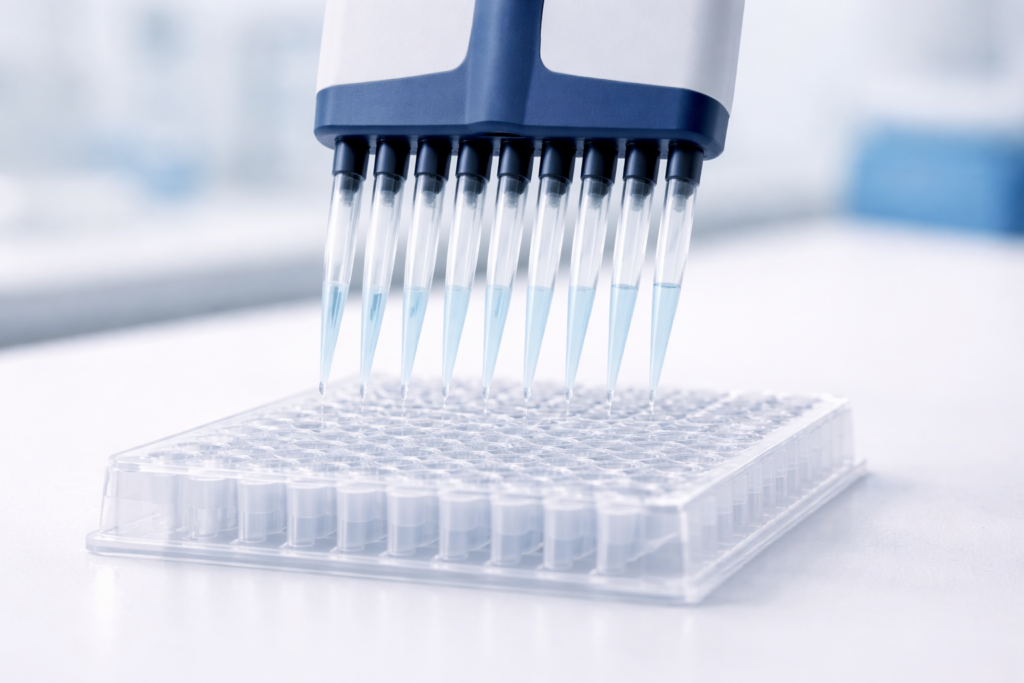
Multichannel manual pipettes are laboratory instruments designed to aspirate and dispense identical volumes across 8, 12, 16, or 24 channels simultaneously-enabling researchers to replicate samples across entire rows or columns of plate-based assays in a single motion. Unlike single-channel pipettes, which are optimized for individual samples, multichannel pipettes dramatically accelerate plate-based workflows while introducing a unique challenge: maintaining consistent volume delivery across all channels requires strict adherence to technique, tip selection, and equipment maintenance. This guide walks you through the mechanics of multichannel pipetting, practical selection criteria for your lab’s needs, evidence-based best practices, and troubleshooting strategies to help you achieve reliable, reproducible results.
What Is a Multi Channel Manual Pipette?
A multichannel manual pipette is a hand-operated instrument with multiple independent plungers arranged in a fixed spacing (typically 9 mm, matching the 96-well plate column or row geometry) that dispense the same volume from all channels in a single actuation. Labs use multichannel pipettes to rapidly transfer liquids to or from 96-well plates, 384-well plates (8- or 12-channel only), and PCR strip tubes, trading the precision advantage of single-channel pipettes for speed and consistency across replicates. However, multichannel pipettes are not suitable for irregular sample patterns, low-throughput workflows, or single-tube applications-tasks where a single-channel pipette remains faster and more practical.
How Multichannel Manual Pipettes Work (and Why They Can Be Tricky)
The Air-Displacement Principle
All manual multichannel pipettes operate on air displacement: when you depress the plunger, it compresses the air column above the liquid meniscus in the pipette tip. That pressure gradient draws liquid upward. Upon release, the plunger’s mechanical stops determine the expulsion volume. Each channel functions as an independent air-displacement system, but they share one critical limitation-they are mechanically linked by a single plunger assembly.
Across-Channel Consistency: The Real Challenge
The fundamental challenge in multichannel pipetting is achieving identical aspiration and expiration volumes across all channels simultaneously. Inconsistency arises from several factors:
- Uneven tip sealing: If one or more tips do not achieve a perfect seal against the well bottom, that channel will aspirate liquid before others, drawing a smaller volume.
- Disparate tip lengths: Manufacturing tolerances mean tips vary slightly in length; longer tips contact wells at different depths than shorter ones.
- Unequal plunger travel: Worn guides or debris in the plunger mechanism can cause slight differences in the distance each piston travels.
- Angle bias: Tilting the pipette during aspiration changes the submersion depth of different tips, leading to variation in air pressure at the meniscus.
- User fatigue: Operator fatigue in late rows of a 96-well plate often results in inconsistent immersion depth or actuation speed.
These effects compound, particularly when working with viscous liquids or low-volume ranges where margin for error is narrow.
Positive Displacement vs. Air Displacement
Positive displacement pipettes use a motorized piston that physically contacts the liquid (via an elastomer seal or disposable cartridge), eliminating the air-displacement vulnerability. They excel with foaming, volatile, or high-viscosity liquids. However, manual positive displacement multichannel pipettes are rare and expensive; most labs rely on air-displacement systems and mitigation through technique and tip selection.
8 vs 12 vs 16/24 Channels – Which One Fits Your Workflow?
Selecting the correct channel count depends on your plate geometry and workflow efficiency.
| Workflow | Best Channel Count | Typical Volume Range | Notes |
|---|---|---|---|
| PCR prep, small batch amplification | 8-channel | 10–200 µL | Matches 12-row or 8-row PCR strip format; single-row transfer |
| 96-well plate replication (rows) | 12-channel | 5–300 µL | Fastest for row-based assays; matches 8-well strips across 12 columns |
| 96-well plate replication (columns) | 8-channel | 5–300 µL | Matches 8-well strips along columns; slower per row but matches column layout |
| 384-well plate work | 8- or 12-channel only | 1–50 µL | 16/24-channel incompatible with 384 spacing (half plate at a time) |
| Irregular patterns or mixed volumes | Single-channel | Variable | Multichannel creates waste and cross-contamination risk; not suitable |
Selection criterion: Match your most frequent task. If 90% of your work is 96-well row-based transfers, choose 12-channel. If you split time between 96-well and 384-well, prioritize 8-channel for compatibility.
Choosing the Right Volume Range (Practical Selection)
Pipette accuracy and precision degrade significantly at the extremes of a pipette’s range. Air-displacement pipettes are rated to deliver their stated accuracy (typically ±2–10% depending on channel count and brand) within a “nominal operating range” that spans roughly 40% to 100% of the maximum volume. Operating below 40% of max increases relative error exponentially.
| Range | Common Label | Best Use | Common Mistakes |
|---|---|---|---|
| 0.5–10 µL | Tip-top, ultra-micro | qPCR prep, ultra-low assay volumes | Using for 2 µL when a 1–5 µL pipette exists; tip dead volume is significant |
| 10–100 µL | Micro | qPCR, ELISA serum addition, plate prep | Pipetting 5 µL when the 10–100 range is “nominal” at 40+ µL |
| 100–300 µL | Standard | Master mix distribution, buffer replication | Overloading tubes; ignoring viscosity effects at max volume |
| 300–1200 µL | Macro, bulk | Buffer distribution, dilution plates | Underutilizing; many labs keep single-channel 1200 µL because staff avoid short-range use |
Rule of thumb: Use the channel count and volume range combination that keeps your typical transfer in the 50–100% zone of the pipette’s scale. A 8–12-channel 10–100 µL pipette is more accurate for dispensing 50 µL to 96-well plates than pushing a 0.5–10 µL pipette to its limit, even though both are “capable.”
Pipette Tips Matter More in Multichannel Work
Tip Fit and Sealing
Multichannel pipettes are highly sensitive to tip fit. A loose tip creates a slow leak during aspiration, reducing net volume; a tight tip can bend during mounting, deforming the channel seal. Always:
- Use tips explicitly rated for your pipette model and channel count.
- Press tips onto the shaft assembly with a gentle, straight motion-do not twist.
- Verify that all tips are seated to the same depth; visual inspection under a desk lamp reveals misalignment instantly.
- Discard bent or worn tips; reusing compromised tips is the #1 cause of inconsistent multichannel delivery.
Filtered vs. Non-Filtered Tips
- Filtered tips (sterile polyethylene or polypropylene with integral aerosol barrier) prevent aerosol contamination and protect the pipette’s internal mechanism. Essential for cell culture, microbiology, and any work with infectious or hazardous materials.
- Non-filtered tips are adequate for non-biological chemistry, buffer prep, and plasmid work. Slightly faster and cheaper, but offer no sterility or aerosol protection.
For multichannel work involving cells or pathogens, filtered tips are not optional.
Low-Retention Tips
Standard plastic tips retain 2–5 µL of residual liquid due to polarity and geometry. For foaming solutions (proteins, surfactants) or viscous media (glycerol, DMSO), this “dead volume” causes carryover contamination and volumetric loss.
- Low-retention tips (hydrophobic or specially shaped) reduce adhesion to 1 µL or less.
- Cost is higher (~2× standard), but essential for viscous or foaming liquids.
- Avoid using low-retention tips with aqueous buffers on 96-well plates-no advantage, and the hydrophobic coating can paradoxically increase dripping.
Racked vs. Bulk Tips
- Racked tips come pre-organized in stackable racks, aligned to the 9 mm spacing of multichannel pipettes. Faster mounting, consistent seating. Preferred for high-throughput work.
- Bulk tips are loose in a bag; slower to mount, harder to align, risk of bent tips. Suitable only for low-volume tasks where speed is not critical.
Investment: Use racked, filtered tips for any sterile or high-precision work.
Tip Fit & Sealing Checklist
- Tips are rated for your specific multichannel model and channel count.
- All tips seated to identical depth (no visibly skewed alignment).
- No cracks, bends, or wear on any tip.
- Aspirate and dispense 10 µL of water into a waste trough; no visible dripping or spraying.
- After 500 cycles or end of day, discard all tips; do not reuse.
Technique: Best Practices for Multichannel Pipetting (Step-by-Step)
Forward Pipetting (Standard, Aspiration → Dispensing)
- Position the pipette vertically above the source well or plate. Ensure all tips are aligned with the wells.
- Immerse tips to a consistent depth (typically 2–3 mm below the surface for 96-well plates, 1–2 mm for PCR strips). Avoid plunging to the well bottom; this creates vortex suction and air bubbles.
- Depress the plunger smoothly to the first stop. Pause for 1 second to allow air equilibration.
- Aspirate slowly by releasing the plunger at a controlled, even pace (2–3 seconds for volumes >20 µL). Do not snatch the plunger back; this introduces bubbles.
- Pause with the plunger fully released for 1 second, then lift vertically upward to exit the well.
- Touch-off (optional): Touch the tip to the inside edge of the source well to remove external liquid droplets. Do not wipe tips on the well rim; this causes contamination and volume loss.
- Position over destination well and immerse tips to a consistent depth (1–2 mm for 96-well plates). Angle should remain vertical.
- Depress the plunger smoothly to the first stop to dispense the preset volume. Pause 1 second (critical for accurate delivery).
- Lift and touch-off at the well edge if desired, then return to rest position.
- Discard tips after the run or if contamination is suspected.
Reverse Pipetting (Improved Consistency for Low Volumes and Viscous Liquids)
Reverse pipetting inverts the plunger sequence to reduce bubble formation and improve volume consistency, especially for volumes <20 µL or viscous solutions.
- Pre-set the plunger to a position beyond the aspirate mark-typically 20–30% deeper than your target volume. This creates a “buffer zone.”
- Aspirate as normal to the first stop, pulling additional air into the tip.
- At the destination, depress the plunger past the first stop to the second mark, dispensing your preset target volume plus the buffer air.
- Retract the plunger to the first stop, drawing the residual air back into the tip (this “reverse” step prevents liquid from clinging to the tip).
- Lift and discard the tip with the air pocket intact.
When reverse pipetting is essential: Volumes <5 µL, high-viscosity media (>5 cP), foaming solutions, or when replicate variance exceeds 5% with forward pipetting.
Pre-Wetting and Conditioning
Before aspirating into a plate well, pre-wet the tips by aspirating and dispensing your target liquid 2–3 times from the source well. This:
- Saturates the tip plastic, preventing liquid retention variation.
- Equilibrates temperature and reduces surface tension effects.
- Dramatically improves consistency, especially for viscous or protein-containing solutions.
Pre-wet guidance: Always pre-wet for viscous or foaming liquids. Optional but recommended for biological buffers.
Immersion Depth and Angle
- Immersion depth variability across channels is the #1 source of uneven aspiration. Measure your well depth and train staff to a specific, repeatable depth (use a pen mark on the pipette shaft if needed).
- Angle: Multichannel pipettes must be held vertically (0°). Even 5° tilt shifts the submersion depth of distal tips relative to proximal ones.
- Speed: Aspirate at a moderate, even pace. Fast aspiration risks bubble formation; slow aspiration (<1 second) is acceptable but increases fatigue.
Dwell Time and Air-Equilibration
After aspirating, pause for 1 second before lifting tips. This allows the air column to stabilize and prevents liquid “rebound” into the tip during withdrawal. Similarly, pause 1 second after dispensing to allow all liquid to exit the tip.
Do / Don’t Summary for Multichannel Plate Work
DO:
- Use filtered, racked tips for sterile work.
- Pre-wet tips and maintain consistent immersion depth.
- Hold the pipette vertically.
- Pause 1 second after aspiration and dispensing.
- Discard tips after each run.
- Pre-wet tips 2–3 times for viscous liquids.
- Test-dispense 5 µL into a waste trough to verify no leaking.
DON’T:
- Use bent, cracked, or misaligned tips.
- Aspirate to different depths across the same multichannel transfer (primary cause of uneven volumes).
- Angle or tilt the pipette during liquid handling.
- Reuse tips across multiple sample sets.
- Pipette at the extremes of the pipette’s range (e.g., 2 µL from a 10–100 µL pipette).
- Aspirate too quickly or too slowly; aim for steady 2–3 second aspiration.
- Ignore dripping; dripping indicates a tip seal problem-discard immediately.
Accuracy, Precision, and Calibration (ISO 8655 in Practice)
Accuracy vs. Precision: The Distinction
Accuracy is the closeness of a measured value to the true (reference) value. A multichannel pipette with ±5% accuracy will deliver volumes within 5% of the nominal setting on average, even if individual transfers vary. Precision is the repeatability of measurements-how tightly the results cluster around their mean. A multichannel pipette might deliver 100 µL with ±2% precision (all channels within 98–102 µL of each other) but −5% accuracy (average delivery is 95 µL, not 100 µL). Accuracy is verified by comparison to a reference (electronic balance, calibrated rig); precision is assessed by measuring replicate deliveries within the lab.
ISO 8655 and Routine Verification
ISO 8655 is the international standard for manual pipette performance. It defines:
- Accuracy tolerance: Systematic error (bias) for a multichannel pipette, typically ±2–10% depending on volume and channel count.
- Precision (repeatability): Random error, quantified as coefficient of variation (CV), typically <2% for mid-range volumes on single-channel pipettes and 2–4% on multichannel pipettes.
- Test procedure: Gravimetric (weighing) or photometric (absorbance) method, using filtered tips and deionized water.
For routine lab verification, you do not need to send the pipette to a calibration service unless it fails in-house testing. Most labs perform a “consistency check” quarterly or after heavy use.
When to Calibrate: Usage-Dependent Guidance
- Light use (<500 cycles/month): Annual calibration or in-lab verification annually.
- Moderate use (500–2000 cycles/month): In-lab verification every 6 months; external calibration if CV exceeds 3%.
- Heavy use (>2000 cycles/month): In-lab verification monthly; external calibration if CV exceeds 2% or accuracy drifts >±5%.
Most manufacturers recommend external calibration service every 24 months regardless of usage, especially for multichannel pipettes in regulated labs (pharma, diagnostics).
In-Lab Consistency Check Across Channels (Simple, Safe, Non-Technical)
Equipment: 0.5 mL microcentrifuge tubes (12 or 8 for your channel count), electronic balance (0.1 mg resolution), deionized water, waste container.
Procedure:
- Tare the balance with one microcentrifuge tube on the pan.
- Aspirate your target volume (e.g., 50 µL) from a beaker of deionized water using your multichannel pipette with filtered, racked tips.
- Dispense into the first tube, place on balance, record mass (in mg).
- Repeat step 3 for all remaining channels (tubes 2–12 or 2–8), using fresh tubes each time.
- Calculate mean mass and coefficient of variation (CV = standard deviation / mean × 100).
- Target CV: <3% for mid-range volumes (40–80% of pipette max). If CV >3%, check tip fit, immersion depth, and tip condition. Retest with new tips.
Example: If you dispense 50 µL eight times and get masses of 49.2, 50.1, 49.8, 50.3, 49.5, 50.0, 49.9, 50.2 mg (mean = 49.95 mg, SD = 0.36 mg), then CV = 0.72%, which is excellent. If you get 45, 52, 48, 54, 46, 51, 49, 50 mg (mean = 49.4 mg, SD = 2.98 mg), then CV = 6.0%, indicating a problem-likely uneven tip sealing or immersion depth variation.
Troubleshooting Guide
| Symptom | Likely Cause | Quick Fix | When to Service/Calibrate |
|---|---|---|---|
| Uneven volumes across channels (2–5 µL variation, CV >4%) | Bent or misaligned tips; uneven immersion depth | Discard all tips, re-seat new set, repeat consistency check at identical immersion depth | If CV remains >3% with new tips and careful technique, inspect plunger guides for debris or wear; external calibration recommended |
| Bubbles in tips during aspiration | Aspirating too fast; insufficient tip immersion; air leak | Slow down; immerse 2–3 mm deeper; check for cracks in tips or worn plunger seals | If bubbles persist after technique correction, seal integrity problem; send for service |
| Dripping from one or more tips during hold | Tip not seated properly; worn or cracked tip; contamination on shaft | Discard tips, re-seat new ones; check shaft for dried liquid and clean with lint-free cloth | If dripping continues with new tips and clean shaft, plunger seals may be degraded; service recommended |
| Inconsistent first row vs. last row of 96-well plate | User fatigue; plunger angle drift in late transfers | Ensure operator posture is neutral; take a 30-second break every 2–3 plates; check plunger actuation angle visually | Fatigue-related issues resolve with technique. If first row is consistently high/low regardless of position, check plunger guides |
| Poor tip seating on shaft (tips rock or fall off) | Wrong tip brand or model for your pipette; shaft wear | Use only tips certified for your multichannel model; inspect shaft for cracks or nicks | Shaft damage requires replacement; external service |
| Volume loss over time during a 96-well plate transfer | Gradual plunger wear; seal degradation; accumulated residue in plunger | Disassemble plunger (if serviceable) and clean with distilled water and lint-free cloth; lubricate with manufacturer-supplied oil if applicable | If loss >5% after cleaning, seals are likely degraded; schedule service |
Ergonomics and Fatigue (Why People Hate Multichannel)
Common Strain Points
Multichannel pipetting demands repetitive, high-force actuation across dozens of wells per plate. Common complaints include:
- Thumb and thenar eminence pain: The plunger requires 5–15 N of force across 8–24 independent resistance points. Over 500 cycles, the cumulative load strains the thumb and palm.
- Wrist extension fatigue: Holding the pipette aloft in a vertical orientation for 10–30 minutes without support creates sustained wrist extensor load.
- Forearm fatigue: The weight of a multichannel pipette (typically 150–250 g) and sustained grip tension accumulate over plates.
Actuation force varies by brand and model; premium multichannel pipettes engineered for comfort may reduce resistance by 20–30% compared to budget models, meaningfully reducing fatigue during large sample sets.
Work Habits: Posture, Breaks, and Task Rotation
- Posture: Sit upright with your forearm supported by the bench or an armrest. Do not reach or hunch. Ensure the pipette holder is within arm’s reach so you spend minimal time holding the pipette between wells.
- Breaks: Take a 2–3 minute break every 3–4 plates (every 1000–1500 pipetting cycles). Stretch your thumbs, wrists, and forearms.
- Task rotation: Intersperse multichannel plate work with single-channel tasks or non-pipetting work (vortexing, labeling, data entry) to distribute strain.
- Support equipment: Use a multichannel pipette stand or carousel to hold the pipette between uses. This eliminates sustained grip.
Electronic Multichannel: When It Reduces Strain
Electronic or semi-automated multichannel pipettes (pneumatic, motor-driven) eliminate manual plunger actuation entirely. A single thumb press or foot pedal triggers all channels. For labs performing >10 plates per day, 5 days per week, electronic multichannel pipettes reduce repetitive strain injury risk dramatically and are cost-effective over 2–3 years. However, they introduce maintenance complexity and are beyond the scope of manual systems.
Multichannel vs. Single-Channel – When Each Is Better
| Scenario | Better Tool | Why |
|---|---|---|
| 96-well plate replication of a single sample to all wells | 12-channel | 12 transfers (rows) vs. 96 single-channel transfers; 8× speed improvement |
| 8-row PCR amplification setup | 8-channel | All rows prepared simultaneously; single-channel would require 8 separate steps |
| qPCR replicates (4 technical replicates of 3 samples) | Single-channel | 12 transfers total; multichannel offers no speed advantage (can’t skip wells) and introduces cross-well contamination risk |
| Serial dilution (1:2, 1:4, 1:8 steps across a plate column) | Single-channel | Column-by-column dilution requires careful volume precision and irregular tip placement; multichannel inflexible |
| Pooling samples from single columns into a tube | Single-channel | Multichannel cannot access a single tube reliably |
| Master mix distribution to 384-well plate from a reservoir | 8-channel multichannel (384 spacing) or 12-channel (half-plate at a time) | Two-pass 12-channel process still 4× faster than single-channel; or dedicated 8/12-channel 384-plate model |
Rule of thumb: Multichannel excels when the task involves regular, full-row or full-column transfers on standard plates. Single-channel is safer and faster for irregular patterns, small batches, or tube-to-tube work.
FAQ
Q: What are multichannel manual pipettes used for?
A: Multichannel manual pipettes rapidly transfer identical volumes across 8, 12, 16, or 24 samples simultaneously, enabling researchers to replicate samples to rows or columns of 96-well plates, PCR strip tubes, or 384-well plates in a single motion. They are standard in high-throughput assays (ELISA, qPCR prep, immunoassays, serial dilutions) and plate-based screening workflows where speed and consistency across replicates are critical.
Q: Do multichannel pipettes improve accuracy?
A: Not inherently. Multichannel pipettes and single-channel pipettes operate on the same air-displacement principle and are rated to identical ISO 8655 accuracy tolerances (typically ±2–10% depending on volume). However, multichannel pipettes excel at consistency across replicates-all channels deliver the same volume in one motion, eliminating the human timing variability that occurs when a user performs 12 separate single-channel transfers. This consistency is what makes multichannel pipettes valuable for plate-based assays, not raw accuracy.
Q: Why do multichannel pipettes feel inconsistent across channels?
A: Inconsistency arises when tips are misaligned, immersion depth varies between channels, tips are worn or bent, the plunger is angled, or the user’s hand position drifts. The most common cause is uneven immersion depth during aspiration-if the distal tips (ends farthest from the user) enter the well 1 mm shallower than the proximal tips, they aspirate less volume due to lower pressure. Strict adherence to vertical pipette orientation, consistent immersion depth, and visual tip alignment checks eliminate >95% of cross-channel variance.
Q: What tips should I use for multichannel pipetting?
A: Use filtered, racked tips explicitly certified for your multichannel model and channel count. Verify that all tips are seated to identical depth on the shaft with a visual inspection under a desk lamp. For sterile or biohazard work, filtered tips are essential. For viscous or foaming liquids, low-retention tips reduce carryover error. Always discard tips after each run or sample set; reusing tips is the leading cause of poor reproducibility.
Key Takeaways
- Multichannel pipettes are tools for high-throughput, plate-based liquid handling-not general-purpose pipettes. Use them when your workflow involves full-row or full-column transfers to 96-well or PCR strip plates; single-channel pipettes are faster and safer for irregular patterns or tube-to-tube work.
- Channel consistency is a technique problem, not a hardware limitation. Strict control of immersion depth, vertical orientation, plunger angle, and tip alignment eliminates >95% of cross-channel variation. Poor results usually indicate user technique or worn/misaligned tips, not a defective pipette.
- Volume range selection is critical. Operate multichannel pipettes in the 40–100% zone of their range. A 10–100 µL multichannel pipette is more accurate and precise for dispensing 50 µL than a 0.5–10 µL pipette at its extreme.
- Tip quality and fit are non-negotiable. Invest in filtered, racked, brand-matched tips. Bent or misaligned tips create immediate volume errors and are the #1 cause of failed consistency checks. Pre-wet tips for viscous liquids to saturate the plastic and reduce adhesion variation.
- Forward and reverse pipetting each have a role. Forward pipetting is standard and faster. Reverse pipetting (aspirating past the mark, then drawing back the surplus air) is essential for low-volume work (<5 µL) and viscous solutions where bubble formation or tip adhesion would otherwise limit precision.
- Ergonomic strain is real and cumulative. Multichannel pipettes demand high actuation force and repetitive motion. Support your forearm, take breaks every 3–4 plates, and consider electronic multichannel systems if your lab processes >10 plates daily-the reduction in repetitive strain injury risk justifies the cost.
- Calibration is usage-dependent, not calendar-dependent. Labs with moderate use (500–2000 cycles/month) should perform in-lab consistency checks every 6 months. Heavy-use labs should check monthly. External calibration is recommended annually or if in-lab CV exceeds 3%.
- Troubleshooting starts with the simplest interventions. Uneven volumes, dripping, and bubbles are almost always resolved by discarding old tips, re-seating new tips, checking immersion depth, and verifying vertical orientation. Hardware service is rarely needed if technique and tip quality are ruled out first.