
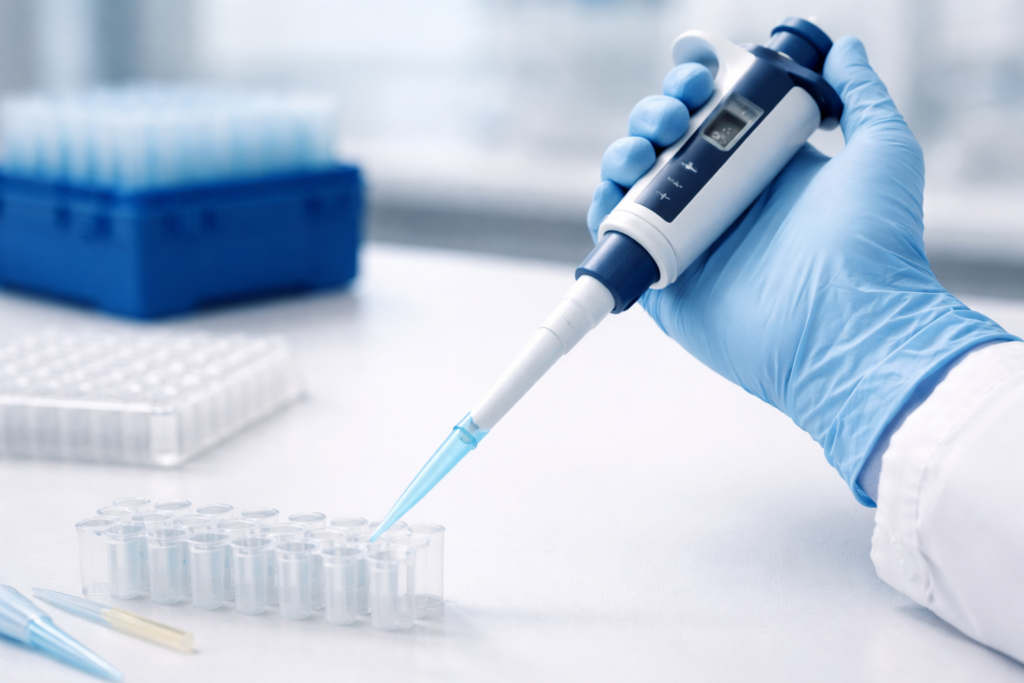
A single channel manual pipette is a handheld laboratory instrument that precisely measures and transfers small liquid volumes-typically from 1 µL to 5 mL-one sample at a time using manual plunger action. This guide covers everything you need to know: the mechanics behind single channel pipettes, how to select the right volume range for your work, proper technique to minimize errors, and troubleshooting strategies that will help you get consistent results in your daily lab operations. Correct pipetting technique matters far more than the brand you purchase; even premium channel pipettes produce poor results when used incorrectly, while well-maintained standard models deliver reliable data when handled properly.
What Is a Single Channel Manual Pipette?
A single channel manual pipette dispenses one liquid sample per action, making it the workhorse of analytical, molecular biology, and clinical laboratories. The term “single channel” refers to the fact that it has one dispensing tip position-unlike multichannel pipettes that dispense to 8 or 12 wells simultaneously. Single channel pipettes are found in nearly every lab because they work with any standard pipette tip size and are ideal for non-repetitive, variable-volume tasks.
You’ll encounter the single channel pipette most often in PCR setup, qPCR plate preparation, cell culture work, general chemistry experiments, and any protocol requiring precise liquid transfers where you’re not processing identical samples in parallel. The simplicity and precision of this design have made single channel pipettes the baseline standard against which other liquid-handling tools are measured.
How Single Channel Manual Pipettes Work: The Air-Displacement Principle
Most manual channel pipettes operate using air-displacement technology: a piston moves up and down inside a cylindrical chamber, creating a small air cushion above the liquid in the tip. When you press the plunger down, the air pocket compresses, forcing liquid out. When you release the plunger, air re-expands, creating a vacuum that draws liquid in.
The Two-Stop Mechanism
Nearly all single channel pipettes have two distinct plunger positions:
- First stop (measuring stop): A mechanical resistance point where the plunger pauses. Pressing to the first stop draws in your target volume.
- Second stop (blow-out stop): Beyond the first stop, pressing further ejects any remaining liquid from the tip, useful for viscous samples or when complete delivery is critical.
Standard practice is to use only the first stop for routine work. The second stop is deployed strategically-for example, when transferring glycerol solutions or when protocols specifically require complete tip evacuation.
Positive-Displacement Pipettes: A Special Case
Standard air-displacement models work well for most aqueous solutions. However, positive-displacement pipettes use a piston that moves inside the tip itself rather than above the liquid. This design eliminates the air cushion and is superior for volatile liquids (like DMSO or chloroform), high-viscosity solutions, or samples prone to foaming. If your lab regularly handles these materials, positive-displacement channel pipettes are worth the higher cost and learning curve.
Single Channel vs Multichannel (Channel Pipettes)-When Each Wins
The choice between a single channel pipette and multichannel (often called 8-channel or 12-channel) depends on your workflow, sample volume, and error tolerance.
Comparison Table
| Task/Context | Best Choice | Why | Tip Type |
|---|---|---|---|
| PCR plate setup (8 wells, varied primers) | Single channel | Variables differ; multichannel risks cross-contamination or volume mismatches | Standard tips |
| 96-well qPCR plate (all wells same reagent) | Multichannel | Identical volume to many wells; 8 tips ÷ 12 columns = ~3 passes vs 96 with single | Standard tips |
| Cell counting (scattered samples) | Single channel | Sporadic locations; multichannel alignment wastes tips | Standard tips |
| Gradient dilution series | Single channel | Non-linear spacing; multichannel inflexible | Standard tips |
| High-throughput screening (full plate) | Multichannel | Speed essential; systematic repeat workflow | Standard tips |
| Enzyme assay (1–4 replicates per condition) | Single channel | Low replicate count; setup speed irrelevant | Standard/filtered |
Key Differences
Single channel pipettes excel at flexibility and accuracy for non-repetitive tasks. You can adjust volume mid-workflow, easily skip wells, and handle contamination by changing one tip rather than eight.
Multichannel (channel pipettes) save time in high-throughput applications but require careful alignment, introduce more plunger-force variability across the eight channels, and demand higher training standards to avoid errors. A single channel pipette puts responsibility on precise technique; a multichannel distributes it across eight simultaneous events-amplifying small mistakes.
For most research labs, the single channel remains the default because flexibility outweighs speed gains in nonlinear protocols.
Choosing the Right Volume Range: The P10–P1000 Logic
Manual channel pipettes come in fixed volume ranges, labeled by their maximum capacity: P10, P20, P200, P1000. The number refers to microliters (µL). Selecting the correct range is critical because using a pipette near the middle of its range gives the best accuracy and precision.
Why the Middle of the Range Matters
The internal piston mechanism has tighter tolerances and better repeatability in the center of its travel. Using a P200 to measure 180 µL is excellent practice-you’re using ~90% of the piston travel, staying well within the accurate zone. Using the same P200 to measure 5 µL is terrible-the piston barely moves, increasing error. Conversely, attempting 250 µL with a P200 exceeds its range entirely.
Volume Range Selection Mini-Table
| Range | Typical Label | Best For | Common Mistakes |
|---|---|---|---|
| 1–10 µL | P10 | DNA quantification, tiny enzyme additions, qPCR primers | Using for 2 µL (too low in range); mixing tips between P10 and P20 |
| 2–20 µL | P20 | PCR primers, small buffer additions | Using for 1 µL; confusing with P10 tips |
| 20–200 µL | P200 | Most molecular work, typical aliquoting | Using for 5 µL; insufficient immersion depth for low volumes |
| 200–1000 µL | P1000 | Large buffer volumes, cell culture media | Attempting 1.5 mL (exceeds range); inadequate tip sealing at <300 µL |
Pipette Tip Selection by Range
Each single channel pipette range requires corresponding tip sizes:
- P10 tips (~10 µL nominal capacity): tapered, typically colored yellow or white
- P20 tips (~20 µL): tapered, often white or light blue
- P200 tips (~200 µL): medium bore, usually yellow or light blue
- P1000 tips (~1000 µL): wide bore, frequently blue
Using a P1000 tip on a P200 pipette results in poor sealing and dripping. Using a P10 tip on a P20 will provide excessive dead volume. Cross-compatibility errors are a leading cause of poor reproducibility in teaching labs.
Pipette Tips, Compatibility, and Contamination Control
The pipette tip is where accuracy meets the sample. A poor tip-to-pipette seal, low-quality plastic, or the wrong tip type can undermine even the best technique.
Why Tips Affect Accuracy and Precision
The tip must create an airtight seal with the pipette’s dispensing end (the cone). If the seal is loose, air leaks during aspiration or dispensing, reducing the volume transferred. Low-quality tips have:
- Inconsistent bore diameters (causing variable sealing force)
- Stress cracks from handling or autoclaving
- Manufacturing tolerances outside ISO standards
Premium tips cost 2–3× more but ensure reproducible results, especially critical in assay development or regulatory-grade work.
Filtered vs Non-Filtered Tips
Non-filtered tips are standard for most applications-aqueous solutions, cell culture, buffer transfers.
Filtered tips (aerosol barrier filters or hydrophobic filters in the shaft) are essential for:
- qPCR pre-amplification work (preventing aerosol contamination traveling up the tip into the pipette)
- RNase-sensitive protocols
- Highly viscous or foaming solutions that might splash backward
Filtered tips cost more and slightly increase plunger resistance; use them only when contamination risk is genuine.
Low-Retention Tips
Some tips have specially treated or textured surfaces to reduce liquid clinging. Use low-retention tips when:
- Transferring expensive reagents (insulin, growth factors)
- Working with very small volumes (dilution series)
- Protocols demand maximum accuracy from small aliquots
Standard tips are fine for routine work; low-retention is a specialized upgrade.
Sterile and RNase/DNase-Free Tips
Most modern tips are sterile and come in sealed bags. RNase/DNase-free tips are necessary for:
- RNA extraction and qPCR
- Sensitive protein work
- Any protocol listed as “nuclease-free”
Standard sterile tips are adequate for protein assays, cell culture, and buffer handling. Don’t pay for RNase-free if your application doesn’t require it.
Common Compatibility Errors and Prevention
- Mixing tip sizes across pipettes: Label your pipettes and their dedicated tip boxes clearly. Many labs use color-coded pipette holders that match tip box colors.
- Incorrect tip insertion: The tip cone must fully seat on the pipette nozzle. Partial insertion creates a slow leak during dispensing.
- Tip reuse: Never reuse tips across samples (contamination) or across the same sample twice (bacteria/nucleases from pipette shaft).
Accuracy, Precision & Calibration (ISO 8655)
Accuracy vs Precision: Snippet-Ready Definition
Accuracy is how close your measured value is to the true value (trueness). Precision is how repeatable your measurements are (standard deviation). A pipette can be precise but inaccurate (consistently dispensing 195 µL when set to 200 µL) or accurate but imprecise (averaging 200 µL but ranging from 185–215 µL). ISO 8655 specifies that both accuracy and precision must fall within defined tolerances for each volume range.
What ISO 8655 Means in Practice
ISO 8655 is the international standard for volumetric measurement with manual or electronic pipettes. It defines:
- Maximum permissible error (bias) for each volume
- Maximum permissible standard deviation (precision)
- Testing conditions (temperature 15–25 °C, humidity 45–75%)
For example, a P200 pipette dispensing 100 µL must deliver 100 ± 2.4 µL (±2.4% accuracy) and have a standard deviation ≤ 0.8 µL across 10 consecutive measurements. Manufacturers test pipettes at three points within the range and publish certified accuracy profiles. If your lab requires ISO 8655 compliance documentation, request it during purchase-not all vendors provide it automatically.
Calibration Frequency Guidance
Calibration depends on usage intensity:
- Low-use labs (< 5 hours/week): annual calibration sufficient
- High-use labs (> 30 hours/week, multiple operators): quarterly or semi-annual
- Regulatory environments (clinical, pharma): per protocol, often quarterly
Maintenance Checklist
| Frequency | Action |
|---|---|
| Daily | Wipe external surfaces; check plunger moves freely; inspect for cracks |
| Weekly | Clean the cone/nozzle with a lint-free cloth; check tip sealing |
| After shock or drop | Test dispense into a weighing boat; if volume is off, schedule recalibration |
| After servicing | Request post-service calibration certificate from technician |
| Annually | Send to certified service center for full calibration (unless quarterly required) |
Best Practices: How to Pipette Correctly (Step-by-Step)
Technique is the largest variable in pipetting accuracy. Master these steps and your results will be reproducible regardless of pipette brand.
Forward Pipetting (Standard Method)
Forward pipetting is the default for most applications:
- Attach a fresh tip to the pipette and firmly seat it.
- Set the volume dial to your target (e.g., 50 µL on a P200).
- Pre-wet the tip (optional but recommended for viscous or volatile liquids): aspirate and dispense your sample liquid 2–3 times to coat the tip’s internal surface, bringing it to temperature and chemical equilibrium.
- Immerse the tip into the source liquid, approximately 2–3 mm below the surface. Immersion depth matters: too shallow risks air aspiration; too deep increases tip wetting on withdrawal.
- Aspirate slowly (1–2 seconds), keeping the tip submerged. Rapid aspiration draws air bubbles.
- Pause briefly (1 second dwell time) after reaching full volume, allowing the air cushion to stabilize.
- Withdraw the tip at a slight angle to minimize liquid trailing.
- Dispense into the target tube by pressing to the first stop, waiting 1–2 seconds (dwell time), then carefully withdrawing. Do not blow out unless protocol requires it.
- Change the tip before your next sample (always).
Reverse Pipetting (High-Accuracy Method)
Reverse pipetting is superior for viscous liquids, foaming solutions, or when maximum accuracy is critical:
- Set the volume to 10–15% above your target (e.g., set to 115 µL if you want to deliver 100 µL).
- Aspirate as above, drawing the extra volume.
- Dispense to the first stop only-this leaves the excess in the tip.
- Touch the tip to the tube wall and withdraw, leaving the extra liquid in the tip. This avoids the bubble instability of blowing out and gives 1–2 µL higher precision on small volumes.
- Discard the tip (it still contains the reserved liquid).
Reverse pipetting uses more tips but is worth it for assay development, titrations, or any work where 0.5–1% error is unacceptable.
Pre-Wetting, Temperature, and Liquid Class Effects
- Pre-wetting: Essential for volatile organics (DMSO, ethanol) and when transferring small volumes repeatedly. Coat the tip with 2–3 small aspirations of the sample to equilibrate the tip’s temperature and reduce evaporation loss.
- Temperature effects: Liquid volume changes ~0.1% per °C. Cold samples aspirated into a warm tip will expand slightly; warm samples into a cold tip contract. For highest accuracy, let tips and samples equilibrate to room temperature or use temperature-matched aliquots.
- Liquid class: Aqueous solutions (water, buffers) flow smoothly. Oils and glycerol (high viscosity) require slower plunger action and may need positive-displacement pipettes. Organic solvents and foaming solutions (detergents) demand special tips and reverse pipetting. Know your liquid class and adjust technique accordingly.
Do/Don’t Quick Reference
Do:
- Always use a fresh tip for each new sample
- Immerse tips 2–3 mm into liquid
- Aspirate and dispense slowly (2–3 seconds)
- Allow 1-second dwell times between aspiration/dispensing and withdrawal
- Pre-wet tips when working with volatile compounds
- Store pipettes vertically with tips removed
- Calibrate annually (or per SOP)
Don’t:
- Mix and match tip sizes across pipette ranges
- Pipette above or below the specified range
- Rapid-fire aspiration (creates bubbles)
- Leave tips on pipettes overnight (causes tip warping and plunger drift)
- Reuse tips across samples
- Mouth pipette (banned in virtually all modern labs)
- Use damaged, cracked, or bent tips
Troubleshooting Common Problems
| Symptom | Likely Cause | Quick Fix | When to Recalibrate/Repair |
|---|---|---|---|
| Dripping from tip | Poor tip seal; debris on cone | Remove tip, wipe cone with lint-free cloth, re-seat new tip firmly | If problem persists after cleaning, pipette may have worn cone-send for service |
| Bubbles in tip | Rapid aspiration; tip not fully submerged | Slow down aspiration to 2–3 seconds; ensure 2–3 mm immersion | N/A-user error, not pipette fault |
| Inconsistent volumes | Tip seal degrading; plunger friction increasing | Change tips; clean plunger/shaft with alcohol wipe; check for debris | After cleaning, test 10 consecutive measurements; if CV > 5%, recalibrate |
| Poor tip sealing (leaking) | Wrong tip size; cone damage; tip not fully inserted | Verify tip matches pipette range; seat firmly; wipe cone | If sealing fails with correct tip installed, cone is likely worn-service required |
| Plunger feels rough or sticky | Dust/salt buildup in shaft; tip residue dried on plunger | Gently wipe plunger with cloth dampened in water/ethanol; do not force | If roughness persists, do not force plunger-ship for professional cleaning |
| Unable to achieve target volume | Calibration drift; internal seal degradation; plunger misalignment | Perform forward/reverse pipette test into weighing boat; compare to SOP | If volume is consistently ±3% off, recalibrate; if ±5%, likely internal damage-service |
| Contamination event (sample cross-contamination in a batch) | Tip reuse across samples; improper tip change procedure | Discard all samples from that batch if critical; use fresh tip for each future sample | N/A-operator procedure, not pipette issue |
Ergonomics: Reducing Hand Fatigue with Manual Pipettes
Manual pipetting involves repetitive gripping and plunger actuation. Over months or years, this can lead to repetitive strain injury (RSI), carpal tunnel syndrome, or tendinitis.
RSI Risk Factors
- High daily pipetting volume (> 2,000 pipettes/day)
- Excessive plunger force (poorly maintained pipette requiring hard pressing)
- Poor posture (hunched over bench, awkward wrist angle)
- Inadequate breaks
- Gripping pipette too tightly
Ergonomic Features to Evaluate
- Plunger force: Should require 1–2 N (roughly 100–200 grams of force) for comfortable operation. If a pipette feels “sticky” or requires hard pressing, it needs service.
- Grip design: A contoured, wider handle reduces fatigue compared to thin cylindrical designs. Some models offer textured grips to prevent slipping.
- Pipette weight: Lighter is better for high-volume days. Standard manual pipettes weigh 40–80 g; ensure the weight is balanced and not top-heavy.
- Tip ejector mechanism: Spring-loaded ejectors reduce thumb strain compared to manual push buttons.
Workstation and Behavioral Habits
- Breaks: Take 5–10 minute breaks every hour of intensive pipetting; rotate tasks to engage different muscle groups.
- Posture: Keep wrists neutral (not bent); ensure pipette tips are at eye level to reduce neck strain; sit with feet flat and back supported.
- Task rotation: Alternate between pipetting, data entry, and analytical work to distribute physical load.
- Stretching: Simple wrist and forearm stretches before and after intensive pipetting reduce tension.
When Electronic Pipettes Become Worthwhile
Electronic (motorized) pipettes eliminate plunger force and reduce repetitive motion, making them valuable if your lab performs > 10,000 liquid transfers weekly or employs staff with pre-existing RSI conditions. However, electronic pipettes cost 3–5× more and introduce battery/charging logistics. For most research labs with moderate to low daily transfer volumes, good ergonomic technique with manual channel pipettes is sufficient.
Frequently Asked Questions (FAQ)
1. What is a single channel pipette?
A single channel manual pipette is a handheld device that precisely measures and transfers small liquid volumes (typically 1 µL–5 mL) one sample at a time using a manual plunger mechanism. It is the most common pipette type in research, clinical, and analytical laboratories because it offers flexibility, affordability, and high accuracy when used correctly.
2. What is the difference between a single channel pipette and a multichannel (channel pipettes)?
A single channel pipette dispenses one sample per action, while multichannel (8-channel or 12-channel) channel pipettes dispense identical volumes to 8 or 12 wells simultaneously. Single channel pipettes are better for non-repetitive workflows, small sample sets, or when variable volumes are needed; multichannel channel pipettes save time in high-throughput screening or plate-filling tasks. Single channel pipettes require one tip change per sample; channel pipettes require eight, so cross-contamination risk is different.
3. What size of pipette should I use?
Use a pipette that keeps your target volume in the middle of its range. For example, use a P20 for 8–18 µL, a P200 for 50–180 µL, and a P1000 for 300–900 µL. This maximizes accuracy because the piston mechanism is most precise at mid-range travel. Avoid using a P1000 for 100 µL or a P20 for 1 µL because you sacrifice both accuracy and precision.
4. Is mouth pipetting banned?
Yes. Mouth pipetting is strictly prohibited in modern laboratories and is a violation of OSHA regulations and institutional biosafety protocols in most countries. Mouth pipetting risks ingestion of toxic, radioactive, or biological hazards, and it is completely unnecessary given the low cost and universal availability of manual pipettes. There are no legitimate exceptions.
5. How do pipettes work?
Manual channel pipettes use the air-displacement principle: a plunger moves down, compressing air above the liquid, forcing it out (dispensing); the plunger pulls up, creating a vacuum that draws liquid in (aspiration). The plunger typically has two stops: the first stop draws the target volume, and the second stop (blow-out) empties any remaining liquid if needed. Positive-displacement pipettes work differently-the piston extends into the tip itself, eliminating the air cushion, making them better for volatile or viscous liquids.
Key Takeaways
- A single channel pipette is the most flexible and affordable liquid-handling tool for non-high-throughput labs and offers superior accuracy when technique is rigorous.
- Always use a pipette range that keeps your target volume in the middle (40–80% of maximum capacity).
- Forward pipetting is standard; reverse pipetting gives superior accuracy for small volumes or viscous liquids.
- Proper tip sealing, tip size selection, and pre-wetting are critical-these account for 60% of accuracy variance, not the pipette brand.
- ISO 8655 compliance ensures your pipette meets accuracy/precision tolerances; request calibration certificates annually or per regulatory SOP.
- Clean the cone regularly, change tips between samples, and allow 1-second dwell times between aspiration and dispensing to maximize reproducibility.
- Channel pipettes are faster for repetitive high-throughput work, but single channel pipettes excel at flexibility, contamination control, and precision when each sample differs.
- Ergonomics matter: invest in a well-maintained pipette with low plunger force, practice neutral wrist posture, and rotate tasks to prevent RSI.
- Pre-wet tips for volatile liquids, use filtered tips for aerosol-sensitive work, and use reverse pipetting for assay development or regulatory work demanding 0.5% accuracy.
- Troubleshooting dripping, bubbles, or inconsistent volumes usually comes down to technique, tip quality, or cone cleanliness-not a defective pipette.