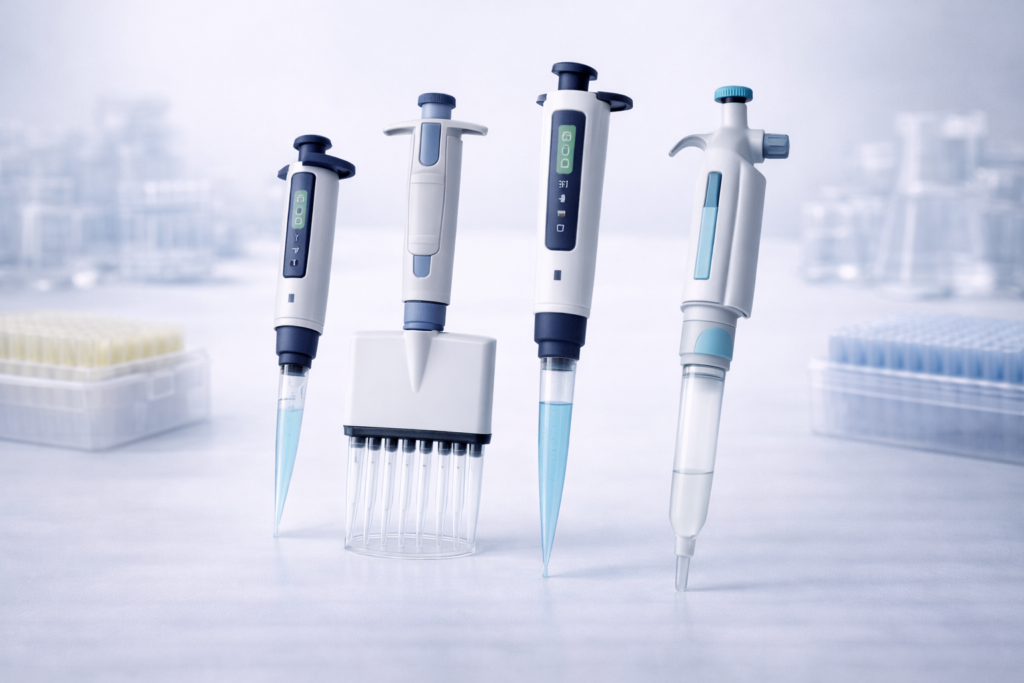
In lab purchasing, “pipette” can mean three different things: (1) micropipettes (often called pipettors) for microliter volumes and precision work, (2) serological pipettes (mL-scale, used with a pipette controller), and (3) disposable/transfer pipettes (droppers for non-precision transfers). This page focuses mainly on micropipette manufacturers, because that’s where brand differences in performance, ergonomics, service, and tip ecosystems matter most for accuracy and workflow.
Below you’ll find (a) a practical guide to comparing manufacturers, (b) a quick “choose by application” table, and (c) a structured directory of major manufacturers (examples, not a complete global list), plus an at-a-glance comparison to shortlist suppliers faster.
What Makes a “Good” Pipette Manufacturer?
Use this checklist to compare manufacturers in a way that matches procurement reality (performance + lifecycle support), not marketing.
- Accuracy/precision reputation: Consistency across units, stability over time, and confidence in stated specs.
- Ergonomics and user fatigue: Plunger force, balance, grip comfort, readability, and ease of tip ejection.
- Product breadth: Single- and multichannel; manual and electronic; positive displacement; repeaters/dispensers; compatibility with plate workflows.
- Ecosystem: Tip/consumables availability, compatibility strategy (universal vs fitted systems), and clarity of documentation for third-party tips.
- Service, calibration, warranties: Local calibration options, turnaround time, parts availability, warranty clarity, and repair pathways.
- Documentation/certifications: Clear manuals, maintenance instructions, published performance specs, and traceable calibration documentation options.
- Availability and lead times: Distributor network, regional stock, supply continuity for both instruments and tips.
Quick Buyer Guide (Choose by Application)
| Application | What matters most | Recommended pipette type/features |
|---|---|---|
| PCR / molecular biology | Contamination control, repeatability at low volumes, comfortable repetitive use | Air-displacement micropipettes; consider electronic for repeat dosing; use filtered tips where needed |
| Cell culture | Sterility workflows, speed, comfort, easy decontamination | Single + multichannel for plates; electronic can reduce fatigue; easy-clean exterior and robust service support |
| Analytical chemistry | Chemical compatibility, accuracy at required volumes, low drift | Match materials to solvents; consider positive displacement for challenging liquids; strong calibration support |
| Viscous/volatile liquids | Minimize evaporation/viscosity bias; consistent aspiration/dispense | Positive displacement or well-designed electronic modes; low-retention tips where appropriate |
| Teaching labs | Durability, simple controls, easy maintenance, clear labeling | Manual air-displacement; choose robust designs and straightforward serviceability |
| High-throughput screening | Speed, plate alignment, consistency across channels | Electronic multichannel; 96/384-compatible handheld options or automation-ready solutions |
Manufacturers by Pipette Type (Navigation)
These groupings help you shortlist quickly. “Examples include…” lists common options; always verify the exact model line and local availability.
Manual single-channel
- Examples include: Eppendorf, Gilson, Sartorius, Thermo Scientific, Socorex, Nichiryo, BrandTech/BRAND (Transferpette line)
Manual multichannel
- Examples include: Eppendorf, Gilson, Sartorius, INTEGRA Biosciences, Socorex, Thermo Scientific
Electronic single-channel
- Examples include: Eppendorf, Sartorius, INTEGRA Biosciences, Socorex, BrandTech/BRAND
Electronic multichannel
- Examples include: INTEGRA Biosciences, Eppendorf, Sartorius, Socorex, Thermo Scientific
Positive displacement
- Commonly used when liquids are viscous, radioactive, corrosive, or volatile; this approach avoids an air cushion and uses direct piston–sample contact in a disposable assembly.
- Examples include: Gilson (positive displacement lines), Eppendorf (positive displacement options), Sartorius (model-dependent)
Repeater pipettes / dispensers
- Repeating dispensers can be useful when you need many identical dispenses quickly (e.g., routine plate filling).
- Examples include: Eppendorf, BrandTech/BRAND, Sartorius, Gilson
Automation / high-throughput compatible solutions
- Examples include: Hamilton, Tecan, Beckman Coulter, Opentrons, Sartorius (automation portfolios vary by region)
Serological pipettes & controllers (brief)
- Serological pipettes are typically plastic, mL-scale, and used with a pipette aid/controller; selection is often driven by sterility, graduation clarity, and fit with your controller.
- Controller manufacturers commonly include Drummond (pipette aids) and others; serological pipette manufacturers commonly include Corning/Costar, BD/Falcon, Greiner Bio-One.
Directory – Major Pipette Manufacturers
This directory is intentionally not “complete.” It covers widely encountered manufacturers in research, clinical, QC, and teaching labs, plus a few automation-focused suppliers that procurement teams frequently evaluate.
Manufacturer vs distributor (important)
A manufacturer designs and produces the pipette (and sets performance specs, parts, and service procedures), while a distributor sells and ships products-often across many brands-and may also coordinate service. Thermo Fisher Scientific operates across multiple lab product categories and brand families, while Fisher Scientific is a major channel many labs use for purchasing convenience and broad catalog access (availability and service routes can vary by country).
Eppendorf
- What they are known for: Broad adoption in life science labs and a deep focus on micropipette workflows.
- Typical product families: Manual and electronic single/multichannel; supporting repeaters/dispensers; service programs.
- Best fit for: Molecular biology, general research, teams that value consistent feel across instruments.
- Notes on tips/consumables ecosystem: Often supports fitted systems; many labs also evaluate compatible third-party tips after fit testing.
- Buying & service considerations: Check local calibration options, swap/loaner policies, and parts lead times.
Gilson
- What they are known for: Strong presence in academic and industrial labs; widely used manual pipettor families.
- Typical product families: Manual single/multichannel; electronic options; positive displacement families (line-dependent).
- Best fit for: Mixed workflows, teaching labs, routine QC where durability and serviceability matter.
- Notes on tips/consumables ecosystem: Mix of universal-style and brand-matched options depending on model; validate tip fit for sealing and ejection.
- Buying & service considerations: Ask about seal kits, typical maintenance intervals, and local repair turnaround.
Sartorius (incl. Biohit heritage in many regions)
- What they are known for: Pipetting plus broader lab ecosystem (balances, filtration, etc.), with pipette lines common in many institutions.
- Typical product families: Manual and electronic pipettes; multichannel options; some regions bundle with lab management/service offerings.
- Best fit for: Labs standardizing across multiple equipment categories and wanting consolidated vendor management.
- Notes on tips/consumables ecosystem: Often offers manufacturer tips; compatibility depends on cone geometry and tip family-test before standardizing.
- Buying & service considerations: Confirm whether calibration is handled in-house, via partner labs, or via centralized service.
Rainin (Mettler Toledo)
- What they are known for: Strong micropipette identity in many markets and long-running instrument families.
- Typical product families: Manual and electronic single/multichannel; service and calibration programs in many regions.
- Best fit for: High-use pipetting teams where ergonomics and consistency across users is a priority.
- Notes on tips/consumables ecosystem: Some systems are designed around brand-specific tip families; plan tip supply continuity before standardizing.
- Buying & service considerations: Verify tip availability (stock + lead time) and whether you can qualify alternate tips without performance loss.
Thermo Scientific (pipettes as part of a broader lab portfolio)
- What they are known for: Integration into large lab purchasing programs and broad availability through multiple channels.
- Typical product families: Manual and electronic single/multichannel; general-purpose ranges for routine lab work.
- Best fit for: Labs that want a single vendor footprint across many consumables and instruments (where practical).
- Notes on tips/consumables ecosystem: Often supports both vendor tips and compatible options; confirm fit and performance in your volume ranges.
- Buying & service considerations: Clarify which service organization handles calibration locally (manufacturer network vs third-party).
BrandTech / BRAND
- What they are known for: Liquid handling tools including pipettes and dispensers; commonly encountered in general lab procurement.
- Typical product families: Manual and electronic pipettes; repeaters/dispensers; broader liquid handling accessories.
- Best fit for: General chemistry/biology labs needing dependable daily instruments and repeat dispensing options.
- Notes on tips/consumables ecosystem: Often aligned to widely available tip formats, but always validate sealing and ejection force.
- Buying & service considerations: Check spare parts availability and whether local distributors support warranty repairs.
INTEGRA Biosciences
- What they are known for: Multichannel and higher-throughput-friendly handheld formats, including 96/384-style handheld instruments in many markets.
- Typical product families: Electronic multichannel; 96/384 handheld platforms; supporting single-channel families.
- Best fit for: Plate-based workflows (PCR plates, ELISA-style setups, screening labs) and teams optimizing throughput.
- Notes on tips/consumables ecosystem: Often pairs with dedicated tip solutions for alignment and performance; confirm ongoing tip supply.
- Buying & service considerations: Pay attention to training needs, battery/charging logistics, and service coverage for electronic units.
Socorex
- What they are known for: Broad pipette offerings in many regions, including manual and electronic families.
- Typical product families: Manual micropipettes, electronic micropipettes, multichannel options.
- Best fit for: Labs seeking mainstream feature sets with a strong distributor presence in certain markets.
- Notes on tips/consumables ecosystem: Usually supports common tip types; verify fit on the exact cone geometry.
- Buying & service considerations: Confirm who performs calibration locally and whether parts are stocked domestically.
Nichiryo
- What they are known for: Established pipette manufacturing presence (especially recognized in parts of Asia and global distribution).
- Typical product families: Manual and electronic micropipettes; multichannel options depending on region.
- Best fit for: Teams standardizing pipettes across sites that already source Nichiryo through existing channels.
- Notes on tips/consumables ecosystem: Commonly supports standard tip families; qualification testing remains essential.
- Buying & service considerations: Check regional model availability (lines can differ by market).
Hamilton (liquid handling + automation)
- What they are known for: Automation-forward liquid handling, widely evaluated for high-throughput and regulated environments.
- Typical product families: Robotic liquid handling platforms; automated pipetting channels/modules; related consumables.
- Best fit for: Labs moving beyond handheld pipetting into automation, method standardization, and traceability needs.
- Notes on tips/consumables ecosystem: Automation platforms often rely on validated tip types; consumables are part of the system qualification.
- Buying & service considerations: Budget for installation qualification, preventive maintenance, and service contracts.
Tecan
- What they are known for: Automated liquid handling and plate-based workflows.
- Typical product families: Liquid handling workstations; accessories for plate movement and workflow integration.
- Best fit for: Screening labs, core facilities, and production-like workflows that need repeatable automated pipetting.
- Notes on tips/consumables ecosystem: Often requires validated tips and labware definitions; consumables become part of your SOP.
- Buying & service considerations: Focus on application support, uptime, and service response times.
Beckman Coulter (automation and instruments)
- What they are known for: Broad instrument portfolio and liquid handling systems in many labs.
- Typical product families: Automated liquid handlers (product lines vary); integration with plate workflows.
- Best fit for: Labs already using Beckman platforms and wanting workflow continuity.
- Notes on tips/consumables ecosystem: Automation tips are typically system-qualified; changing tips may require revalidation.
- Buying & service considerations: Clarify service coverage, software support lifecycle, and consumables lead times.
Opentrons
- What they are known for: Accessible benchtop automation options for labs that want programmable workflows without full-scale robotic systems.
- Typical product families: Benchtop liquid handling robots; accessories and compatible labware ecosystems.
- Best fit for: Academic labs, method development, and teams that can support scripting/configuration.
- Notes on tips/consumables ecosystem: Tip and labware definitions can be constrained by validated compatibility; plan standard labware.
- Buying & service considerations: Evaluate who will “own” method setup internally (automation champion vs vendor support).
Drummond (controllers and specialty pipetting)
- What they are known for: Pipette aids/controllers and specialty micro-dispensing tools in many markets.
- Typical product families: Serological pipette controllers; specialty dispensing solutions.
- Best fit for: Cell culture rooms and labs doing frequent mL-scale sterile transfers.
- Notes on tips/consumables ecosystem: More about serological pipette fit and filter options than micropipette tips.
- Buying & service considerations: Check battery/service support and availability of sterile accessories.
Corning (serological pipettes and consumables focus)
- What they are known for: Cell culture consumables; widely used serological pipettes in many regions.
- Typical product families: Serological pipettes; broader cell culture plastics.
- Best fit for: Cell culture and routine sterile liquid transfers.
- Notes on tips/consumables ecosystem: Sterility assurance and packaging formats (individually wrapped vs bulk) are often the deciding factors.
- Buying & service considerations: Plan for consistent lot supply if your workflows are sensitive to plastics variability.
Comparison Table (At-a-Glance)
Use this table to make a procurement shortlist, then validate with a small in-lab evaluation (fit, comfort, and performance in your real liquids).
| Manufacturer | Strengths | Best for | Not ideal when | Notes (tips ecosystem/service) |
|---|---|---|---|---|
| Eppendorf | Broad micropipette adoption, strong product coverage | Molecular biology, general research | You need only low-cost basic tools | Tip family may be model-specific; confirm local calibration |
| Gilson | Durable manual families, broad presence | Teaching + routine labs | You require advanced electronic modes only | Validate tip fit; check seal kit availability |
| Sartorius | Portfolio breadth, common institutional standardization | Multi-site standardization | You need a niche specialty format | Confirm regional model lineup and service route |
| Rainin (Mettler Toledo) | Strong micropipette identity, many service programs | High-use teams | Tip supply is uncertain in your region | Some systems emphasize fitted tips; plan supply |
| Thermo Scientific | Broad availability, purchasing convenience | Mixed labs with consolidated purchasing | You need a very specialized format | Clarify who services calibration locally |
| BrandTech/BRAND | Solid general liquid handling + repeat dispensing | General lab workflows | You need high-throughput multichannel focus | Often compatible with common tip formats; verify performance |
| INTEGRA Biosciences | Plate-oriented handheld throughput options | 96-well/384-well workflows | You rarely work with plates | Electronic support + consumables continuity matter |
| Socorex | Wide range in many regions | General purpose | You need a tightly unified tip platform | Confirm distribution and calibration coverage |
| Hamilton | Automation ecosystem | Regulated/high-throughput automation | You only need handheld pipettes | Service contracts and validation are key |
| Tecan | Automation integration | Screening/core facilities | Low sample volume and ad hoc work | Software + service lifecycle planning is essential |
| Beckman Coulter | Automation + lab instrument continuity | Platform standardization | You need open-ended custom hardware | Tips often system-qualified; revalidation may apply |
| Opentrons | Programmable benchtop automation | Labs with in-house automation skills | No internal bandwidth for setup | Check validated labware/tip options |
| Drummond | Controllers for serological workflows | Cell culture mL transfers | You mainly pipette microliters | Focus on controller ergonomics + battery |
| Corning | Serological consumables | Cell culture | You need micropipettors | Prioritize sterility, packaging, and supply |
How to Avoid Common Buying Mistakes
- Mixing up transfer pipettes vs micropipettes: Droppers and disposable transfer pipettes are not precision instruments.
- Buying the wrong volume range: Choose models that cover your routine volumes in the middle of their range (not always at the extreme).
- Ignoring tip compatibility: “Fits on the cone” is not the same as “meets accuracy/precision”; qualify tips on critical assays.
- Skipping calibration/service planning: Budget time and process for routine checks and periodic calibration to avoid drift and downtime.
- Choosing “cheap” without QC expectations: Low upfront cost can become expensive if variability, breakage, or tip supply issues cause repeat work.
FAQs
Who are the major manufacturers of pipettes?
Commonly encountered manufacturers in micropipettes include Eppendorf, Gilson, Sartorius, Rainin (Mettler Toledo), Thermo Scientific, BrandTech/BRAND, Socorex, and others, with additional suppliers focused on automation such as Hamilton and Tecan. (Examples vary by region and distributor coverage.)
What’s the difference between a pipette manufacturer and a distributor?
Manufacturers design/build the instrument and define specifications and service parts, while distributors sell, stock, and ship products (often across multiple manufacturers) and may coordinate service depending on region. Thermo Fisher Scientific spans multiple brands and lab product categories, while Fisher Scientific is a major purchasing channel many labs use to source a wide catalog.
Are “universal” tips truly universal?
Usually not in a strict sense: many “universal” tips fit many cones, but sealing, ejection force, and accuracy/precision can still vary by pipette model and tip lot. Treat “universal” as “commonly compatible,” then qualify tips on the pipette models and assays you care about.
Manual vs electronic: what should I choose?
Manual pipettors are often chosen for durability and straightforward maintenance, while electronic pipettors can reduce operating force and help with repetitive workflows and consistency. Choose electronic when fatigue, repetition, or complex pipetting modes matter; choose manual when simplicity, robustness, and easy field service are priorities.
When do I need positive displacement?
Positive displacement is commonly used for difficult liquids (viscous, volatile, corrosive, etc.) because it avoids an air cushion and uses direct piston–sample contact, which can improve consistency in those cases. If your lab frequently handles glycerol-rich buffers, solvents, oils, or other “problem liquids,” it’s often worth evaluating a positive displacement option alongside technique changes (pre-wetting, reverse pipetting).
How often should pipettes be calibrated?
A practical baseline is at least once per year, and then more often if usage is heavy, multiple users share instruments, liquids are aggressive, or the step is quality-critical. Many labs add interim performance checks (in-house gravimetric checks) between formal calibrations to catch drift early.
Key Takeaways
- “Pipette” can mean micropipettes, serological pipettes + controllers, or disposable transfer pipettes-this page is mainly about micropipette manufacturers.
- Compare manufacturers on lifecycle factors: ergonomics, service coverage, parts, and tip ecosystem-not only specs.
- Match pipette type to application: air displacement for routine aqueous work is common, while positive displacement is often used for challenging liquids.
- Manual vs electronic is a workflow decision; electronic can reduce force and support repetitive modes, while manual is simple and durable.
- Multichannel and plate-friendly formats matter most for PCR/ELISA-style plate work and throughput.
- Tip compatibility must be qualified on your exact pipette models and assays-“universal” doesn’t guarantee performance.
- Plan calibration and downtime: define intervals, service routes, and backup coverage for critical workflows.
- For automation, evaluate the full system (tips, labware definitions, service contracts, validation needs), not just the robot.
- Build a short in-lab evaluation: include representative liquids (aqueous + challenging), typical users, and real workflows.
- Standardize thoughtfully: fewer models simplifies tips/service, but keep special tools (PD, repeaters, multichannel) where they prevent errors.