
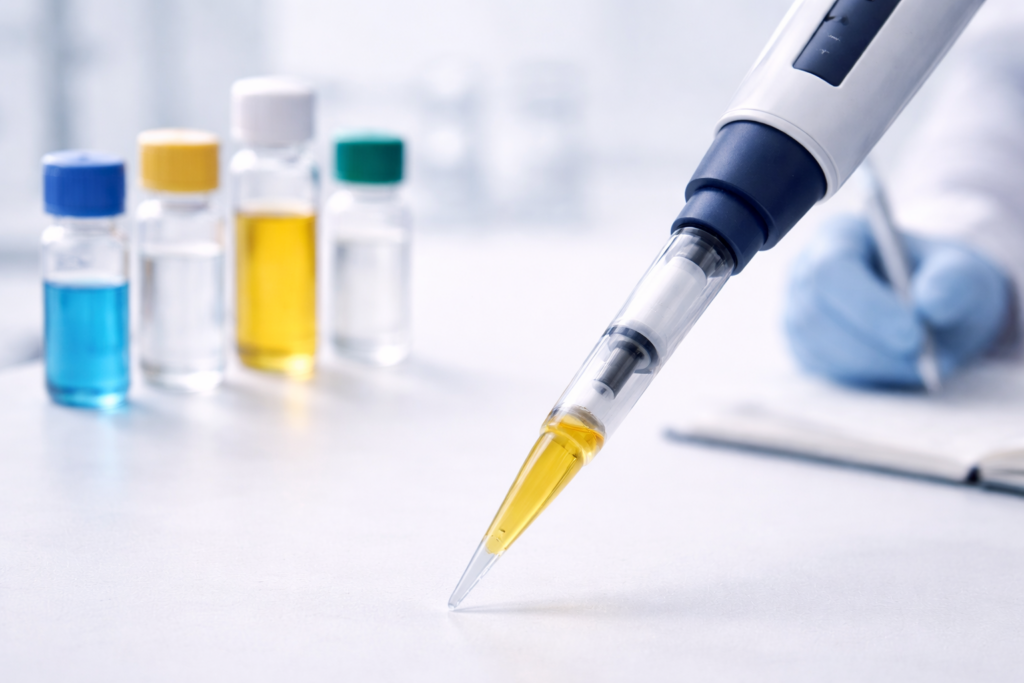
A positive displacement pipette is a specialized liquid handling instrument in which the piston makes direct contact with the aspirated sample, eliminating the air cushion present in conventional tools. This fundamental design difference addresses a critical gap in laboratory practice: standard air displacement pipettes fail when handling challenging liquids-volatile solvents that evaporate instantly, viscous samples that cling to tip walls, or biological fluids that foam unpredictably. Positive displacement pipettes solve these problems by removing the variable that causes 90% of pipetting errors when working with non-aqueous liquids: the compressible air gap.
Unlike air displacement pipettes, where temperature, pressure, viscosity, and vapor pressure all distort the air volume and compromise accuracy, a positive displacement pipette operates on a simple physical principle: liquid volume is proportional only to piston stroke distance. This independence from sample properties makes these instruments indispensable for specialized applications in molecular biology, forensic analysis, pharmaceutical development, and chemical research. Understanding when and how to deploy a displacement pipette can dramatically improve data quality and operator safety in your laboratory.
What Is a Positive Displacement Pipette?
A positive displacement pipette is a precision instrument where the piston mechanism is housed not in the pipette body, but within a disposable capillary/piston (CP) tip. This architectural distinction is the source of all its advantages and constraints.
In a traditional air displacement pipette, the piston remains fixed inside the reusable pipette shaft, separated from the liquid by an air cushion. This dead volume-typically 50–100 µL-acts as a compressible buffer that responds to sample properties, temperature fluctuations, and atmospheric conditions.
By contrast, in a positive displacement pipette, the piston travels inside the disposable tip itself, in direct contact with the liquid surface. The capillary bore is precisely machined (often to ±5 µm tolerances) so that a liquid-filled piston slides smoothly within it. When you draw back the plunger, the piston rises, pulling the sample upward into the capillary through surface tension. When you dispense, the piston descends and physically pushes every microliter from the tip-there is no air gap to expand or contract, no dead volume to harbor contaminants, and no surface film left clinging to the walls.
This direct piston-to-liquid contact is the defining characteristic of the positive displacement pipette. It eliminates the most significant source of error in non-aqueous liquid handling: the interaction between compressible gas and incompressible liquid under variable external conditions.
How Positive Displacement Pipettes Work
The operational sequence of a positive displacement pipette is straightforward but demands correct technique to yield its promised accuracy.
Step 1: Tip Attachment
Insert the disposable CP tip into the collet (chuck) at the pipette shaft and gently push until the tip seats fully. Some models require pressing the plunger to the first stop to lock the collet against the tip. Verify the fit is secure-a loose tip will leak and introduce air into the system.
Step 2: Pre-dispensing (First Stop)
Press the plunger to the first stop position. This action ejects air from the tip and prepares the capillary piston for aspiration. For volatile liquids, this also saturates the immediate environment with solvent vapor, reducing evaporation in subsequent steps.
Step 3: Aspiration
Immerse the tip vertically into the sample and slowly release the plunger, allowing it to return to the home position. As the plunger rises, the piston inside the tip simultaneously rises, creating a partial vacuum that draws the sample into the capillary. The volume aspirated is determined purely by the distance the piston travels-typically 1 mm of piston movement per microliter.
Step 4: Dispensing
Position the tip at the destination vessel and press the plunger to the first stop. The piston descends, forcing the liquid out of the capillary. Here is the critical advantage: because the piston makes flush contact with the capillary walls throughout its travel, virtually all sample is expelled. There is no residual film, no carryover, no incomplete delivery.
Step 5: Blow-Out (Optional)
Press the plunger past the first stop to a second detent position to eject the tip into the waste container. This secondary motion is optional for single-tip work but standard for multichannel positive displacement pipettes.
Why Volume Accuracy Is Independent of Vapor Pressure
In an air displacement pipette, when you aspirate an acetone sample at room temperature, acetone molecules continuously evaporate into the air cushion above them. As more acetone vaporizes, the air pressure in the sealed tip increases, pushing back against the piston and reducing the volume of liquid drawn in-even though you set the same target volume. The higher the volatility and the warmer the room, the more pronounced this error becomes.
In a positive displacement pipette, acetone molecules still evaporate, but they have nowhere to accumulate-they escape past the piston into the open air above. The liquid surface remains in direct contact with the descending piston, and the volume is determined solely by how far the piston travels. Volatility is irrelevant.
Similarly, when aspirating viscous glycerol with an air displacement pipette, the liquid’s high density compresses the air cushion, causing the air to shrink and the pipette to over-deliver (drawing more than the set volume). A positive displacement pipette feels no such effect because there is no air cushion to compress. The piston simply moves through its programmed stroke, and the volume delivered equals the capillary volume swept by that motion.
Positive vs. Air Displacement Pipettes (CRITICAL SECTION)
| Liquid Type | Best Choice | Key Reason |
|---|---|---|
| Aqueous solutions (pH 4–8, room temp) | Air displacement | Lower cost, higher throughput, sufficient accuracy for standard buffers and water |
| Organic solvents (acetone, methanol, hexane, acetonitrile) | Positive displacement | No air cushion = no evaporation loss, no vapor pressure leakage, no aerosol contamination |
| Viscous non-aqueous (pure glycerol, mineral oil, resin solutions) | Positive displacement | Piston makes direct contact; complete volume dispensing; no air compression artifacts |
| Blood, serum, plasma, semen | Positive displacement | Prevents foaming, eliminates air bubbles, complete dispensing without film carryover |
| Corrosive/hazardous chemicals (HCl, acetone, trichloromethane) | Positive displacement | Disposable tip protects pipette shaft; single-use piston prevents cross-contamination and operator exposure |
| Samples at non-ambient temperature (4°C, 37°C, 60°C) | Positive displacement | Temperature-independent; thermal expansion of air cushion does not affect delivered volume |
| Foaming liquids (detergents, surfactants, whole blood) | Positive displacement | Direct contact prevents bubble formation; piston does not trap air pockets |
| High-density solutions (glycerol, DMSO, silicone oil) | Positive displacement | No air compression; consistent accuracy across density ranges |
| Aqueous solutions requiring multichannel speed (96-well plate) | Air displacement | Positive displacement lacks 96-channel options; cost-prohibitive for high-throughput |
The contrast is stark: air displacement pipettes assume the sample behaves like water. They excel when that assumption holds true. The moment you deviate-into solvents, viscous media, or biological complexity-those assumptions collapse, and air displacement pipettes become a source of systematic error. A positive displacement pipette removes those assumptions entirely by eliminating the air variable.
When Should You Use a Positive Displacement Pipette?
1. Organic Solvents and Volatile Liquids
Acetone, ethanol, methanol, hexane, and other volatile compounds evaporate rapidly in open air. When aspirated with an air displacement pipette, they evaporate into the air cushion, increasing internal pressure and causing droplets to leak from the tip even before you dispense. These lost droplets are a safety hazard (chemical vapor exposure), a contamination risk (bench contamination, cross-sample transfer), and a measurement error (you deliver less than intended). A positive displacement pipette eliminates evaporation loss entirely because the liquid remains in sealed contact with the piston-no air cushion to fill with vapor, no pressure buildup, no leakage.
2. High-Viscosity Liquids
Glycerol, honey, castor oil, and protein solutions move slowly. When you aspirate viscous fluid with an air displacement pipette at standard speed, you draw air bubbles into the tip-the viscous sample cannot fill the dead space fast enough. When you dispense, that bubble expands, and much of the sample remains stuck to the tip walls. A positive displacement pipette solves this by: (a) making direct piston contact, which pushes every molecule from the tip, and (b) providing tactile feedback so you can aspirate at the correct slow speed without air bubbles forming.
3. Biological Fluids (Blood, Semen, Saliva, Cerebrospinal Fluid)
These samples are complex: they foam easily, contain suspended cells that degrade under pressure, and pose biohazard risks. Air displacement pipettes can trap air pockets (especially in samples with cells or proteins), causing bubble-related errors and aerosol contamination. A positive displacement pipette eliminates these risks through direct piston contact and disposable single-use tips that contain all aerosols within the sealed tip.
4. Corrosive and Hazardous Chemicals
Hydrochloric acid, strong oxidizers, and other corrosive compounds damage the seals, shafts, and pistons of reusable pipette components over time. A positive displacement pipette uses a single-use disposable capillary piston, so the expensive pipette body never contacts the damaging sample. This protects equipment longevity and reduces operator exposure to hazardous vapors (the sealed tip contains the sample; the piston seal never touches the corrosive liquid).
5. Temperature-Sensitive Samples
Cold samples (0°C restriction enzyme solutions, PCR reaction mixes at 4°C) cause the air in an air displacement pipette to cool and shrink, reducing tip pressure and causing over-delivery (more liquid drawn than intended). Hot samples (60°C PCR product, 37°C cell culture) cause the opposite: air expansion, under-delivery. A positive displacement pipette is unaffected by sample temperature because there is no temperature-sensitive gas phase.
6. Foaming Liquids
Detergents, surfactants, and biological fluids with suspended bubbles are problematic for air displacement pipettes because air pockets form, trap foam, and distort the measured volume. A positive displacement pipette’s direct piston contact prevents bubble formation in the first place.
In summary: if your sample deviates from “room-temperature aqueous solution,” a positive displacement pipette merits serious consideration.
Advantages of Positive Displacement Pipettes
1. Superior Accuracy and Precision with Challenging Liquids
When handling viscous, volatile, or biological samples, positive displacement pipettes deliver 3–4 times better accuracy than air displacement alternatives-not because the mechanics are superior, but because they remove the variables that distort air displacement results. Published studies consistently show systematic error reductions of 50–80% when switching to positive displacement pipettes for non-aqueous work.
2. Complete Volume Dispensing-No Carryover
The piston’s direct contact with capillary walls ensures that nearly 100% of the aspirated volume is expelled. In contrast, air displacement pipettes typically leave a residual film (2–5% of the tip volume) clinging to the walls because the air cushion cannot reach the last few microliters. For applications requiring maximal accuracy-quantitative PCR, trace analysis, forensic DNA recovery-this difference is material.
3. Zero Evaporation Loss
With volatile solvents, an air displacement pipette loses measurable volume to evaporation before you finish dispensing. A positive displacement pipette prevents this entirely because the piston-sealed capillary is a closed system until the very moment of dispense. Samples remain chemically intact and quantitatively unchanged.
4. No Aerosol or Vapor Contamination
Because the piston seals the sample inside the capillary tip during aspiration and dispensing, no aerosols escape into the lab air. For volatile organic compounds (VOCs), biohazards, and radioactive materials, this containment is both a safety feature and a contamination-prevention measure. The lab environment remains cleaner, and operator exposure is minimized.
5. Temperature Independence
A positive displacement pipette delivers the same volume whether your sample is at 4°C or 60°C. There is no thermal expansion of a gas phase to distort the measurement. This is critical for cold rooms (4°C incubation facilities), thermal cycling (PCR workflows), or any temperature-controlled environment where air displacement pipettes would be mis-calibrated.
6. Single-Use Piston Eliminates Cross-Contamination
Each positive displacement pipette tip includes a disposable piston that is discarded after use. This eliminates the cross-contamination risk inherent in reusable air displacement pistons, which can transfer sample residue, salts, or contaminants from one use to the next. For forensic DNA work, microbial analysis, or clinical diagnostics, this isolation is invaluable.
7. Protection for Equipment and Operator
When pipetting corrosive or hazardous materials, the disposable capillary piston absorbs the chemical damage that would otherwise degrade the pipette shaft and seals. The operator never directly handles the hazardous liquid; the sealed tip contains it. For radioactive samples, a positive displacement tip can be disposed of as contaminated waste without risk of spreading contamination to the pipette itself.
Limitations and Trade-offs
1. Higher Consumables Cost
Disposable capillary piston tips are significantly more expensive than standard air displacement tips-typically 5–15 times higher per tip. For a lab running 1,000+ pipetting operations daily, this cost difference can reach hundreds of dollars per week. For low-throughput or occasional use, the cost is justified; for high-volume production, it may not be economically feasible.
2. Limited Throughput and Multichannel Options
Most positive displacement pipettes are single-channel instruments. While multichannel versions exist, they are rare, expensive, and available only in limited channel counts (12 or 24 channels rather than 96). Labs requiring 96-well plate automation must rely on air displacement systems for speed. This makes positive displacement pipettes unsuitable for large-scale screening or high-throughput assays.
3. Smaller Volume Range Coverage
Positive displacement pipettes typically cover narrow ranges-0.5–10 µL, 3–25 µL, 10–100 µL. Stacking multiple instruments to cover a broad range is costly. Air displacement pipettes offer wider single-channel ranges (0.5–1000+ µL), reducing the need for multiple tools.
4. Steeper Operator Learning Curve
Correct aspiration speed and technique differ markedly between positive and air displacement pipettes. Operators accustomed to air displacement may over-aspirate with positive displacement instruments, drawing air into the tip and negating the accuracy advantage. Training is essential; misuse will produce poor results.
5. Tip Attachment and Tip Availability
Not all positive displacement tip formats are compatible with all pipette bodies. Some models use proprietary collet designs, limiting tip sourcing to expensive original manufacturers. Ensuring adequate tip supply is critical-running out of the correct tips during an experiment is a costly problem.
6. Maintenance and Calibration Requirements
Although generally robust, positive displacement pipettes require regular calibration (6–12 months) and careful storage. Leaving them on the bench rather than on a hanger can damage the piston mechanism. Preventive maintenance is essential for longevity.
Best Practices for Accurate Liquid Handling
Tip Installation
Secure the CP tip fully into the collet, ensuring a tight seal. For many models, press the plunger to the first stop to lock the collet mechanism. Verify the tip does not rotate or slide-a loose tip will compromise accuracy immediately. Inspect the tip for cracks, debris, or manufacturing defects before use; discard any questionable tips.
Aspiration Speed and Technique
Release the plunger slowly-taking 1–2 seconds to return to the home position. Rapid aspiration can introduce air bubbles (especially with viscous samples) or create pressure waves that compromise accuracy. Keep the pipette vertical and maintain gentle, steady pressure throughout. For very viscous liquids, allow an additional 0.5–1 second of settling time before dispensing to ensure the sample fully occupies the capillary.
Pre-Wetting for Volatile Liquids
Before aspirating the final sample volume, aspirate and dispense the target liquid 3–5 times, keeping the tip immersed. This saturates the immediate capillary environment with solvent vapor, reducing evaporation from the final sample. For extremely volatile compounds (100% ethanol, acetone), increase pre-wetting to 5–8 cycles.
Accurate Liquid Handling with Consistent Methodology
When performing quantitative liquid handling across multiple samples, maintain identical technique: identical aspiration speed, identical tip immersion depth, identical pause duration before dispensing. Consistency is the foundation of precision. Record procedural details in your protocol so that repeat assays use identical liquid handling parameters.
Minimizing Carryover Between Samples
While positive displacement pipettes dramatically reduce carryover compared to air displacement tools, you can further minimize it by: (a) rinsing the tip between samples if conducting sequential pipetting from a shared stock solution, or (b) using fresh tips for each sample if maximum contamination prevention is required. The disposable nature of the piston means that carryover-prevention cost is simply the cost of an extra tip.
Storage and Maintenance
Store positive displacement pipettes vertically on a stand or hanger to prevent dust ingress and piston mechanism strain. Do not leave them lying on the bench. At regular intervals (weekly for heavily used pipettes), inspect the tip attachment mechanism and collet for debris or damage. Clean the outside of the pipette shaft with a lint-free cloth and approved solvent. Calibration should be performed every 6–12 months, depending on use intensity; maintain calibration records for GLP/GMP compliance.
Common Mistakes and Troubleshooting
Under-Dispensing (Delivering Less Than the Set Volume)
Cause 1: Loose Tip
If the CP tip is not securely seated in the collet, the piston will not make full contact with the capillary, and volume will be lost.
Solution: Re-seat the tip firmly and verify the collet lock engages.
Cause 2: Cracked or Damaged Capillary
A hairline crack in the tip allows the sample to leak internally, reducing delivered volume.
Solution: Discard the tip and start with a new one from a fresh package.
Cause 3: Incorrect Aspiration Speed (Too Fast)
Drawing the plunger too quickly can introduce air into the capillary, leaving an air bubble that reduces effective capillary volume.
Solution: Slow down; take 1.5–2 seconds for complete aspiration. Practice with test liquid.
Cause 4: Inadequate Sample Immersion
If the tip is not submerged deeply enough during aspiration, air enters the capillary.
Solution: Immerse the tip at least 5–10 mm into the sample vessel.
Sample Carryover Between Samples
Cause: Insufficient rinsing or tip reuse without cleaning.
Solution: For serial sampling from a stock, aspirate and dispense the stock 2–3 times between samples to flush residue. For maximum purity, use a fresh tip for each sample-the disposable design makes this economical for small batches.
Tip Leakage During Aspiration or Dispensing
Cause 1: Over-Pressurization
Pressing the plunger too forcefully, especially on the second stop (blow-out), can exceed the tip’s seal pressure and cause leakage.
Solution: Press gently to the first and second stops; do not force.
Cause 2: Mismatched Tip and Pipette
A tip designed for one pipette model may not seal correctly in another’s collet.
Solution: Verify tip compatibility with your specific pipette model.
Cause 3: Contaminated Collet
Dust or sample residue on the collet threads prevents a tight seal.
Solution: Clean the collet with a lint-free cloth and allowed solvent, then dry thoroughly.
Wrong Application Choice
Scenario: A researcher uses a positive displacement pipette for routine aqueous buffer solutions, spending premium tip costs unnecessarily.
Solution: Reserve positive displacement pipettes for challenging liquids (organic solvents, viscous samples, biological fluids, temperature-sensitive samples). Use air displacement pipettes for routine aqueous work to optimize cost and throughput.
FAQ
Q: What are positive displacement pipettes used for?
Positive displacement pipettes are used to accurately dispense volatile organic solvents (acetone, methanol, ethanol), viscous liquids (glycerol, oils, blood), corrosive chemicals, biological samples (serum, semen), and temperature-sensitive materials where standard air displacement pipettes fail due to evaporation, air bubble formation, or thermal expansion errors. They are essential in molecular biology, forensic science, pharmaceutical development, and chemical analysis where sample integrity and measurement accuracy are critical.
Q: What is the difference between positive and air displacement pipettes?
The fundamental difference lies in whether an air gap exists between the piston and the sample. Air displacement pipettes maintain a cushion of air between the piston and liquid; this air responds to temperature, pressure, and sample volatility, causing systematic errors. Positive displacement pipettes eliminate this air gap entirely-the piston is housed in the disposable tip and makes direct contact with the liquid. This design removes the variables that distort non-aqueous pipetting, delivering superior accuracy for challenging samples at the trade-off of higher tip costs and lower throughput.
Q: Are positive displacement pipettes more accurate?
For aqueous solutions at room temperature, air and positive displacement pipettes are comparably accurate. For volatile, viscous, or biological samples, positive displacement pipettes are dramatically more accurate-delivering 3–4 times better precision and 50–80% lower systematic error. The advantage emerges only when the sample properties challenge air displacement assumptions; for standard buffers, positive displacement offers no benefit over cost-effective air displacement tools.
Q: Do positive displacement pipettes need calibration?
Yes. Positive displacement pipettes should be calibrated every 6–12 months (more frequently if used heavily), following ISO 8655 gravimetric methods. Calibration includes verification of accuracy across the volume range, assessment of precision, and adjustment of piston mechanics as needed. Regular preventive maintenance (seals, lubrication, collet inspection) can prevent 97% of calibration drift; only ~3% of errors require true recalibration after preventive steps are completed.
Key Takeaways
- Use positive displacement pipettes for volatile, viscous, biological, corrosive, or temperature-sensitive samples-these are the only scenarios where they outperform air displacement alternatives.
- The piston-in-tip design is the enabler: by eliminating the air cushion, positive displacement pipettes remove temperature, pressure, and volatility as error sources, delivering accuracy independent of sample properties.
- Accuracy gain is material for challenging liquids: expect 3–4× improvement in precision when switching from air displacement to positive displacement pipettes for non-aqueous work, backed by peer-reviewed research.
- Cost is the primary limitation: disposable capillary piston tips are 5–15× more expensive than standard tips, and multichannel throughput options are limited or unavailable, restricting positive displacement to low-throughput, high-accuracy workflows.
- Technique matters: slow, deliberate aspiration (1–2 seconds), secure tip seating, and pre-wetting for volatile samples are non-negotiable for realizing the accuracy advantage.
- Contamination prevention is built-in: the disposable piston eliminates cross-sample contamination and protects operators from hazardous materials; this safety benefit justifies cost in forensic, microbiological, and clinical laboratories.
- Calibration and maintenance are essential: perform gravimetric calibration every 6–12 months, store on a hanger (never on the bench), and conduct preventive maintenance annually to ensure continued accuracy and equipment longevity.
- Choose the right tool for the job: reserve positive displacement pipettes for applications where sample properties challenge standard air displacement performance; use air displacement pipettes for routine aqueous work to optimize throughput and cost.