
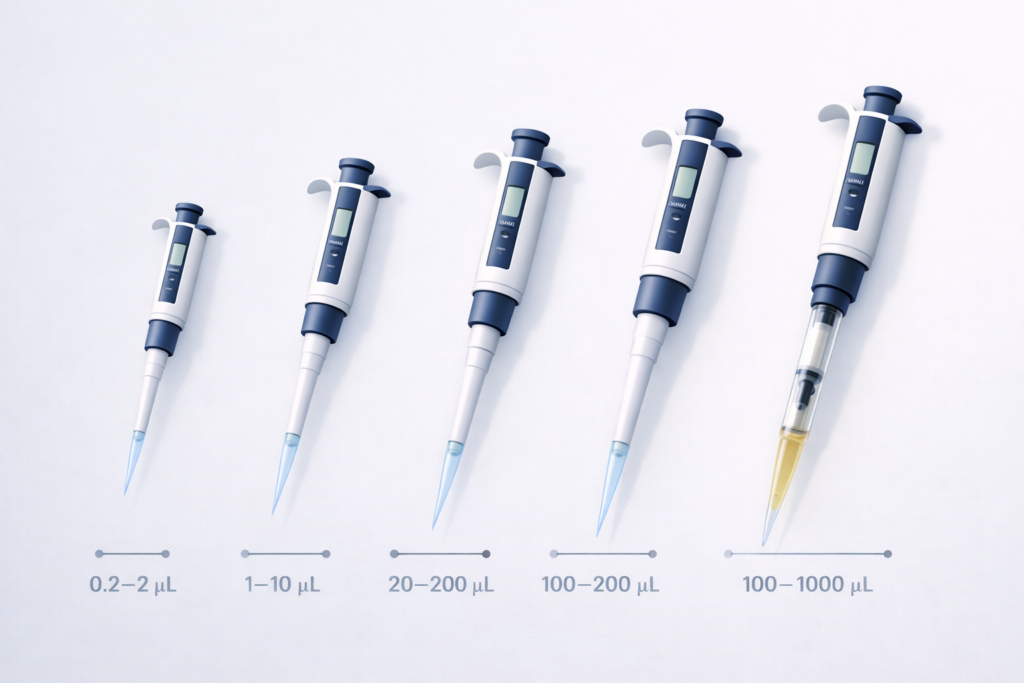
Choosing a pipette is often treated as a simple decision, but volume range matters far more than many users realize. Every pipette is designed to deliver its highest accuracy only within a specific portion of its stated range. When you work too close to the minimum or maximum, errors increase-even if the instrument is well maintained. This guide explains how pipettes by volume range truly work, why accuracy drops at extremes, and how to select the right tool for any task. By the end, you’ll have a clear, repeatable framework for making confident, defensible pipette choices in real laboratory conditions.
Why Volume Range Matters in Pipetting Accuracy
Accuracy vs. precision (briefly):
Accuracy describes how close a delivered volume is to the true value. Precision describes how consistently the same volume is delivered across repetitions. A pipette can be precise but inaccurate, or accurate once but not repeatable. Volume range directly affects both.
Why working near minimum or maximum causes errors:
At the low end of a pipette’s range, mechanical tolerances, air cushion instability, and evaporation effects become significant. At the high end, piston travel limits and seal deformation introduce variability. These effects are inherent to design, not user error.
The 20–80% rule:
Most laboratories follow a practical guideline: aim to pipette between 20% and 80% of a pipette’s nominal range. This is where accuracy and precision are most stable, and where calibration specifications are typically optimized.
Common Pipette Volume Ranges Explained
Sub-microliter (<1 µL)
These volumes are extremely sensitive to temperature, humidity, and handling technique. Small air movements, tip wetting, and surface tension dominate performance. Use only when necessary and with strict technique control.
Low volume (1–10 µL)
Common in molecular biology and analytical chemistry. Errors here are often invisible but impactful. Consistent pre-wetting and slow aspiration are critical.
Medium volume (10–200 µL)
This is the most forgiving range and the backbone of routine lab work. Accuracy is generally robust, and technique variation has a smaller effect.
High volume (200–1000 µL)
Used for buffers, media, and sample preparation. Mechanical effort increases, and fatigue can affect consistency during repetitive tasks.
Macro volumes (>1 mL)
Often handled by specialized instruments rather than standard micropipettes. Air displacement limitations become significant, especially with viscous liquids.
Standard Micropipette Sizes and Their Ideal Use
| Pipette | Nominal Range | Ideal Working Range | Typical Use |
|---|---|---|---|
| P2 | 0.2–2 µL | 0.5–1.5 µL | Enzymes, primers, trace reagents |
| P10 | 1–10 µL | 2–8 µL | DNA/RNA prep, small aliquots |
| P20 | 2–20 µL | 5–15 µL | Concentrated reagents |
| P200 | 20–200 µL | 40–160 µL | General lab work |
| P1000 | 100–1000 µL | 200–800 µL | Buffers, media |
This table illustrates why a single “do-everything” pipette is a myth. Each size has a sweet spot where performance is strongest.
How to Choose the Right Pipette for a Specific Volume
Example: measuring 5 µL
A P10 is the correct choice. A P20 can technically deliver 5 µL, but it operates too close to its lower limit, increasing variability.
Example: measuring 150 µL
A P200 is ideal. The volume sits comfortably within the 20–80% range, offering strong accuracy and repeatability.
Example: measuring 900 µL
A P1000 should be used. Attempting this volume with a smaller pipette would require multiple transfers and compound error.
What to do if you’re between two ranges:
Choose the pipette where the target volume falls closer to the middle of the range. This often means selecting the smaller of the two compatible options, as long as the volume is not near its upper limit.
What Happens If You Use the Wrong Volume Range
Under-delivery:
At very low settings, incomplete aspiration and evaporation lead to systematically low volumes.
Over-delivery:
Near maximum settings, piston overtravel and seal compression can cause excess liquid uptake.
Increased coefficient of variation (CV):
Even if the mean volume appears correct, run-to-run variability increases, undermining quantitative work.
Tip wetting errors:
At extremes, inconsistent liquid films inside the tip amplify error, especially for aqueous solutions.
These effects explain why simply “setting the dial” is not enough for reliable pipetting.
Manual vs Electronic Pipettes for Different Volume Ranges
At low volumes, stability of aspiration speed and consistent plunger movement matter more than force. For repetitive mid-range work, automation reduces operator variability and fatigue. At high volumes, physical effort becomes a limiting factor during long sessions. In this context, manual pipettes require more technique discipline, while electronic pipettes can improve consistency by standardizing motion-particularly in repetitive protocols.
Real-World Lab Scenarios
Only one pipette available:
If forced to use a single instrument, stay as far from the minimum setting as possible. Adjust protocols to avoid extreme volumes when feasible.
Measuring uncommon volumes (e.g., 159 µL):
Select a pipette whose ideal working range covers the volume, even if the number looks arbitrary. Precision matters more than round values.
Working below the recommended minimum:
If unavoidable, increase repetitions, pre-wet tips thoroughly, and document the limitation. Understand that accuracy claims no longer apply.
FAQ
1) What size pipette should I use for 10 µL?
A P10 is optimal because 10 µL is at the top of its ideal range, while larger pipettes operate too close to their minimum.
2) Can a P200 accurately measure 20 µL?
It can, but accuracy and precision are reduced. A smaller pipette designed for that range will perform better.
3) Why shouldn’t I pipette at the extreme limits?
Mechanical tolerances, air cushion instability, and evaporation effects dominate at extremes, increasing error.
4) What is the most versatile pipette size?
The P200 is often considered the most versatile due to its broad, stable mid-range coverage.
Key Takeaways
- Volume range directly controls pipetting accuracy and precision.
- The 20–80% rule is a practical accuracy safeguard.
- Each pipette size has a defined performance “sweet spot.”
- Working near minimum or maximum settings increases error.
- Choose the pipette where your target volume sits closest to mid-range.
- Technique cannot fully compensate for poor range selection.
- Document limitations when working outside recommended ranges.
- Understanding ranges beats relying on habit or convenience.