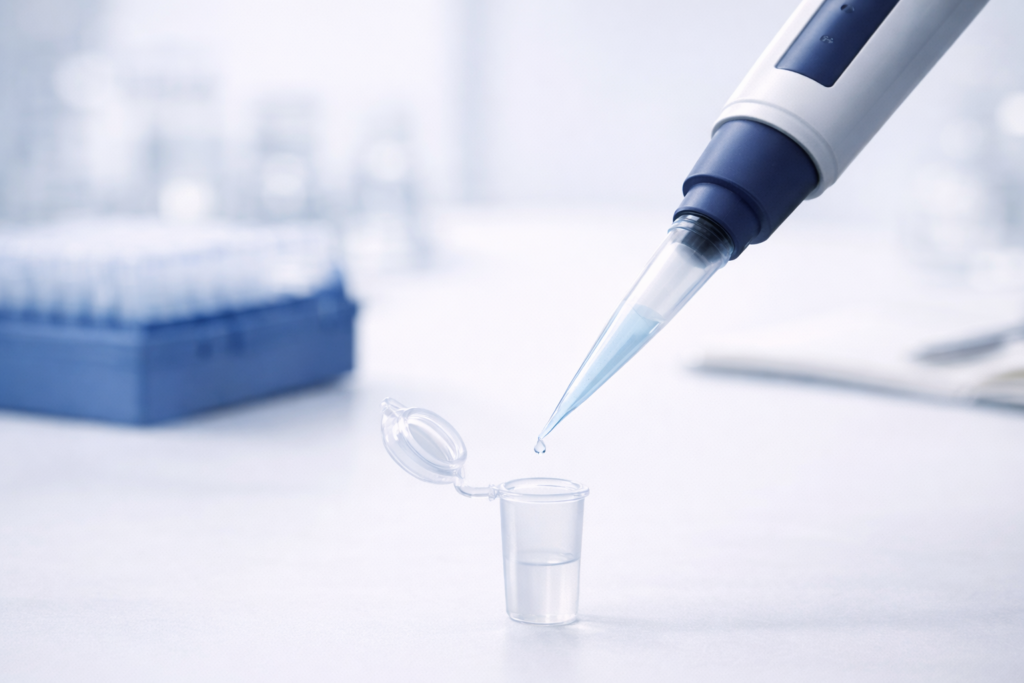
Ultra-low volume pipetting (0.1–2 µL) sits at the edge of what air-displacement tools can reliably handle. At this scale, evaporation, liquid retention, and minute technique differences dominate your error budget. A 0.02 µL loss may look trivial-but at 0.2 µL it’s a 10% error. This guide explains why these volumes are difficult, which tools actually work at each target volume, and how to execute step-by-step techniques that labs use to stay accurate. You’ll also get troubleshooting tables and practical alternatives when 0.1 µL transfers aren’t realistic.
Why 0.1–2 µL Is So Hard to Pipette
Evaporation and temperature effects
At sub-microliter scales, evaporation happens during aspiration, dwell, and dispense-especially with warm tips or volatile solvents. A few seconds of delay can measurably reduce delivered volume. Temperature mismatches between pipette, tips, and sample increase air expansion/contraction, adding bias.
Surface tension and droplet retention
Surface tension dominates gravity. Liquids cling to plastic, forming menisci that refuse to release. Even with low-retention plastics, droplets can hang inside the tip or on the rim, causing under-delivery unless technique compensates.
Why small absolute errors become huge relative errors
A ±0.02 µL absolute error is negligible at 20 µL, but catastrophic at 0.2 µL. This is why accuracy specs look “good” on paper yet fail in practice if technique isn’t optimized.
Which Pipette Should You Use for 0.1, 0.2, 0.5, 1, and 2 µL?
Decision guide (tool realism vs. technique burden):
| Target volume | Best tool | Why | Notes |
|---|---|---|---|
| 0.1 µL | Positive displacement | Eliminates air cushion; best control | Air-displacement is unreliable here |
| 0.2 µL | Positive displacement (preferred) | Minimizes evaporation/retention | P2 only with expert technique |
| 0.5 µL | P2 (lower half) or positive displacement | Feasible with strict SOP | Use low-retention tips |
| 1.0 µL | P2 (sweet spot) | Most P2s are accurate here | Pre-wetting matters |
| 2.0 µL | P2 (upper end) | Easier release and repeatability | Watch immersion depth |
Clear guidance:
- A standard P2 is realistic from ~0.5–2.0 µL with disciplined technique.
- Below 0.5 µL, success depends more on operator skill than specs; positive displacement becomes the practical choice.
- Specialty micro-tools can help, but technique still dominates outcomes at these scales-especially for volume pipettes used near their minimum.
Tips Matter More Than the Pipette at Ultra-Low Volumes
Low-retention tips
Use certified low-retention plastics to reduce droplet hang-up. Avoid generic tips with loose fits or inconsistent surface treatments.
Filtered vs non-filtered
- Filtered tips: Use when aerosol contamination or enzymes (PCR/qPCR) are involved.
- Non-filtered tips: Acceptable for clean aqueous work; often release droplets more easily.
Tip fit and sealing
A poor seal creates aspiration variability. Seat tips consistently-firm, straight, and without rocking.
Pre-wetting: when and how (short SOP)
Pre-wetting coats the tip interior, stabilizing aspiration.
SOP: Aspirate and dispense the target volume 2–3 times into waste; proceed immediately to the real transfer. Skip pre-wetting only when evaporation risk outweighs benefit (very volatile solvents).
Technique SOP (Step-by-step)
Forward pipetting (ultra-low volumes)
- Set volume; attach a fresh low-retention tip.
- Pre-wet (2–3 cycles) if appropriate.
- Hold pipette vertical; immerse tip 0.5–1 mm only.
- Aspirate slowly to the first stop; pause 1–2 s.
- Withdraw tip smoothly; avoid wiping the exterior.
- Dispense to the second stop with a brief touch-off to the vessel wall.
- Pause 1 s, then withdraw.
Use when: aqueous samples, 0.5–2 µL, when release is reliable.
Reverse pipetting (when it helps)
- Press to the second stop before aspiration.
- Aspirate slowly; pause 2 s to equilibrate.
- Dispense to the first stop only (leave excess in tip).
- Touch-off gently; discard remaining liquid.
Why it helps: Improves consistency when droplets hang or viscosity increases.
Notes: Keep immersion shallow and dwell times consistent. For viscous samples, slow everything down; for aqueous buffers, consistency beats speed.
Common Mistakes (and How to Fix Them)
| Symptom | Likely cause | Quick fix | Prevention |
|---|---|---|---|
| Bubbles in tip | Too fast aspiration; poor seal | Slow down; reseat tip | Practice slow, vertical aspiration |
| Inconsistent dispenses | Temperature mismatch | Equilibrate tips/samples | Work at room temp |
| Droplets hanging | Tip surface/technique | Reverse pipetting; touch-off | Low-retention tips |
| Sample loss | Evaporation delay | Shorten dwell time | Work efficiently |
| Below minimum range | Tool mismatch | Switch tools or redesign | Avoid <0.5 µL on P2 |
When to Switch to Positive Displacement
Choose positive displacement when working with volatile solvents, viscous liquids, or hazardous samples. By removing the air cushion, these systems prevent evaporation bias and improve release at tiny volumes. They also reduce operator-to-operator variability-critical when results must be reproducible across shifts.
Practical Lab Scenarios
PCR/qPCR master mix setup
Avoid adding 0.1–0.2 µL of enzyme directly. Instead, pre-dilute the enzyme so you can add 1–2 µL accurately. This improves precision and reduces enzyme loss on plastics.
Enzyme addition
Use reverse pipetting with low-retention tips; keep enzymes cold but equilibrate tips briefly to avoid condensation artifacts.
Serial dilution at very small volumes
Don’t chase 0.1 µL transfers. Redesign the dilution (e.g., 1:10 using 1 µL into 9 µL) or create an intermediate dilution to keep transfers ≥1 µL.
FAQ
1) Can you pipette 0.1 µL?
Yes, but not reliably with standard air-displacement tools. Positive displacement or redesigned workflows (pre-dilutions) are the practical solutions.
2) Can you pipette 0.2 µL?
Expert operators may succeed with a P2, but variability is high. Positive displacement dramatically improves repeatability.
3) Can you pipette 1 microliter accurately?
Yes. Most P2 pipettes perform best around 1 µL when paired with low-retention tips and consistent technique.
4) What should I do if I need 0.1 µL but only have a P2?
Redesign the protocol: pre-dilute the reagent so you can transfer ≥1 µL, or use reverse pipetting and accept higher uncertainty.
Key Takeaways
- Below 0.5 µL, technique dominates specs-choose tools accordingly.
- Low-retention tips and a good seal are non-negotiable.
- Pre-wetting stabilizes results for aqueous samples.
- Reverse pipetting improves consistency when droplets hang.
- Redesign protocols to avoid sub-0.5 µL transfers when possible.
- Positive displacement wins for volatile, viscous, or hazardous liquids.
- Keep temperature and timing consistent to limit evaporation bias.