
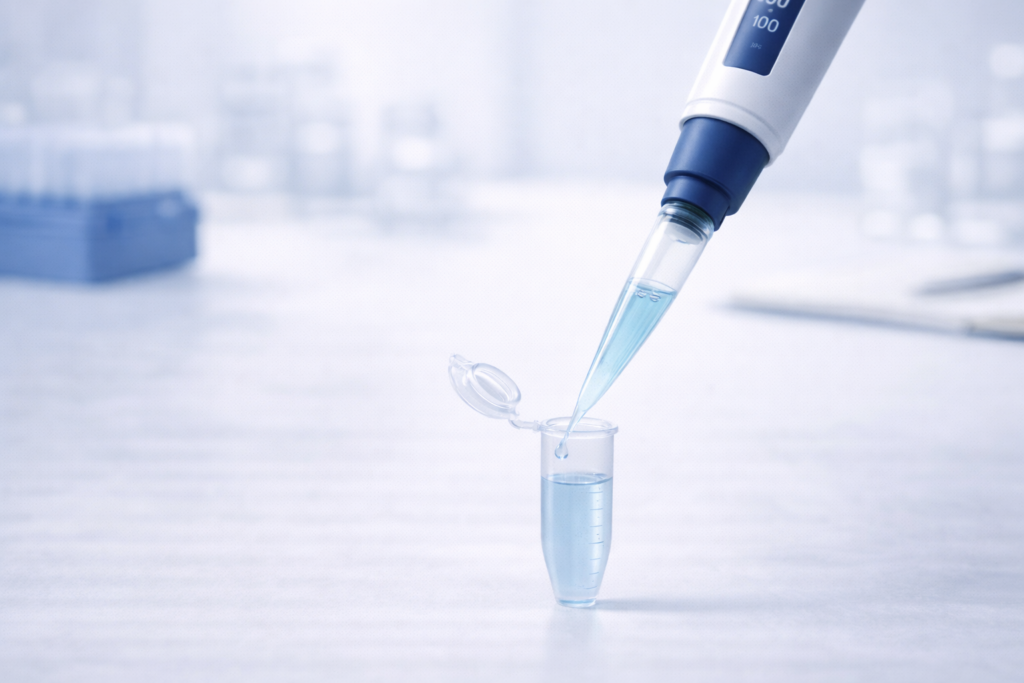
A 100–1000 µL pipette, commonly called a P1000, is designed for transferring relatively large microliter volumes in routine laboratory work. While it looks similar to smaller micropipettes, accuracy and technique change significantly as volume increases. Air displacement behavior, plunger control, and tip filling dynamics all become more critical above 500 µL. Many errors occur when P1000 pipettes are used outside their optimal range-especially at the low end. This guide explains how P1000 pipettes really perform, where they are most accurate, proper technique, and when you should not use one at all.
What Is a 100–1000 µL Pipette Used For?
A P1000 pipette is typically used for bulk liquid handling, not precision micro-dispensing. Common applications include:
- Dispensing buffers and wash solutions
- Aliquoting culture media
- Transferring non-viscous reagents
- Adding master mixes in molecular workflows
The P1000 is popular because it covers a wide range of volumes with one tool. However, this versatility often leads to misuse-especially when it replaces smaller pipettes for convenience. While it can dispense 100 µL, that does not mean it should.
Accuracy Zones of a P1000 Pipette
Pipettes are calibrated to perform best near the middle to upper portion of their range. Accuracy and precision decline rapidly near the minimum setting.
| Volume Range | Accuracy Level | Recommendation | Risk |
|---|---|---|---|
| 100–200 µL | Low | Avoid if possible | High variability, poor reproducibility |
| 300–600 µL | Moderate | Acceptable for non-critical work | Increased CV vs smaller pipettes |
| 700–1000 µL | High | Optimal operating range | Minimal if technique is correct |
Key point: A P1000 is most reliable above ~70% of its maximum volume. Below that, mechanical tolerances and air cushion instability dominate error.
Why P1000 Is Not Ideal for Low Volumes
Using a P1000 at 100–200 µL creates several compounding problems:
Mechanical limitations
At low settings, the plunger travel is minimal. Small inconsistencies in thumb pressure cause large percentage errors.
Error amplification
A ±5 µL deviation at 100 µL equals a 5% error-unacceptable in most assays.
Poor resolution
Volume adjustment increments are coarser than on a P200 or P300, making fine control difficult.
Rule of thumb:
- Use P200 for 20–200 µL
- Use P300 for 50–300 µL
- Reserve P1000 for ≥300 µL
P1000 vs Serological Pipettes
For repeated large-volume transfers, a P1000 may not be the best tool at all.
| Feature | P1000 | Serological Pipette |
|---|---|---|
| Accuracy | High (single dispense) | Moderate |
| Speed | Slow for repeated transfers | Very fast |
| User fatigue | High over time | Low |
| Volume range | Max 1 mL | 1–50 mL |
| Best use | Precise 0.3–1 mL transfers | Bulk liquid handling |
If you are dispensing multiple milliliters, switching to serological pipettes or automated dispensers improves consistency and ergonomics.
Proper Technique for Pipetting 100–1000 µL
Forward pipetting SOP
- Pre-wet the tip 2–3 times at target volume
- Press plunger to first stop
- Immerse tip 3–5 mm below liquid surface
- Aspirate slowly and smoothly
- Pause briefly before withdrawal
- Dispense at a slight angle against tube wall
Speed and plunger control for large volumes
Large volumes require slower aspiration. Fast plunger release introduces turbulence, leading to bubbles and under-aspiration.
Preventing splashing and bubbles
- Keep dispense speed controlled
- Use angled dispensing
- Avoid “blow-out” into shallow vessels
- Never eject liquid forcefully
Choosing Tips for 100–1000 µL Pipettes
Tip selection has a larger impact at high volumes than most users realize.
Tip capacity and overflow risks
Some tips labeled “1000 µL” overflow at ~900 µL depending on liquid properties. Always leave headspace.
Standard vs wide-bore tips
- Standard tips: General aqueous solutions
- Wide-bore tips: Viscous buffers, cell suspensions
Tip sealing importance
Poorly seated tips cause:
- Leaks
- Inconsistent aspiration
- Aerosol formation
Always press tips firmly but avoid excessive force that can deform seals.
Common Mistakes When Using P1000 Pipettes
| Mistake | Cause | Fix | Prevention |
|---|---|---|---|
| Using P1000 for 100 µL | Convenience | Switch to P200 | Match pipette to volume |
| Splashing and aerosols | Fast dispense | Slow plunger release | Angle dispense |
| Inconsistent dispense | Poor tip seal | Reseat or replace tip | Standardized loading |
| Wrong tip size | Mismatched capacity | Use rated tips | Tip labeling checks |
Typical Applications for 100–1000 µL Pipettes
P1000 pipettes excel when:
- Preparing media aliquots
- Dispensing buffers into tubes or plates
- Transferring samples ≥300 µL
- Adding reagents where ±1–2% error is acceptable
They are not ideal when:
- Precision below 200 µL is required
- High-throughput dispensing is needed
- Viscous or foaming liquids dominate
In these cases, smaller pipettes, serological pipettes, or automation provide better outcomes.
FAQ
1) How many mL is 1000 µL?
1000 µL equals 1 milliliter (mL).
2) Is a P1000 accurate at 100 µL?
No. Accuracy and precision are poor at the low end of its range. A P200 is more appropriate.
3) Why are pipettes called P1000?
The “P” stands for pipette, and “1000” indicates the maximum volume in microliters.
4) When should I not use a P1000 pipette?
Avoid it for volumes below 200–300 µL, high-throughput dispensing, or when working with highly viscous liquids.
Key Takeaways
- P1000 pipettes are most accurate above 700 µL
- Avoid using P1000 for 100–200 µL volumes
- Slow aspiration and dispense are critical at large volumes
- Tip choice and sealing strongly affect accuracy
- Repeated large-volume transfers favor serological tools
- Match pipette range to target volume-not convenience
- Pre-wetting tips improves reproducibility
- Technique matters more as volume increases