
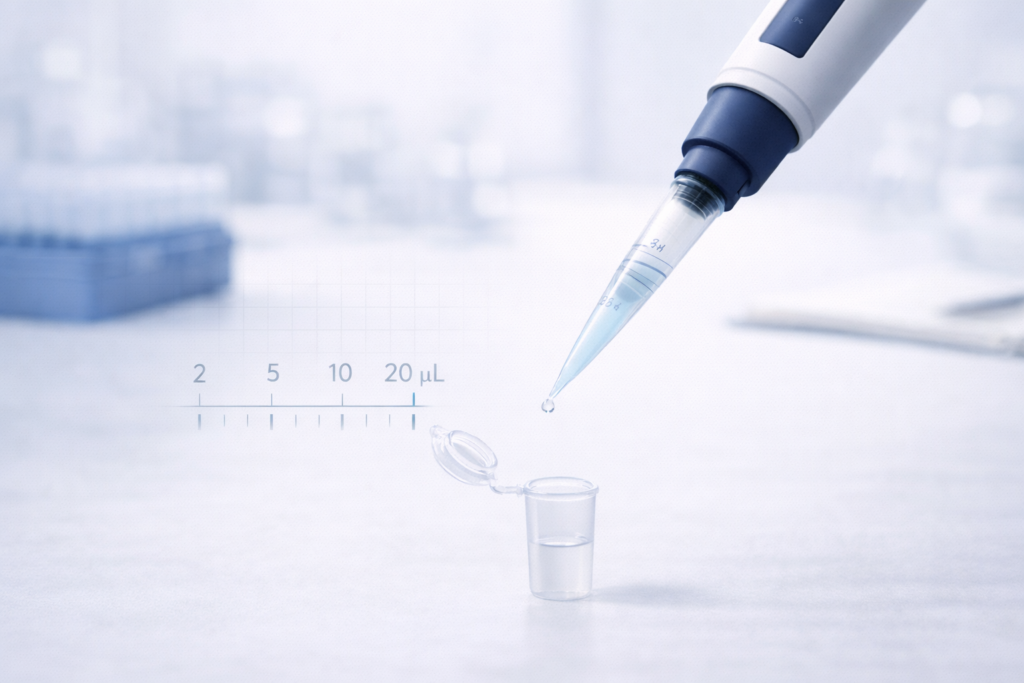
The 2–20 µL range is the workhorse of modern molecular and biochemical laboratories. Whether you are setting up PCR reactions, adding enzymes, or dispensing reagents for routine assays, this volume window appears in almost every protocol. It is popular because it balances usability with precision-small enough for sensitive reactions, yet large enough to be handled reliably with standard micropipettes. In this guide, you’ll learn how to choose the right pipette within the 2–20 µL range, how technique affects accuracy more than specifications, and which common mistakes cause variability at low volumes.
Why the 2–20 µL Range Is So Widely Used
Most wet-lab workflows concentrate around reaction volumes of 10–50 µL, where individual components are often added in 2–20 µL increments. This range offers a practical compromise between precision and ease of handling.
A P20 pipette delivers better relative accuracy than ultra-low-volume pipettes because evaporation, surface tension, and tip wetting effects are easier to control above ~2 µL. At the same time, it avoids the excessive relative error seen when using larger pipettes near their lower limits. For many labs, a P20 becomes the default tool for daily work because it covers most routine additions without constant pipette changes.
Which Pipette Should You Use Within the 2–20 µL Range?
Although a P20 is versatile, it is not always the best choice for every volume inside its range. Selecting the correct pipette reduces error before technique even comes into play.
| Target volume | Recommended pipette | Why | Notes |
|---|---|---|---|
| 2–3 µL | P2 | Operates closer to mid-range accuracy | Requires excellent technique |
| 5 µL | P20 | Within optimal accuracy zone | Pre-wet tips recommended |
| 10 µL | P20 | Ideal balance of precision and handling | Most common use case |
| 20 µL | P20 | Upper design limit | Avoid P200 at this volume |
A P20 is ideal for 5–15 µL tasks. For 2–3 µL, a P2 often provides better control. For volumes near 20 µL, resist the temptation to use a P200-accuracy suffers dramatically at the lower end of larger pipettes.
Accuracy Zones of a P20 Pipette
Every pipette has a performance “sweet spot.” For a P20, the best accuracy and precision typically occur between 5 and 15 µL.
At the lower limit (2–3 µL), risks increase: droplets may cling to the tip, air compression becomes significant, and any inconsistency in plunger speed leads to under-delivery. At the upper limit (18–20 µL), performance is usually acceptable, but repeated use at maximum volume accelerates seal wear and calibration drift.
Manufacturer specifications assume ideal conditions-calibrated instruments, distilled water, and controlled temperature. Real lab conditions introduce variables like viscous reagents, inconsistent technique, and tip variability, all of which disproportionately affect low volumes.
Technique Matters More Than the Pipette
Forward Pipetting SOP (Standard Method)
- Set the volume and attach a properly fitting tip.
- Pre-wet the tip by aspirating and dispensing the liquid 2–3 times.
- Depress the plunger to the first stop.
- Immerse the tip 1–2 mm below the liquid surface.
- Slowly release the plunger to aspirate.
- Touch the tip to the vessel wall and dispense smoothly to the first stop, then to the second stop.
- Withdraw the tip while the plunger is fully depressed.
Reverse Pipetting – When It Helps
Reverse pipetting is useful for viscous or foaming liquids and for volumes below 5 µL. You aspirate by going to the second stop and dispense only to the first stop, leaving excess liquid in the tip. This reduces under-delivery caused by surface tension and improves consistency at very low volumes.
Key technique factors include pre-wetting tips, maintaining shallow immersion depth, and using consistent plunger speed. Variability in any of these introduces measurable error at 2–20 µL.
Choosing the Right Tips for P2–20 Pipettes
Tips matter as much as the pipette itself at low volumes. Low-retention tips reduce liquid adhesion, especially for enzymes and detergents. Proper tip fit is critical-poor sealing causes air leaks that lead to under-aspiration.
Filtered tips are necessary when working with DNA, RNA, or hazardous samples to prevent aerosol contamination of the pipette shaft. For routine buffer transfers, non-filtered tips are usually sufficient and offer slightly better tactile feedback.
Common Mistakes When Pipetting 2–20 µL
Low volumes amplify small errors. Recognizing patterns helps correct them quickly.
| Problem | Likely cause | Fix | Prevention |
|---|---|---|---|
| Inconsistent volumes | Variable plunger speed | Slow, controlled motion | Practice with water |
| Droplets sticking to tip | High surface tension | Use low-retention tips | Pre-wet every time |
| Bubbles during aspiration | Tip too shallow | Increase immersion slightly | Watch liquid level |
| Under-delivery at 2–3 µL | Using P20 too low | Switch to P2 | Stay mid-range |
| Overconfidence near limits | Using max volume routinely | Choose better-matched pipette | Follow volume zones |
P20 vs P200 vs P2 – Quick Comparison
A P2 excels at 0.2–2 µL, where a P20 struggles. A P20 is ideal for most molecular biology tasks between 5 and 15 µL. A P200 is designed for 20–200 µL and performs poorly at 20 µL due to high relative error and poor resolution. Using a P200 at 20 µL is usually a bad idea unless no alternative exists.
Typical Lab Use Cases
PCR / qPCR setup: Most reactions rely on 1–10 µL additions of templates, primers, and enzymes. Accuracy directly affects amplification efficiency.
Enzyme or reagent addition: Small errors at 2–5 µL can double or halve effective concentrations.
Serial dilutions: Avoid performing entire dilution series at 2–3 µL steps. Increase volumes to reduce cumulative error.
FAQ
1) What pipette should I use for 20 µL?
A P20 is the best choice. It operates at its upper limit but remains far more accurate than a P200 at the same volume.
2) What is the difference between P20 and P200 pipettes?
The difference is volume range and resolution. A P20 is designed for precision at low volumes, while a P200 sacrifices low-end accuracy for higher capacity.
3) Can you pipette 2 µL accurately?
Yes, but accuracy depends heavily on technique, tip choice, and often using a P2 instead of a P20.
4) Do I need special tips for 2–20 µL pipettes?
Low-retention tips are strongly recommended, and filtered tips are needed for nucleic acid work.
Key Takeaways
- The 2–20 µL range dominates routine molecular workflows.
- P20 pipettes perform best between 5–15 µL.
- For 2–3 µL, consider switching to a P2.
- Technique influences accuracy more than brand or model.
- Pre-wetting tips significantly improves consistency.
- Avoid using P200 pipettes at 20 µL.
- Tip quality and fit are critical at low volumes.