
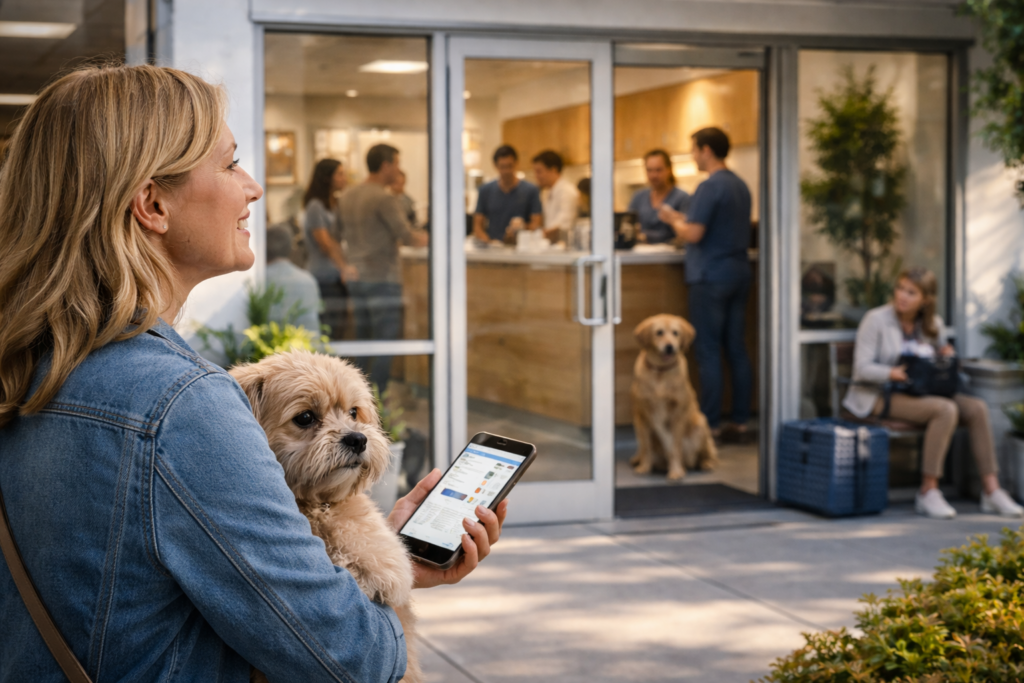
Most pet owners choose a veterinary clinic within a few miles of home — and they find it through a single Google search. Local SEO is the system that determines whether your clinic shows up when those searches happen, whether your listing earns the click, and whether your profile and website generate enough trust to turn that click into a booked appointment. This guide gives you a complete, practical framework for ranking in your area and becoming the veterinary practice local pet owners notice, trust, and choose.
What Local SEO Means for Veterinary Practices
Local SEO is not the same as general SEO. Broad SEO targets national or global audiences with topic-based content. Local SEO is specifically about making your veterinary practice visible to people who are physically near you and actively searching for the services you provide.
For veterinary clinics, local SEO means appearing:
Google decides which local businesses to show based on three core factors: relevance (does your profile and website match the search), distance (proximity to the searcher), and prominence (how well-known and trusted your practice appears based on reviews, citations, links, and profile quality). All three factors must be addressed together for your veterinary practice to rank well consistently.
How Local Pet Owners Actually Search
Understanding how pet owners search is the foundation of a smart local SEO strategy. They are not searching the way an SEO professional would expect.
High-intent search patterns
- “Vet near me” and “veterinarian near me”: The dominant queries, almost always performed on mobile, often in low-level urgency. Google automatically applies local intent to these searches.
- “Emergency vet [city]” or “24-hour vet near me”: High urgency, extremely high intent; the pet owner needs help now and will call the first credible result.
- “Dog vaccinations [city]”, “cat dental cleaning [city]”, “puppy vet [neighborhood]”: Service-specific, often by species — these indicate a pet owner who knows what they need and is comparing clinics.
- Branded searches like “[Your Clinic Name] reviews”: A pet owner who heard about you and is now verifying your reputation before booking.
What pet owners notice first in local search
When a pet owner sees the local pack on Google, they scan in this order:
- How close you are (shown on map and in distance label)
- Star rating and review count (immediately visible)
- Whether you are open now (real-time hours visibility)
- Your clinic name and category (are you a full-service vet? emergency clinic? specialist?)
- Profile photo quality (real clinic or generic?)
Local SEO must address both the ranking (appearing in the map pack) and the trust (earning the click over competitors who also appear).
Google Business Profile: The Foundation of Local Visibility
For most veterinary clinics, the Google Business Profile (GBP) is the single highest-impact local SEO asset — more immediately powerful than any website change you could make. A fully optimized profile can put you in the local pack for dozens of nearby pet owner searches and drive phone calls, direction requests, and website clicks every day.
Claiming and verifying
If you have not claimed and verified your Google Business Profile, do this first. Unclaimed profiles give Google (and competitors) control over information that directly affects your reputation and rankings. Verification can be done via postcard, phone, or video call depending on your region.
Category selection
Category selection has a stronger impact on which searches you appear for than most other GBP signals.
- Primary category: Select “Veterinarian” or “Animal Hospital” (whichever most accurately describes your main service type).
- Secondary categories: Add relevant supporting categories such as “Emergency Veterinarian Service,” “Animal Dental Care Service,” “Veterinary Pharmacy,” or species-specific designations where Google allows.
Selecting the right categories directly influences which “near me” and service-specific searches you are eligible to appear for.
Business description
Your business description (750 characters) should:
- State your core veterinary services clearly
- Include your city or region naturally
- Reference species you treat
- Communicate a differentiated value (same-day availability, fear-free handling, cat-only rooms, etc.)
- Not be keyword-stuffed — Google penalizes low-quality descriptions
Services section
The GBP Services section is underused by most veterinary practices. Add individual services with titles and descriptions:
- Wellness Exams
- Vaccination Appointments
- Dental Care
- Surgery
- Diagnostics
- Puppy / Kitten Care
- Senior Pet Care
- Parasite Prevention
- Emergency Care
Write 1–2 sentence descriptions for each. This helps Google match your profile to specific service queries and helps pet owners quickly confirm you offer what they need.
Photos and videos
Profiles with photos receive significantly more direction requests and website clicks than those without. Post:
- Exterior and interior clinic photos
- Exam rooms, reception area, surgical suite, and diagnostic equipment
- Team photos (individual and group)
- Pets in care (with owner permission)
- Before/after or seasonal care content where appropriate
Update photos regularly — a profile with only old photos signals inactivity to both Google and potential clients.
Q&A section
Seed your own Q&A by asking and answering the most common questions your front desk receives:
- “Do you accept walk-ins for emergencies?”
- “What pet species do you treat?”
- “Is there parking available?”
- “Do you offer payment plans?”
- “What are your weekend hours?”
Monitor this section — anyone can submit questions, and unanswered questions leave pet owners without reassurance.
Google Business Posts
Posts appear on your profile in search results and signal profile activity to Google. Use them for:
- Seasonal pet health reminders (tick prevention, heatstroke, dental month)
- New services or expanded hours
- Promotions (wellness packages, puppy/kitten first visit offers)
- Community events or shelter partnerships
Post at least twice per month to maintain profile freshness.
Profile completeness checklist
- ✅ Verified profile
- ✅ Correct primary and secondary categories
- ✅ Full, keyword-natural business description
- ✅ Accurate NAP (name, address, phone)
- ✅ Complete and current hours (including holidays)
- ✅ Services listed with descriptions
- ✅ 10+ real, recent clinic photos
- ✅ Q&A seeded and monitored
- ✅ Posts published at least 2×/month
- ✅ Messaging enabled if your team can respond promptly
Reviews, Reputation, and Google Reviews
Google reviews influence both your local rankings (Google uses review quantity, recency, and response rate as prominence signals) and your click-through rate in the map pack (pet owners compare star ratings before they click). Neglecting reviews means losing on both dimensions simultaneously.
Why reviews drive local decisions
Research on pet-owner loyalty confirms that trust, communication, and perceived value are the primary drivers of both client choice and long-term retention. Reviews are how pet owners verify those qualities before they ever visit your clinic. A practice with 12 reviews and a 4.2 rating will consistently lose clicks to a nearby competitor with 140 reviews and a 4.8 rating — even if the 12-review clinic is clinically superior.
How to build a steady review flow
When to ask:
- Immediately after a positive wellness visit or vaccination appointment
- 24–48 hours after a successful surgery or procedure when the pet owner has seen good results
- After a resolved emergency or urgent case, once acute stress has subsided
How to ask:
- Staff verbal invitation at checkout: “If you’ve had a good experience today, we’d really appreciate a Google review — it helps other local pet owners find us.”
- Automated email or SMS follow-up 24 hours post-visit with a direct link to your Google review form
- A short QR code card in the reception area linking to the review page
How often:
- Aim for a consistent, ongoing stream — 4–8 reviews per month is more valuable than 30 in one month and none for the next six. Google’s algorithm favors recency and consistency.
How to respond to reviews
Respond to every review — positive and negative.
Positive responses: Thank the client, mention the pet’s name or the service if possible, reinforce a key message (“We’re glad Milo’s dental procedure went smoothly — preventive dental care makes such a difference for dogs.”).
Negative responses: Acknowledge the concern calmly, apologize for the experience, and invite the client to contact you directly. Never argue, never over-explain, and never reveal protected client information. Your response is primarily written for future readers, not for the unhappy client.
A veterinary practice with 100+ reviews, a 4.7+ average, and thoughtful responses to every review projects trust before a pet owner ever visits the website or calls the front desk.
Website Optimization for Veterinary Local SEO
Your website reinforces and extends the signals established by your Google Business Profile. A clinic with a strong GBP but a thin, poorly structured website will plateau in local rankings — because Google uses website relevance, authority, and content quality as part of its local prominence assessment.
Homepage local clarity
Your homepage should include:
- Your clinic name, city/neighborhood, and service type clearly in the H1 or headline
- Your full NAP (name, address, phone) prominently placed, ideally in the header and footer
- Service summary with links to individual service pages
- Local references (neighborhood names, city landmarks, local community references)
Service pages for local SEO
Generic “Services” pages do not rank for local search queries. Individual, optimized service pages do.
Pages like:
- “Dog Vaccinations in [City]”
- “Cat Dental Cleaning — [Clinic Name], [City]”
- “Emergency Vet in [Neighborhood], [City]”
…capture high-intent, ready-to-book searches that a homepage cannot rank for on its own.
Each service page needs: a headline with location signal, a description of the service process, trust signals (reviews, credentials), and a clear booking CTA.
Embedded map and contact clarity
Embed a Google Map on your contact page and reference your exact address on every page (typically in the footer). This reinforces your location signal for Google and makes it frictionless for pet owners to get directions.
Mobile performance
Google indexes the mobile version of your website first (mobile-first indexing). A slow, hard-to-use mobile site directly harms local rankings and destroys conversion even when you rank well. Ensure:
- Pages load in under 3 seconds on mobile
- Phone numbers are tap-to-call
- Navigation is thumb-friendly
- Content is readable at default font size without zooming
Schema markup
At minimum, add LocalBusiness / Veterinarian schema to your homepage and contact page with: business name, address, phone, geo-coordinates, opening hours, and URL. Add FAQPage schema to your FAQ sections to be eligible for rich results in Google. Schema does not replace content quality but helps Google confidently classify and present your clinic data.
Keyword Research and Local Search Intent
Effective veterinary SEO strategy is built on understanding search intent, not just keyword volume. A keyword that brings high-intent local pet owners is worth infinitely more than one that brings curious readers who never book.
Core keyword categories
Primary high-intent keywords:
- “vet near me” / “veterinarian near me”
- “veterinary clinic [city]”
- “animal hospital [city]”
- “emergency vet [city]”
Service + location combinations:
- “dog vaccinations [city]”
- “cat spay [city/neighborhood]”
- “puppy vet [city]”
- “senior dog vet [city]”
- “rabbit vet [city]” (species-specific)
- “dog dental cleaning [city]”
Question-based and educational keywords:
- “when should I take my puppy to the vet”
- “how often do cats need vaccinations”
- “signs of dental disease in dogs”
Emergency and urgent keywords:
- “24 hour vet [city]”
- “emergency vet open now [city]”
- “vet clinic open Saturday [city]”
Mapping intent to pages
| Keyword Type | Best Page to Target |
|---|---|
| “vet near me” / “veterinary clinic [city]” | Homepage |
| “dog vaccinations [city]” | Vaccination service page |
| “emergency vet [city]” | Emergency/urgent care page |
| “puppy vet [city]” | Puppy/kitten care page |
| “cat dental cleaning [city]” | Dental care page |
| “how often should my dog see a vet?” | Blog/FAQ content |
| “senior dog care [city]” | Senior pet care page |
Use free tools like Google Search Console (once installed) to discover what search terms are already driving traffic to your site and identify gaps where service pages are missing.
Local Citations, NAP Consistency, and Directory Signals
Local citations are mentions of your business name, address, and phone number (NAP) on external websites — directories, review platforms, local listing sites, and veterinary associations.
Why citations matter
Citations tell Google that your business exists, is located where you say it is, and is recognized across the wider web. Consistent citations across authoritative sources strengthen your local prominence score — one of Google’s three main local ranking factors.
Core directories for veterinary clinics
Priority citation sources include:
- Google Business Profile (primary)
- Yelp
- Bing Places for Business
- Apple Maps
- Facebook Business Page
- Foursquare / Swifty
- Yellow Pages
- Healthgrades (if applicable)
- Veterinary association directories (AVMA member directory, national and regional equivalents)
- Local Chamber of Commerce listings
NAP consistency: the most commonly missed element
Every instance of your business name, address, and phone number across the internet must be identical — not just similar. Even minor inconsistencies (abbreviating “Street” to “St.” in some places, using a slightly different suite number, listing two different phone numbers) can dilute your local authority signal.
How clinics introduce NAP inconsistencies:
- Moving locations without updating all old listings
- Changing phone numbers without a full directory audit
- Using different business name formats (“City Pet Clinic” vs. “City Pet Clinic LLC” vs. “City Veterinary Clinic”)
- Having old location data in legacy directories never updated
Audit your citations annually using tools like BrightLocal, Whitespark, or manual Google searches for your business name, and correct any inconsistencies.
Local Content That Helps Clinics Rank
Local content for veterinary practices is not just “writing blog posts.” It is creating pages and resources specifically designed to match what local pet owners in your area are searching for and caring about.
High-value local content types
Service area pages: If you serve multiple suburbs or neighborhoods around your main location, create dedicated pages for each (“Veterinary Clinic Serving [Suburb], [City]”) that reference local context, not just repeated address information.
Local pet health topics: Tailor content to regional realities — local tick and flea risks by season, regional wildlife hazards (snakes, toxic plants, seasonal parasites), breed popularity in your area, local regulatory requirements for pet licensing.
Local FAQ content: Answer questions specific to your area: “Are heartworm cases common in [city]?” “What vaccines are required for dogs in [state/region]?” “What should I do if my dog eats [local plant]?”
Community event coverage: Post about your participation in local shelter drives, pet adoption events, school education visits, or community pet health clinics. These pages build local relevance and earn natural local mentions.
Seasonal pet care content: “Protecting Your Dog from Summer Heat in [City],” “Preparing Your Cat for Winter in [Region]” — targeted seasonal content that earns both local search traffic and social engagement.
What local content is not
- Thin pages that stuff a city name 15 times into generic text
- Content copied from national veterinary resources with only a location name changed
- Blog posts with no local relevance that could have been published by any clinic anywhere
Google’s Helpful Content guidance is clear: content must be genuinely useful to the audience it claims to serve. For local veterinary clinics, that means content that reflects your community, your climate, your pet population, and your specific area of practice.
Technical SEO Basics That Support Local Rankings
Technical SEO does not directly determine local pack rankings in most cases, but technical problems can suppress or cap your local visibility by preventing Google from correctly crawling, indexing, and understanding your clinic’s web presence.
Technical SEO essentials for veterinary clinics
Crawlability and indexation:
- Ensure your key pages (homepage, service pages, contact page) are not accidentally blocked by robots.txt or noindex tags
- Check Google Search Console for crawl errors and indexation issues
Mobile performance and Core Web Vitals:
- Page load time under 3 seconds on mobile
- No layout shift or interactivity issues that frustrate users
- Compress large images (especially practice and team photos, which tend to be oversized)
Title tags and meta descriptions:
- Each page should have a unique, descriptive title tag (60 characters max) that includes the target keyword and city
- Example: “Veterinary Clinic in [City] | [Clinic Name] – Dog & Cat Care”
- Meta descriptions should summarize the page and include a soft CTA (150–160 characters)
Internal linking:
- Link between service pages and to your booking page from every service page
- Link from blog content to relevant service pages (e.g., a dental awareness post links to the dental care service page)
- Do not let any important page be “orphaned” — reachable only through navigation
Duplicate content:
- Avoid creating multiple service pages with near-identical copy
- If you have multi-location clinic pages, ensure each has genuinely unique content
HTTPS:
- Your clinic website should be served over HTTPS. An insecure site hurts trust signals and is a negative ranking factor for Google.
Social Media and Local Engagement
Social media is not a direct Google ranking factor, but it supports local SEO through several indirect channels.
Social media contributes to local visibility by:
- Driving branded searches: When local pet owners follow your Facebook or Instagram page and later search your clinic name directly, that branded search activity signals local relevance to Google.
- Supporting review generation: Facebook and Instagram posts that remind clients to leave a Google review are among the most effective review request methods for practices with engaged followings.
- Building community trust and word-of-mouth: Local pet owner groups on Facebook and Nextdoor are influential recommendation channels; a strong social presence makes it more likely your clinic is mentioned.
- Generating local links: Community organizations, shelters, and local media sometimes link to businesses they feature on social media, producing modest but real local authority signals.
What social media is not: a substitute for Google Business Profile optimization, citation building, or review generation. Clinics that invest heavily in Instagram content while neglecting their GBP are misallocating their local marketing resources.
Use social media as a trust-reinforcement and retention channel for existing clients, while your core local SEO system (GBP, reviews, website, citations) handles new client acquisition.
Building Local Authority Beyond Your Website
Google’s prominence factor rewards veterinary practices that are recognized and referenced across the local web — not just well-optimized on their own properties.
Local backlinks and mentions
High-value local link sources:
- Local Chamber of Commerce (most offer member directory listings with links)
- Veterinary and animal welfare associations (local chapters of national organizations)
- Local pet shelters and rescue organizations (partnerships, volunteer vet care, adoption drives)
- Local pet businesses: groomers, trainers, boarders, pet stores (reciprocal links and co-promotion)
- Local media: newspaper features, community blogs, local news websites covering pet health topics
- School or community organization websites (for educational events you sponsor or participate in)
How to earn local links:
- Offer a free educational talk or pet health article to a local media outlet
- Partner with a shelter for discounted or sponsored spay/neuter or wellness days
- Sponsor a local pet event and ensure the organizer links to your website from the event page
- Join the local Chamber of Commerce and claim your listing
Community presence as a trust signal
Local clinics that are physically and socially present in their communities — visible at adoption events, referenced in local Facebook groups, mentioned in neighborhood apps — develop a form of ambient local authority that reinforces every other element of their local SEO strategy. This cannot be fully manufactured through technical SEO alone; it is built through genuine local engagement over time.
Local SEO Priorities for Veterinary Clinics
Not all clinics are in the same position. Use this prioritization framework to focus your effort where it matters most at your current stage.
Fix first: foundations for all clinics
For any clinic with incomplete foundations or no current local visibility:
- Claim, verify, and fully complete your Google Business Profile (categories, services, description, photos, hours)
- Ensure NAP consistency across your website, GBP, and top directories
- Start a systematic review request process — even 4–5 new reviews per month compounds quickly
- Fix obvious mobile usability issues on your website (tap-to-call numbers, fast loading, readable text)
- Create or improve your homepage to include city/location signal, service clarity, and a visible CTA
Build next: content and structure for growing clinics
For clinics with foundations in place but weak organic visibility:
- Create individual service pages for your top 5–8 services, each optimized for a service + city keyword
- Build a new clients page and emergency/urgent care page if missing
- Audit and correct citation inconsistencies across Yelp, Bing, Apple Maps, and key directories
- Start publishing 1–2 pieces of local content per month (seasonal topics, local pet health guides)
- Implement LocalBusiness and FAQPage schema on key pages
Optimize later: authority and scale for established clinics
For clinics ranking well but wanting to dominate:
- Pursue local backlinks from shelters, community organizations, Chamber of Commerce, and local media
- Develop service-area pages for all suburbs and neighborhoods you serve
- Build a content calendar targeting high-volume local informational queries
- Expand GBP photo library monthly and test GBP Posts for specific services
- Track rankings and conversions via Google Search Console and GBP Insights to identify where additional effort has the highest ROI
Common Local SEO Mistakes Veterinary Clinics Make
Identify these errors on your current local presence and correct them systematically:
- Incomplete Google Business Profile: Missing services, no photos, blank business description, wrong primary category.
- Inconsistent NAP: Different phone number, address format, or clinic name across website, GBP, and directories.
- Weak service pages: A single “Services” page with bullet points instead of individual, optimized pages per service.
- No review system: Hoping clients will leave reviews organically rather than building a structured, consistent ask process.
- Generic keyword stuffing: Pages that repeat “veterinary clinic [city]” dozens of times with no genuine local relevance — a strategy that Google has penalized for years.
- Ignoring mobile UX: Site that looks fine on desktop but breaks on mobile, where most local searches happen.
- Content with no local relevance: National pet health articles with a city name added, rather than content tied to real local context.
- Relying on social media for local acquisition: Treating Instagram followers as a substitute for local search visibility and GBP optimization.
- Not tracking results: Running local SEO activities with no measurement of GBP actions, local rankings, or call volume trends.
- Confusing visibility with bookings: Celebrating search ranking improvements without tracking whether they are resulting in actual appointment inquiries — the true measure of local SEO success.
How to Measure Local SEO Performance
Local SEO is only worth the investment if it drives measurable growth in client inquiries and appointments — not just ranking improvements that don’t translate into calls.
Google Business Profile Insights
Monitor monthly from your GBP dashboard:
- Search impressions: How many times your profile appeared in local search or maps
- Direction requests: Strongly correlated with physical visit intent
- Phone calls: Tracked calls from GBP — compare month over month
- Website clicks: How many users clicked through to your veterinary website from GBP
- Review count and average rating: Track growth trend and response rate
Website performance (Google Search Console)
- Local query impressions and clicks: Filter for city-specific and service queries
- Click-through rate by page: Identify service pages with high impressions but low clicks (title/meta description improvement opportunity)
- Index coverage: Confirm all key pages are indexed
- Core Web Vitals: Identify speed and usability issues dragging down mobile rankings
Conversion tracking
- Call tracking: Use a dedicated local tracking number linked to your GBP and website to measure call volume changes over time
- Appointment requests: Track form submissions from local search traffic specifically
- New client source data: Ask new clients how they found you; correlate with your GBP and search data
Rankings
Track your position in local pack and organic results for your top 10–15 target keywords using rank tracking tools (BrightLocal, Whitespark, or manual regular checks). Rankings alone are not success — they are an indicator of whether your local SEO foundation is working.
FAQ
How do veterinary clinics rank higher in local search?
Veterinary clinics rank higher in local search by fully optimizing their Google Business Profile (correct categories, complete services, active photos and posts), building a consistent stream of recent Google reviews, ensuring NAP consistency across all directories, optimizing their website with city-specific service pages and local schema, and building local authority through community links and partnerships.
How important is Google Business Profile for local SEO?
It is the single most important local SEO asset for most veterinary clinics. Your GBP determines whether you appear in the Google Map pack — the map 3-pack that appears above organic results for “vet near me” and similar searches, which represents the majority of new client discovery in local veterinary search.
Do Google reviews help veterinary SEO?
Yes, in two ways. Review quantity, recency, and response patterns are direct signals in Google’s local ranking algorithm (prominence). Reviews also determine click-through rate in the map pack — a higher star rating and more reviews means more clicks even when ranking in the same position as a competitor.
What local keywords should a vet clinic target?
Prioritize: “veterinary clinic [city],” “vet near me,” “emergency vet [city],” plus service + location combinations such as “dog vaccinations [city],” “cat dental cleaning [city],” “puppy vet [neighborhood],” and species-specific queries relevant to your practice.
Does social media help local SEO?
Indirectly — social media supports branded search behavior, review generation, and community awareness, but it is not a direct Google ranking factor. It complements a solid local SEO system but cannot replace GBP optimization, reviews, or website content.
What is local content for a veterinary clinic?
Local content is veterinary information tailored to your specific community: regional pet health risks, local event involvement, city-specific service pages, neighborhood-area pages, and educational resources that reflect real conditions and concerns in your practice area — not generic national content with a city name added.
How long does local SEO take to work?
Basic GBP improvements (completing your profile, adding photos, getting 10+ new reviews) can produce visible increases in map impressions and calls within 4–8 weeks. Stronger organic keyword rankings from service page and content development typically take 3–6 months of consistent work. Local authority building (backlinks, citations, content volume) compounds over 6–12 months.
What should a clinic fix first?
Claim and fully optimize your Google Business Profile, correct NAP inconsistencies across directories, start a structured review request process, and fix mobile usability on your website. These four steps have the fastest and most direct impact on local visibility and appointment inquiries.
Conclusion
Local SEO for veterinary clinics is not a set of tactics to run through once — it is a structured, compound system that builds visibility, trust, and local authority over time. The practices that rank best in their areas are not always the ones with the most advertising budget; they are the ones with the most complete, consistent, and trustworthy presence in local search.
That presence is built from five pillars working together: a fully optimized Google Business Profile, a steady flow of genuine Google reviews, a website with local relevance, clear service pages, and conversion-ready design, consistent citations across directories, and growing local authority through community relationships and content.
When all five are aligned, your veterinary practice stops competing for attention in a noisy landscape and starts becoming the obvious, trusted choice for nearby pet owners at the exact moment they are ready to book. That is what strong local SEO delivers — not just rankings, but the right clients, from the right searches, at the right moment, consistently.
If you take one step today, make it your Google Business Profile. Fill in every section, upload real photos, and request your first five reviews this week. That single foundation, built correctly and maintained consistently, will do more for your local visibility than any other marketing activity you can invest in right now.