
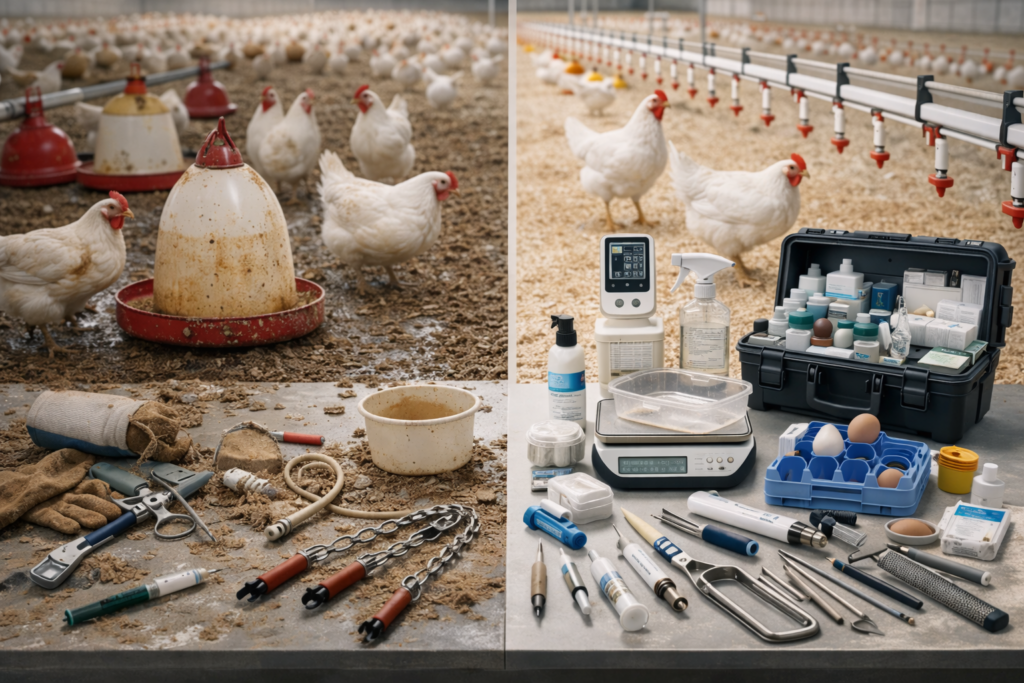
A successful poultry farm is not built on housing and feed alone. It is built on systems — systems for delivering clean water, maintaining precise temperatures, protecting flocks from disease, vaccinating efficiently, monitoring health before problems escalate, and cleaning thoroughly between every production cycle. The equipment that enables these systems is not simply a collection of farm hardware. It is the operational and veterinary infrastructure that determines whether a flock thrives, produces consistently, and survives the biosecurity pressures that threaten modern poultry farming at every scale.
This guide treats poultry equipment the way it should be treated — as a health management framework, not a shopping list. From chicken coops and feeding systems to vaccination tools, sanitation equipment, temperature control systems, and flock monitoring, every category here is explained in terms of what it does, why it matters for flock health, and how to prioritize it across different production types and farm scales.
Whether you are setting up a new operation, upgrading an existing one, or managing flock health as a veterinarian serving chicken farms, this is the most complete, field-relevant guide to poultry veterinary equipment available.
Section 1 — What Is Poultry Veterinary Equipment?
The Full Scope of Poultry Veterinary Equipment
| Category | What It Includes | Health Connection |
|---|---|---|
| Housing systems | Chicken coops, poultry houses, cages, pen systems | Stress, airflow, hygiene, disease transmission risk |
| Feeding systems | Feeders, hoppers, automatic feeders, feed storage | Nutrition delivery consistency, contamination control |
| Water delivery systems | Nipple drinkers, water lines, drinkers | Hydration, medication delivery, bacterial contamination |
| Brooding and temperature control | Brooders, heaters, cooling pads, climate controllers | Chick survival, heat stress, performance |
| Ventilation | Fans, inlets, negative pressure systems | Air quality, ammonia control, respiratory health |
| Vaccination and medication tools | Syringes, vaccinators, spray systems | Disease prevention, treatment delivery |
| Sanitation equipment | Sprayers, disinfectants, footbaths, pressure washers | Pathogen control, between-flock cleaning |
| Monitoring tools | Thermometers, hygrometers, scales, sensors | Early disease detection, environmental management |
| Egg and production equipment | Nesting boxes, collection systems, egg handling | Layer productivity, egg quality, hygiene |
| Manure and waste management | Scrapers, manure belts, compost systems | Ammonia control, pathogen reduction, hygiene |
Why This Connection Matters
The critical insight is this: on a poultry farm, health management and equipment management are inseparable. A water line that is not regularly cleaned generates biofilm that harbors pathogens. A brooder that malfunctions in the first week of chick life produces immunocompromised birds that underperform for the entire growth cycle. A poorly maintained footbath at the poultry house entrance performs no biosecurity function at all.
The right equipment, correctly maintained and systematically used, is the most practical and cost-effective disease prevention tool a poultry farm has.
Section 2 — Essential Equipment Every Poultry Farm Needs
Regardless of production type — broilers, layers, or chick rearing — these foundational equipment categories are non-negotiable.
Housing and containment: Structurally sound chicken coops or poultry houses that protect from weather, predators, and disease vectors; appropriately sized for stocking density; designed for efficient cleaning and ventilation.
Feeding systems: Consistent, waste-minimizing delivery of appropriate feed from chick through to market or peak lay weight.
Water delivery systems: Clean, reliable water access at the correct height and flow rate for bird age and species; nipple drinker systems are the modern standard for both broilers and layers.
Brooders and heating: Precise temperature delivery for newly hatched chicks — critical for survival, immune development, and growth performance in the first two weeks of life.
Ventilation and environmental control: Continuous management of air quality, temperature, humidity, and ammonia levels throughout the production cycle.
Sanitation and biosecurity equipment: Tools for between-flock cleaning, daily hygiene, personnel entry control, and ongoing pathogen management.
Vaccination and medication tools: Species and age-appropriate delivery of vaccines and medications across a flock of potentially thousands of birds.
Flock monitoring tools: Scales for weight tracking, thermometers for environmental monitoring, and observation systems for early health assessment.
Egg handling equipment (layers): Nesting boxes, collection systems, egg cleaning, grading, and storage tools.
Section 3 — Housing, Chicken Coops, and Farm Setup Equipment
Housing is the first line of flock health defense. The structural and design characteristics of chicken coops and poultry houses directly determine air quality, pathogen load, stress levels, and cleaning effectiveness between production cycles.
Poultry House Design and Construction Considerations
The most common poultry farm housing formats are:
- Open-sided houses — natural ventilation through wide sidewall openings; low-cost; effective in tropical and warm climates but limited in climate control capability
- Closed/environmentally controlled houses — mechanically ventilated with cooling pad systems; allow precise temperature, humidity, and air pressure control; standard in modern high-density commercial production
- Battery cage systems — stacked row-based housing for layers; allows high density while maintaining hygiene and individual bird management; often combined with automated feeding, watering, and egg collection systems
- Free-range and enriched colony systems — varying degrees of outdoor access; require robust predator-proofing, weather protection, and perimeter biosecurity fencing
How Housing Affects Flock Health
Stocking density: Overcrowding increases stress, aggression, ammonia build-up, litter moisture, and disease transmission rate. Even the best ventilation system cannot compensate for fundamentally overcrowded housing.
Litter management (floor systems): In broiler floor systems, litter quality is one of the most critical environmental health variables. Wet litter causes footpad dermatitis, breast blisters, and significantly increases the burden of bacterial pathogens (particularly Campylobacter, E. coli, and Clostridium species).
Floor drainage and cleaning access: Poultry houses must be designed for complete cleaning between flocks — smooth, non-porous floor surfaces, no dead spaces that trap organic matter, drains that allow effective pressure washing.
Nesting Boxes (Layers)
For laying hens in non-cage systems, nesting boxes reduce floor eggs (which are heavily soiled), protect egg shell quality, and reduce production waste. The standard recommendation is one nesting box per 5–6 laying hens. Nesting box material and flooring should be cleanable and non-abrasive to egg shells.
Housing-Related Poultry Supplies
- Bedding / litter material — wood shavings, rice husks, straw; depth and management affect ammonia and footpad health
- Perches — required in enriched colony and free-range systems; support natural behavior and reduce floor competition
- Dividers and partition panels — for separating age groups, managing sick bird isolation, and controlling flock movement
- Predator-proof fencing and netting — for free-range and backyard operations; vector wildlife exclusion
Section 4 — Feeding Systems and Water Delivery Equipment
Feeding systems and water delivery systems are the two most used infrastructure components on any poultry farm — and the two most directly connected to contamination risk, nutrient consistency, and flock growth performance.
Feeding Systems
Why feeding system design matters: Poor feeder design wastes significant feed through spillage, allows fecal contamination of feed, creates competition and stress at feeding points, and makes it impossible to monitor actual intake — a key early health indicator.
Manual feeders (hanging tube feeders):
Gravity-feed hoppers suspended at appropriate bird height; the most economical option for small and medium operations. Anti-waste lip designs prevent bill-raking and reduce spillage by 15–40% compared to simple open-pan designs.
Linear trough feeders:
Long-run troughs fed from a central hopper via chain or auger conveyor system; standard on medium-to-large broiler and layer operations; ensures all birds have simultaneous feed access, reducing competition.
Automatic pan feeders:
Round pan feeder heads connected to overhead feed lines with automatic fill sensors; the most practical for high-density broiler housing; trigger-fill systems maintain consistent feed level without human intervention; labor-saving and reduces multiple daily walk-throughs.
Automatic chain feeders:
Endless chain system running through a trough around the house perimeter; very common in layer operations; provides even feed distribution and is easily cleaned.
Feed storage:
- Feed silos (bins) — weatherproof, vermin-proof bulk storage adjacent to the poultry house; correct sizing ensures feed turnover within 7–14 days to prevent moisture absorption, mold growth, and mycotoxin accumulation
- Internal feed hoppers — bridge between bulk storage and in-house feeder systemsCommon buyer mistake: Purchasing feeders without investing in covered, sealed feed storage. Feed stored in open sacks or poorly sealed bins is contaminated by rodents, moisture, and insects — a direct route for Salmonella and mycotoxin introduction to the flock.
Water Delivery Systems
Why water quality matters: Chickens consume approximately twice as much water as feed by weight. Contaminated water is a primary transmission route for Newcastle disease, Marek’s disease, Infectious Bronchitis, E. coli, and Salmonella. It is also the delivery route for soluble medications and vaccines — a system that delivers contaminated water delivers contaminated medications.
Nipple drinker systems:
The modern standard for both broilers and layers in commercial production. Water is delivered on demand through a spring-loaded pin nipple — the bird presses the pin to release water. Advantages over open drinkers include:
- Dramatically reduced water contamination (no open surface exposed to fecal matter, litter, or feathers)
- Consistent water pressure delivery
- Integration with medication and vaccine delivery lines
- Significantly reduced litter wetting compared to open drinkers
Nipple placement height adjusts with bird age — nipples too low cause wet litter; nipples too high cause birds to stretch and waste water.
Bell drinkers (open drinkers):
Water-filled circular open drinkers; appropriate for free-range, small flock, and backyard operations where nipple line infrastructure is not practical. Must be cleaned daily — open surfaces accumulate fecal contamination rapidly.
Water line sanitation:
Water pipes and nipple lines develop biofilm — a bacterial community embedded in a polysaccharide matrix on pipe inner surfaces — that is not removed by flushing alone. Regular acidification of water lines (citric acid or hydrogen peroxide protocols) and between-flock pipe flushing and disinfection are essential hygiene practices, not optional maintenance.
Water tanks and storage:
- Covered, food-grade water tanks prevent algae growth and contamination
- Regular tank cleaning and disinfection between flocks
- Water pressure regulation ensures consistent nipple flow at correct rate
Medication dosers and proportioners:
Venturi-type proportioner injectors deliver soluble medications, vitamins, electrolytes, and vaccines into the water line at a consistent, calculable dilution rate. Essential for water-route vaccination and treatment programs on larger operations.
Section 5 — Brooding, Ventilation, and Temperature Control
Temperature and air quality management are the most critical environmental variables in poultry production — and the ones that most directly determine survival, immune competence, growth performance, and respiratory health.
Brooding Equipment
The brooding period — typically the first 14–21 days of a chick’s life — is the most physiologically vulnerable window of the entire production cycle. Newly hatched chicks cannot thermoregulate effectively. Their internal body temperature tracks environmental temperature closely, and even brief episodes of chilling or overheating during this period compromise the immune system development that determines disease resistance for the entire flock lifespan.
Gas brooders (radiant heating):
Radiant gas burners suspended above the litter provide warmth to the brooding zone below. Chicks self-select their position relative to the heat source — moving closer when cold, further away when warm. Provides a natural thermal gradient.
- Standard starting temperature: 32–35°C directly under the brooder, 28–30°C at the pen perimeter
- Temperature reduced by approximately 2–3°C per week as feathering progresses
Electric brooder plates / contact warmers:
Solid heated plates close to the floor that chicks shelter under, mimicking the contact warmth of a mother hen. Particularly effective for small-scale operations; highly energy-efficient; no combustion gas risk indoors.
Hot air heating systems:
Central heating via hot air distribution through suspended heater units or ducted underfloor systems. Common in fully enclosed, automated poultry houses. Provides uniform temperature across the entire house volume rather than localized heat zones.
Digital brooder controllers:
Programmable temperature controllers connected to temperature sensors and heater systems. Automatically adjust heat output as chick age progresses through pre-programmed temperature decline curves. Removes human error from temperature management and allows remote monitoring in modern systems.
Health impact of poor brooding temperature control: Chilling in the first week increases susceptibility to yolk sac infection, omphalitis, and subsequent broiler performance losses. Overheating causes heat stress, feed intake depression, increased water consumption, and wet litter — creating a cascading series of health risks.
Ventilation Systems
Ventilation serves four simultaneous functions: oxygen delivery, CO2 removal, ammonia dilution, and moisture control. Failure in any one function creates immediate health consequences.
Ammonia from decomposing manure damages respiratory mucosa — the first line of defense against respiratory pathogens. Chronic low-level ammonia exposure (>20 ppm) significantly increases susceptibility to Newcastle disease, Infectious Bronchitis, and chronic respiratory disease complex.
Minimum ventilation (cold weather):
Even in cold conditions, a minimum ventilation rate is required to prevent ammonia, moisture, and CO2 build-up. Minimum ventilation is typically managed by timed fan activation cycles — the fan runs for a defined period every few minutes, drawing controlled fresh air through small side inlets.
Tunnel ventilation (hot weather):
Large-volume fans at one end of the house draw air through the entire house length, creating a wind-chill effect that reduces effective temperature perception in birds by 5–8°C. Standard in warm-climate commercial production and in all broiler houses during hot periods.
Cooling pad systems (evaporative cooling):
Cellulose evaporative cooling pads at the air inlet end of tunnel-ventilated houses drop incoming air temperature by 8–15°C through evaporative cooling. Critical for heat stress prevention in hot climates. System requires clean pad water supply and scale management to maintain pad efficiency.
Key ventilation equipment:
- Axial ventilation fans (multiple sizes based on house volume)
- Ventilation inlets / flap controllers (modulating air entry)
- Evaporative cooling pad systems
- Negative pressure sensors (to verify adequate air movement)
- Automated environmental controllers (integrated fan, inlet, heater, and alarm management)
Environmental Controllers
Modern poultry house environmental controllers integrate temperature sensors, humidity sensors, static pressure monitoring, fan stage control, cooling pad activation, heater control, and alarm systems into a single control unit.
Typical operating targets:
- Temperature: 20–28°C for layers; 18–32°C for broilers depending on age
- Humidity: 50–70% RH
- Ammonia: <20 ppm (ideally <10 ppm)
- CO2: <3000 ppm
- Static pressure: appropriate to house design (typically 10–25 Pa in tunnel systems)Investing in quality environmental controllers pays back in every flock. Manual temperature management by farm workers — even diligent ones — cannot match the precision and response speed of automated control. Temperature excursions of even 2–3°C during critical periods directly affect growth performance and immune competence.
Section 6 — Veterinary Health Tools for Chicken Farms
These are the direct veterinary-use tools that support active disease prevention, treatment, and health monitoring on a poultry farm.
Vaccination Equipment
Vaccination is the foundation of disease prevention in commercial poultry production. The tools that deliver vaccines must ensure accurate dosing, full flock coverage, and vaccine viability from cold chain to bird.
Drinking water vaccination delivery:
The most common mass vaccination route. Vaccines are mixed into the drinking water supply and consumed by the flock. Requires:
- Cessation of water access for 1–2 hours before vaccination (to ensure intake)
- Clean, pathogen-free water lines
- Skimmed milk or stabilizer to protect live vaccine viability in the water
- Complete consumption within 2 hours to prevent vaccine titer loss
Spray vaccination cabinets and coarse spray systems:
Deliver live vaccines as a respiratory droplet via coarse spray over the flock or through a spray cabinet for individual bird processing. Coarse spray (particle size >100 microns) targets upper respiratory tract mucosa — the primary entry site for Newcastle disease and Infectious Bronchitis. Spray vaccination equipment should be calibrated for droplet size and output rate. Fine mist spray (aerosol) achieves deeper respiratory penetration but requires precise technique.
Individual injection vaccinators:
Used primarily for Marek’s disease vaccine (administered at day of hatch), killed vaccines, and in-ovo vaccination. Continuous vaccinators (multi-dose automatic syringes) allow rapid sequential individual injections — doses per minute are dramatically higher than manual syringe techniques, relevant at hatchery scale.
Eye-drop applicators:
Delivers a precise single drop of live vaccine into the eye — the standard route for Newcastle disease (LaSota strain) and Infectious Laryngotracheitis (ILT) vaccination in individual birds. Requires individually catching each bird — practical in small flocks, used with one-bird-at-a-time technique.
Cold chain equipment:
Vaccines are biological products that lose potency rapidly at incorrect temperatures:
- Storage temperature: 2–8°C for most live attenuated vaccines; -18°C for some frozen vaccines (Marek’s HVT)
- Transport: insulated cool boxes with ice packs
- On-farm: dedicated vaccine refrigerator, separate from food and chemicals
- Never freeze vaccines rated for 2–8°C storage
- Check expiry dates and titer certificates from the supplier
Medication Delivery Tools
Oral medication via water lines:
Soluble antibiotics, electrolytes, vitamins, and anthelmintics are routinely delivered through drinking water. Proportioner dosing systems ensure accurate dilution. Note: antibiotic use in poultry is increasingly regulated — use only under veterinary prescription and guidance.
Individual dosing syringes:
For intramuscular or subcutaneous injection of individual birds. Use appropriate needle gauge (23–25G) and length for bird size. Change needles frequently during mass treatment sessions.
Crop tubes / gavage needles:
For direct crop administration of medications or fluids in individual compromised birds. Requires appropriate sizing and careful technique to prevent esophageal trauma and aspiration.
Weighing Scales
Flock average body weight is the single most informative routine performance metric on a poultry farm. Weekly or biweekly weighing allows comparison against breed performance standards, early detection of feed or health problems, and management of stocking density adjustments.
Platform scales with automatic display:
Place the scale in the poultry house and allow birds to walk onto the platform voluntarily — or catch and weigh a random sample. Recommended sample size: 1–3% of flock per weighing session, from multiple locations across the house. Average weights and coefficient of variation (CV) — the spread of weights within the flock — are both informative.
High CV (>10–12%) indicates uneven flock development, which may reflect uneven feed or water access, disease in part of the house, or environmental hotspots from poor ventilation.
Digital Thermometers and Hygrometers
Multiple thermometers positioned at bird height (not high on the wall where temperature differs significantly from bird-level) give accurate environmental temperature data. Minimum/maximum thermometers record temperature excursions between daily checks. Combined temperature-humidity dataloggers that record continuously and export to a computer or smartphone are increasingly standard on professionally managed farms.
Post-Mortem (Necropsy) Tools for On-Farm Disease Diagnosis
When mortality events occur on a poultry farm, rapid on-farm post-mortem examination of fresh carcasses provides the fastest preliminary diagnostic information. A basic on-farm necropsy kit includes:
- Sharp scissors (curved)
- Scalpel handle and blades
- Forceps
- Clean work surface (waterproof, cleanable)
- Sealed sample collection containers for submission to a diagnostic laboratory
- Disposable gloves, eye protection, and protective coverallsImportant: Any unusual mortality pattern, respiratory signs, or neurological signs in a flock should prompt immediate veterinary contact and sample submission to a certified diagnostic laboratory. On-farm post-mortem is preliminary — it does not replace laboratory diagnosis for notifiable diseases such as Avian Influenza or Newcastle Disease.
Section 7 — Sanitation, Biosecurity, and Hygiene Equipment
Biosecurity is not an attitude — it is a set of physical systems, equipment, and documented protocols that prevent pathogens from entering, spreading within, or persisting between production cycles on a poultry farm. It is the most cost-effective disease prevention investment any poultry operation can make.
The Sanitation Sequence
Between every flock, poultry houses and equipment must go through a complete cleaning and disinfection sequence. The sequence order is as important as the products used — skipping or compressing steps dramatically reduces effectiveness.
Step 1 — Dry cleaning: Remove all litter, manure, feathers, and loose organic material. Organic matter inactivates disinfectants — it must be physically removed before any chemical step.
Step 2 — Pre-soak: Apply water and detergent to all surfaces; allow contact time to loosen adherent organic matter from walls, floors, and equipment.
Step 3 — Pressure washing: High-pressure water removes all remaining organic material from surfaces, equipment, and crevices. Clean from ceiling to floor, working toward drains.
Step 4 — Disinfection: Apply approved disinfectant at correct dilution rate to all cleaned surfaces. Coverage and contact time per manufacturer instructions must be respected.
Step 5 — Water line cleaning: Flush and disinfect all water pipes and nipple lines to eliminate biofilm — a step frequently omitted and frequently responsible for persistent pathogen carriage between flocks.
Step 6 — Downtime: Allow a minimum dry-out and downtime period before restocking — this allows disinfectants to work, surfaces to dry (moisture supports pathogen survival), and allows pest control interventions.
Step 7 — Final inspection: Visual and, where warranted, microbiological inspection of surfaces before restocking.
Sanitation Equipment
High-pressure washer:
The most important single piece of sanitation equipment. Pressure washing removes the organic matter that makes disinfection impossible. Minimum 100 bar (1450 PSI) for effective poultry house cleaning. Hot water pressure washers are significantly more effective at removing fat-containing biofilm than cold water units.
Disinfectant sprayers:
- Knapsack sprayers — manual backpack pressure sprayers; practical for smaller buildings, individual equipment items, and vehicle wheel arch disinfection
- Motorized vehicle-mounted sprayers — for large house disinfection; consistent spray pressure and coverage; significantly faster than manual application
- Foggers / thermal foggers — create a fine disinfectant mist for treating air spaces and hard-to-reach surfaces; used for terminal disinfection and ectoparasite control
Footbaths / boot dips:
Positioned at every poultry house entrance — inside and outside the clean/dirty line boundary. Contain an appropriate disinfectant at correct dilution.
Critical footbath management points:
- Change disinfectant solution daily (or more frequently if heavily contaminated)
- Clean the physical tray regularly — accumulation of organic matter inactivates the disinfectant
- Position mats or brush stations before the bath to remove gross soiling from boot soles
- Sunlight exposure and rainwater dilution rapidly reduce efficacy in uncovered outdoor baths
Wheel baths / wheel spray arches:
At farm entry points for vehicles. Wheel arches with automated spray disinfectant are standard on commercial farms. Manual wheel bath trays containing disinfectant are the practical minimum for smaller operations.
Personnel hygiene stations:
Located at the clean/dirty line at every poultry house entrance:
- Coverall storage (clean coveralls for each house entry)
- Boot rack (dedicated farm boots kept inside the clean zone)
- Handwash basin with soap and water
- Footbath
Manure and Waste Management Equipment
Manure accumulation increases ammonia, attracts flies, harbors pathogens, and degrades litter quality.
- Manure belts (battery cage systems) — automated conveyor systems remove manure continuously beneath cages; dramatically reduce ammonia production compared to systems where manure accumulates beneath birds
- Manure scrapers (floor systems) — mechanical scrapers run across solid floors to remove accumulated manure in transitional housing systems
- Composting systems — manage dead birds and manure waste safely; composting generates heat that kills pathogens; regulated in most jurisdictions
- Fly management traps, bait stations, and sprayers — essential in warm seasons; fly populations carry Salmonella, Campylobacter, and other pathogens between houses and to surrounding areas
Section 8 — Monitoring and Flock Management Tools
The difference between a flock that encounters a disease problem and a flock that is devastated by one is almost always early detection. Early detection depends on consistent monitoring.
Environmental Monitoring
Combined temperature and humidity dataloggers:
Modern digital dataloggers record temperature and humidity at programmed intervals throughout the day and night, creating a continuous environmental record. Review of this data reveals nighttime temperature drops, humidity spikes after rainfall, and equipment failures that farm workers may not detect during daytime checks.
Ammonia meters:
Electronic ammonia detectors allow rapid spot-measurement of house ammonia levels. The target is under 20 ppm at bird height. Pen-type ammonia meters are affordable and practical for regular house checks; fixed-mounted continuous monitors with alarm capability are available for automated systems.
Static pressure gauges:
In tunnel-ventilated houses, static pressure differential between inside and outside indicates whether ventilation is functioning correctly. Too low a pressure indicates insufficient negative pressure from fans; too high indicates over-restriction of inlets. Monitoring static pressure is part of ventilation optimization.
Flock Performance Monitoring
Weekly weighing records:
Body weight versus breed standard, and the coefficient of variation within the flock, are leading indicators of health status, feed access equity, and environmental management quality. Weight curve deviation from standard should prompt investigation before clinical signs develop.
Mortality records:
Daily mortality counting and recording by house location (if mortality is spatially clustered, it suggests a localized environmental or infectious cause). Mortality above breed-standard norms triggers veterinary notification.
Feed and water consumption records:
Daily feed and water intake per bird is a highly sensitive early indicator of health changes. Depressed feed intake often precedes clinical disease signs by 24–48 hours in broilers. Automatic feeding systems with consumption monitoring provide this data with no additional labor.
Egg production records (layers):
Daily egg count as a percentage of flock size (hen-day production) is the primary performance metric for layers. Sudden production drops are among the earliest indicators of infectious disease in layer flocks.
Modern Flock Monitoring Technology
- Camera-based activity monitoring: Continuous video-based activity assessment can detect lameness (gait scoring), reduced activity levels, and clustering patterns that indicate cold stress, predator pressure, or disease onset
- Weight on entry sensors: Automated weighing platforms that record individual bird weights as they walk across sensors in the house
- Remote environmental monitoring: Temperature, humidity, and ammonia sensors connected to smartphone apps or farm management software allow remote oversight without requiring on-farm presence
Section 9 — Equipment by Production Type
Equipment priorities differ significantly between broiler production, layer production, and chick rearing.
Broiler Farm Equipment Priorities
Broilers have a short production cycle (typically 35–42 days) but extremely high intensity of management. Growth rate is fast, feed conversion is tight, and the difference between a well-managed and poorly managed environment is directly measurable in kilograms.
Must-have equipment:
- Closed/environmentally controlled house preferred
- Automatic pan or chain feeder system
- Nipple drinker lines
- Gas or hot air heating system for chick phase
- Tunnel ventilation with cooling pads (warm climates)
- Environmental controller
- High-pressure washer for intensive between-flock cleaning
- Platform scales for weekly weight checks
- Litter management tools
Key priority: Temperature and ventilation are the highest-ROI equipment investments for broiler production. Performance losses from thermal stress, poor air quality, or wet litter directly reduce average daily gain and increase feed conversion ratio — both measurable in commercial margin.
Layer Farm Equipment Priorities
Layer hens have a long production cycle (52–72+ weeks laying). Equipment durability, egg quality protection, and long-cycle biosecurity management are the primary concerns.
Must-have equipment:
- Battery cage system or enriched colony system with automated nipple watering
- Automated egg collection conveyor
- Manure belt system (continuous manure removal)
- Nesting boxes (if non-cage system)
- Egg grading and sorting equipment
- Lighting control system (day-length management drives egg production)
- Environmental control system
- Long-cycle water line hygiene system (biofilm prevention)
Key priority: Egg quality and production consistency depend on lighting control (hours of light per day), nutritional consistency, and water access reliability. Water line biofilm is a significant long-cycle problem in layer operations that requires active management.
Chick Rearing / Brooding Setup Priorities
The first three weeks of a chick’s life determine its immune competence and lifetime performance potential. Equipment priorities are entirely focused on precise environmental management.
Must-have equipment:
- Gas radiant or electric contact brooders
- Accurate digital temperature control
- Chick-height thermometers at multiple locations
- Chick-appropriate feed and water equipment (low lip height; bell drinkers initially)
- Ventilation that provides fresh air without cold drafts
Key priority: Temperature uniformity within the brooding space. Cold spots at the pen perimeter, drafts from floor-level air entry, or insufficient brooder capacity for the chick number are the most common causes of early-life performance loss in chick rearing.
Small Professional Poultry Farm (Under 5,000 Birds)
At smaller scale, labor-intensity is more acceptable than at commercial scale. Priority shifts toward quality equipment in critical categories rather than full automation.
Must-have: Sound housing, manual or semi-automatic feeders, nipple drinkers, basic temperature control, high-pressure washer, footbath, scales, thermometers, vaccination equipment.
Helpful upgrades: Environmental controller, automatic feeders, datalogger for temperature/humidity, cooling fans.
Growing Commercial Farm (5,000–50,000 Birds)
At commercial scale, labor cost per bird becomes critical. Automation, remote monitoring, and efficient sanitation systems deliver clear ROI.
Priority upgrades: Full environmental automation, automated feeding lines, motorized sprayer for disinfection, ammonia monitoring, remote access environmental control, continuous manure management.
Section 10 — Must-Have vs. Optional Equipment
Prioritization Framework
| Equipment | Priority | When to Buy |
|---|---|---|
| Weatherproof housing / chicken coops | Essential | Before any birds arrive |
| Feeders (appropriate to scale) | Essential | Before any birds arrive |
| Nipple drinker system | Essential | Before any birds arrive |
| Brooders + temperature control | Essential | Chick arrival or earlier |
| Ventilation fans and inlets | Essential | Before high-density stocking |
| High-pressure washer | Essential | Before first flock termination |
| Footbath + personnel hygiene station | Essential | Day 1 biosecurity |
| Vaccination equipment | Essential | From first flock |
| Platform scales | Essential | From first flock |
| Digital thermometers + hygrometers | Essential | From setup |
| Disinfectant sprayer (knapsack) | Essential | From first between-flock clean |
| Vaccine cold chain (refrigerator + cool box) | Essential | Before first vaccination |
| Feed storage silos / bins | Recommended | As flock size grows |
| Environmental controller (automated) | Recommended | Growth stage or new build |
| Temperature/humidity datalogger | Recommended | Growth stage |
| Motorized disinfectant sprayer | Recommended | Commercial scale |
| Automated feeder lines | Recommended | Commercial scale |
| Manure belt system | Recommended | Commercial layer operation |
| Egg grading machine | Recommended | Significant layer volume |
| Ammonia meter | Recommended | Any managed commercial house |
| Camera-based flock monitoring | Advanced | Commercial farms with remote management needs |
| Automated weight monitoring sensors | Advanced | High-density commercial broiler |
| Remote environmental monitoring app | Advanced | Multi-house commercial operations |
Section 11 — Common Equipment Mistakes on a Poultry Farm
Underinvesting in water system hygiene
The most common and most costly sanitation oversight in poultry farming. Water lines that are not acidified and flushed between flocks build biofilm that harbors Salmonella, E. coli, and other pathogens. Clean water infrastructure is more important than almost any other health investment.
Weak sanitation planning
Buying a basic knapsack sprayer and a bucket of disinfectant is not a biosecurity plan. Effective between-flock sanitation requires a high-pressure washer, appropriate detergents, validated disinfectants, a sequential cleaning protocol, and a downtime period. Cutting any of these steps leaves pathogen carryover that compromises the next flock from day one.
Poor temperature control
Installing a single overhead thermometer at eye level on the wall and checking it once a day is not temperature management. Bird-height temperature at multiple locations, 24-hour monitoring, and responsive automated control are the standard for any farm producing at commercial scale.
Overcrowded or poorly designed chicken coops
Maximum stocking density recommendations exist because density directly affects litter quality, ammonia levels, disease transmission rate, and bird welfare. Exceeding stocking density thresholds to increase production per house is a false economy that increases disease burden, foot lesions, mortality, and antibiotic use.
Buying automation before fixing basic workflows
Automatic feeders and environmental controllers add no value if the underlying water system is contaminated, the house design allows cold drafts, or biosecurity protocols are not being followed. Fix the fundamentals before adding automation.
Ignoring flock monitoring tools
A poultry farm that does not weigh birds weekly, does not track daily mortality by house location, and does not record feed and water consumption has no early warning system for health deterioration. By the time clinical signs are visible to casual observation, significant production and mortality losses have already occurred.
Neglecting backup and maintenance planning
Environmental systems that fail without backup capacity — a ventilation fan that breaks on a hot day, a heater that fails on the coldest night of the brooding period — can kill thousands of birds within hours. Critical equipment categories (fans, heaters, water delivery) require spare parts on hand, regular preventive maintenance, and in some cases, backup units.
Section 12 — How to Choose the Right Poultry Equipment
The Poultry Equipment Buyer Framework
1. Define your production type and scale first
Broiler versus layer operations have fundamentally different equipment profiles. Scale determines whether automation delivers ROI or simply adds maintenance complexity. Answer these questions before purchasing anything.
2. Prioritize health-critical systems
Temperature control, water delivery quality, ventilation, and sanitation equipment are health-critical. Compromise in these categories costs more in production losses and veterinary intervention than any equipment savings could justify.
3. Match equipment to your climate
Hot, humid climates require cooling pad systems and high-capacity tunnel ventilation. Cold climates require heating capacity and minimum ventilation management. Equipment rated for an inappropriate climate underperforms from day one.
4. Calculate labor availability honestly
Manual systems require daily labor investment that automated systems do not. For operations with limited reliable labor, automation in feeding, watering, and environmental control is not a luxury — it is a management risk mitigation tool.
5. Plan for cleaning before you plan for production
House design, flooring, equipment positioning, and drainage must support efficient pressure washing between every flock. If cleaning is difficult, it will be done poorly. If it is done poorly, pathogen carryover will undermine every subsequent flock.
6. Assess local supply chain and service availability
Equipment that cannot be serviced or re-supplied with spare parts locally creates unacceptable operational risk in a sector where environmental equipment failure can cause thousands of dollars of bird losses per hour.
7. Phase your investment based on proven flock performance
Start with excellent fundamentals. Add automation and monitoring as your production performance data confirms the ROI. Never add complexity before mastering simplicity.
Section 13 — FAQ
What equipment is needed for a poultry farm?
Every poultry farm needs: structurally sound housing or chicken coops, appropriate feeders and feeding systems, clean water delivery (nipple drinkers preferred), brooders and temperature control for chick rearing, ventilation fans and controllers, sanitation equipment (high-pressure washer, disinfectant sprayers, footbaths), vaccination tools, platform scales, digital thermometers and hygrometers, and a vaccine cold chain (refrigerator and cool boxes). The specific configuration depends on production type (broiler, layer, free-range) and scale.
What poultry veterinary tools are used on chicken farms?
Poultry farm veterinary tools include: vaccination syringes and spray vaccinators, continuous multi-dose vaccinators, water-route medication proportioners, eye-drop applicators, weighing scales, digital thermometers, ammonia meters, on-farm post-mortem kits (scissors, scalpel, forceps), cold chain equipment for vaccine storage, and clinical observation tools. The poultry farm’s environmental management systems — brooders, ventilation, temperature controllers — are also veterinary health tools in the sense that they are the primary disease prevention infrastructure.
What are the most important feeding systems in poultry farming?
Automatic pan feeders are standard in commercial broiler houses; automated chain or trough feeders are standard in layer operations. Both provide consistent, competition-reducing feed access across the flock. Manual gravity tube feeders are practical for small and medium farms. In all cases, covered bulk feed storage (silos or sealed bins) is equally important — feed contamination at the storage stage undermines any in-house feeding system.
Why is temperature control important in a poultry farm?
Temperature directly controls chick survival in the brooding period, immune system development, feed intake levels, growth rate, and respiratory health across all ages. Chilling causes immune suppression and chick mortality. Heat stress reduces feed intake, increases water consumption, causes wet litter, and impairs egg production in layers. Even moderate temperature excursions cost measurable production performance. Automated environmental controllers eliminate the human error that manual temperature management cannot prevent.
What poultry supplies are essential for flock health?
Essential poultry supplies directly related to flock health include: litter material (wood shavings or rice husks), hospital-grade disinfectants (for between-flock cleaning and ongoing footbath use), vaccination products (maintained on correct cold chain), soluble vitamins and electrolytes for stress management, nipple drinker line acidifiers (for biofilm prevention), personal protective equipment (coveralls, boots, gloves) for farm personnel, and sample collection materials for laboratory submission.
What equipment do chicken coops need?
At minimum, chicken coops and poultry houses need: feeders and drinkers appropriate to bird number and age, litter or flooring appropriate to production system, adequate ventilation for fresh air exchange and ammonia control, heating capability for chick brooding, nesting boxes for laying hens (non-cage systems), cleaning access through doors and drainage, and predator-proof construction. Thermometers for temperature monitoring and basic sanitation supplies should also be present from day one.
What sanitation equipment is important for poultry farming?
The most important sanitation equipment on a poultry farm is: high-pressure washer (for between-flock house cleaning), motorized or manual disinfectant sprayer, footbaths with maintained disinfectant solution at every house entrance, personnel hygiene station (coverall storage, boot change, handwash), water line cleaning system (for biofilm elimination), and manure removal equipment. Thermal foggers are used for terminal disinfection and ectoparasite control.
What should a poultry farm buy first?
In order of priority: (1) sound housing with adequate ventilation capacity; (2) reliable feeding and nipple drinker water systems; (3) brooding and temperature control equipment; (4) high-pressure washer and basic sanitation supplies; (5) footbaths and personnel hygiene station; (6) vaccine cold chain (refrigerator and cool box); (7) vaccination equipment appropriate to planned vaccine schedule; (8) weighing scale and thermometers. Environmental controllers and automation upgrades are high-value additions once the first flock demonstrates that basic systems are functioning reliably.
Section 14 — Conclusion: Equipment Is Your Flock’s First Line of Defense
Poultry equipment is not about convenience or farm appearance. It is about creating the physical conditions under which a flock of birds — denied the freedom to self-select their environment, dependent entirely on human management for food, water, air quality, temperature, and disease protection — can grow, produce, and remain healthy at the level that makes poultry farming economically and ethically viable.
Every category of equipment covered in this guide — from chicken coops and feeding systems to temperature controllers, footbaths, and vaccination tools — directly connects to flock health outcomes. Water lines that are not cleaned carry pathogens. Temperature systems that are not calibrated create immune-suppressed birds. Footbaths that are not maintained are decorative — not functional.
The most successful poultry farms in 2026 are the ones that treat equipment maintenance and biosecurity protocol compliance as non-negotiable operational standards, not as optional add-ons to production management. That discipline, combined with the right equipment for the right production system at the right scale, is what separates consistently profitable farms from ones that face repeated disease challenges, performance shortfalls, and rising veterinary costs.
Build your equipment list around real health priorities. Invest first in the systems that protect birds from disease, deliver consistent nutrition and clean water, and allow thorough cleaning between flocks. Add automation and monitoring as your scale and performance data justify. Maintain everything you install with the discipline it deserves.