
Key Highlights
- Planning your veterinary equipment is a critical step that directly impacts your clinic’s budget, workflow, and quality of care.
- Smart equipment choices for your veterinary clinic balance essential patient care needs with financial discipline, avoiding overspending.
- The right diagnostic equipment enables faster, more accurate diagnoses, leading to better patient outcomes and increased client trust.
- Organizing your equipment by room—from reception to the surgery suite—ensures an efficient and safe environment for staff and animals.
- A successful veterinary clinic starts with must-have items and strategically adds advanced tools as the practice grows.
Introduction
Opening a new veterinary clinic is an exciting journey filled with opportunities to provide exceptional animal care. While your passion and expertise are the heart of your practice, the veterinary equipment you choose forms its backbone. The right tools are not just about performing procedures; they define your clinic’s efficiency, the standard of care you provide, and the trust you build with pet owners. This guide will help you navigate the essential equipment you need to launch a successful practice from day one.
Understanding Veterinary Clinic Equipment Planning
Strategic equipment planning is one of the most significant financial decisions you’ll make when starting your veterinary clinic. It goes far beyond creating a simple shopping list; it’s about making informed choices that support your specific service offerings and long-term goals.
Proper planning ensures you can deliver high-quality patient care from the moment you open your doors. For many new veterinary practices, this process sets the stage for future success or early challenges. Let’s explore why these choices are so critical and how to avoid common mistakes.
Why Smart Equipment Choices Impact Clinic Success
The right equipment directly influences nearly every aspect of your veterinary clinic. From diagnostic accuracy to surgical safety, your tools determine the quality of patient care you can deliver. High-quality and reliable equipment minimizes downtime, allowing you to see more patients and operate more smoothly.
Investing wisely translates into an efficient veterinary practice. When your team has the necessary tools, workflows are streamlined, appointments run on time, and the overall client experience improves. This efficiency isn’t just about speed; it’s about creating a calm, organized environment where animals receive the best possible attention.
Ultimately, a successful veterinary clinic is built on a foundation of trust, positive outcomes, and operational excellence. Your equipment choices are a core part of that foundation, enabling you to build a strong reputation and a profitable practice.
Common Pitfalls—Overspending vs. Underbuying
When it comes to equipment planning, new veterinary clinic owners often fall into one of two traps: overspending or underbuying. Overspending on high-tech gadgets that aren’t immediately necessary can strain your startup budget, leaving you with limited cash for other critical operational needs. This can create financial pressure before you’ve even established a steady client base.
On the other hand, underbuying by choosing low-quality tools or skipping essential items can be just as damaging. Inadequate equipment can compromise patient care, frustrate your staff, and lead to inefficiencies that cost you more in the long run. Skimping on essentials can also limit the services you can offer, hindering your clinic’s growth potential from the start.
The key is to find a balance. A well-thought-out budget and a clear understanding of your immediate needs will help you acquire the right equipment without compromising your financial stability or the quality of your care.
How This Guide Will Help You Prioritize Essentials
Navigating the vast market of veterinary equipment can feel overwhelming. This guide is designed to simplify the process by helping you focus on what truly matters for a successful launch. We will help you move from a simple checklist to a strategic decision-making framework.
Our goal is to equip you with the knowledge to make smart, prioritized investments. Instead of just listing items, we’ll explain their role in your daily operations and how they contribute to your clinic’s success.
This guide will help you:
- Distinguish between must-have veterinary equipment and items that can be purchased later.
- Understand the essential tools needed for different areas of your clinic.
- Align your equipment purchases with your specific services and practice management goals.
- Create a foundation for long-term clinic success through strategic planning.
Defining Your Veterinary Practice Needs
Before you start shopping for veterinary equipment, it’s crucial to define the specific needs of your new veterinary clinic. No two practices are exactly alike, and your equipment list should reflect your unique vision and business model. This initial step ensures you invest in tools that will serve you, your staff, and your patients effectively.
As a practice owner, understanding your service scope, patient volume, and regulatory landscape will guide your purchasing decisions. This clarity helps you avoid buying unnecessary items and ensures you have everything required for excellent patient care from day one.
Clinic Type, Species Focus, and Patient Volume
The type of veterinary clinic you plan to open is the biggest factor in determining your equipment needs. A small animal clinic focusing on cats and dogs will have different requirements than mixed animal clinics that also treat large animals like horses or cattle.
Your species focus dictates everything from the size of your exam tables to the type of diagnostic tools you’ll need. Similarly, your projected patient volume will influence the number of exam rooms you equip and the capacity of your administrative systems.
Consider the following factors:
- Clinic Type: Will you be a general practice, an emergency/urgent care facility, or a specialty clinic?
- Species Focus: Are you opening one of the small animal clinics, or will you handle farm animals and equines?
- Service Volume: How many appointments, surgeries, and diagnostic procedures do you anticipate performing daily?
Regulatory and Safety Requirements for Equipment
Adhering to regulatory requirements and safety standards is non-negotiable when equipping your clinic. Federal, state, and local agencies have specific rules governing certain types of veterinary equipment to ensure both patient and staff safety. Compliance is essential for legal operation and for building a trustworthy practice.
For example, X-ray machines must meet specific radiation safety standards, and autoclaves are necessary for proper sterilization to prevent infections. Your practice management software must also securely handle medical records to protect client privacy.
Failing to meet these requirements can result in fines, legal issues, and damage to your clinic’s reputation. Always research the regulations in your area before making any purchases.
| Equipment Category | Key Regulatory & Safety Consideration |
|---|---|
| Diagnostic Imaging | Must comply with radiation safety laws (e.g., shielding, regular inspections). |
| Sterilization | Autoclaves must be validated and regularly tested to ensure effective sterilization. |
| Anesthesia | Machines require regular maintenance and calibration for patient safety. |
| Pharmacy | Drug storage must meet regulations for temperature control and security. |
Budgeting and Workflow Considerations
A realistic budget and a well-designed workflow are the twin pillars of effective equipment planning. Your budget will determine what you can afford, while your workflow will determine what you truly need to provide efficient veterinary care. Start by listing all potential equipment costs and categorizing them into “essential” and “wish list” items.
When planning, think about operational efficiency. How will each piece of equipment fit into your daily processes? For instance, placing in-house lab analyzers near the treatment area can speed up diagnostic times. An efficient layout reduces staff movement, minimizes stress, and improves the patient experience.
To create a smart plan, consider these points:
- Prioritize Purchases: Allocate funds to must-have items first.
- Consider Layout: Map out where equipment will go to optimize clinic flow.
- Factor in Consumables: Your budget should include ongoing costs for supplies.
- Get Multiple Quotes: Compare prices from different suppliers for major purchases.
Beginner’s Guide: Getting Started with Veterinary Equipment
For new clinics, the sheer volume of available veterinary equipment can be daunting. The key is to start with a strong foundation of essentials that will allow you to provide high-quality veterinary care from the very beginning. Focusing on the core tools for examination, diagnosis, and treatment will set you up for success.
This section provides a straightforward guide to help you identify the non-negotiable items for your startup. By prioritizing these core resources, you can ensure your clinic is functional, safe, and ready to serve your first patients without breaking the bank.
Core Resources and Must-Have Equipment to Begin
Every new veterinary practice needs a core set of essential tools to perform basic medical services. These are the items you simply cannot open your doors without. They form the foundation for your daily operations, from routine check-ups to minor surgical procedures.
Think of these as the building blocks of your practice. This list includes fundamental diagnostic equipment, examination room basics, and essential surgical instruments. Without these, providing a minimum standard of care would be impossible.
Your initial checklist of must-have veterinary equipment should include:
- Examination Room Essentials: Sturdy exam tables, scales, stethoscopes, otoscopes, and thermometers.
- Basic Surgical Instruments: A starter set for common procedures, including spays, neuters, and wound repair.
- Sterilization Equipment: An autoclave is non-negotiable for ensuring all instruments are sterile and safe.
- Patient Housing: Kennels or cages for recovery and hospitalization.
Essential Staff and Space Setup for New Clinics
Your clinic setup and staff are just as important as the equipment you buy. A well-organized space enhances operational efficiency and ensures a safe environment for everyone. Start by designing a logical flow, with a clear path from the reception area to the examination room, treatment area, and surgical suite.
Your staff will need to be trained on all new equipment to ensure they can use it safely and effectively. Proper training minimizes errors, reduces the risk of injury, and empowers your team to provide the best possible veterinary care. A confident and competent team is your greatest asset.
When setting up your space, make sure each area is equipped for its purpose. An examination room should have everything needed for a physical exam within arm’s reach. This thoughtful clinic setup will pay dividends in smooth daily operations and high-quality patient outcomes.
Step-by-Step Process to Equip Your Veterinary Clinic
Now that you understand the fundamentals, it’s time to create a structured plan. This step-by-step guide will walk you through the process of outfitting your veterinary clinic, from initial assessment to final setup. Following a clear process helps ensure you don’t miss any critical details during your equipment planning.
By breaking down the task into manageable steps, you can approach equipment purchasing with confidence and clarity. This methodical approach will help you stay on budget and create a practice that is ready for success.
Step 1: Assess Your Service Offerings and Space
The first step is to get a clear picture of the services you will provide. Will you offer dental cleanings, in-house bloodwork, or digital X-rays? Your service offerings will directly dictate the specific equipment you need. Make a detailed list of every procedure and service you plan to offer in your first year of operation.
Next, conduct a thorough assessment of your physical space. Measure each room and create a floor plan to visualize your workflow. This space planning exercise will help you determine the right size and quantity of equipment. For example, knowing the dimensions of your surgery suite will help you choose an appropriately sized surgical table and lights.
A well-planned layout ensures that your team can move efficiently between tasks, which is crucial for a busy veterinary clinic. This thoughtful approach prevents bottlenecks and enhances both staff productivity and patient safety.
Step 2: Create a Prioritized Equipment Checklist
With your services and space defined, you can now create a comprehensive equipment checklist. The key to this step is prioritization. Divide your list into categories like “must-have,” “strongly recommended,” and “nice-to-have.” This helps you allocate your budget effectively, ensuring you secure all essential items first.
Your checklist should be detailed, including not just major machines but also smaller tools and consumables. Think about the entire workflow for common procedures. What is needed from the moment a patient arrives until they are discharged? This level of detail ensures nothing is overlooked.
To build your prioritized equipment checklist:
- List every item needed for each service you offer.
- Categorize each item as essential for opening (Tier 1), important for early growth (Tier 2), or a future upgrade (Tier 3).
- Integrate needs for practice management, such as computers and software.
- Review the list to ensure it supports a logical and efficient workflow.
Step 3: Source High-Quality and Compliant Equipment
Once your list is prioritized, the equipment sourcing phase begins. Your goal is to find high-quality, durable tools that meet all regulatory requirements. While pre-owned equipment can be a budget-friendly option, always verify its condition, warranty, and service history. For critical items like anesthesia machines or autoclaves, buying new often provides greater peace of mind and reliability.
Research reputable suppliers who specialize in veterinary equipment. A good supplier can offer valuable advice, installation support, and training for your team. Don’t base your decision on price alone; consider the long-term value, including warranty, customer service, and the availability of replacement parts.
When sourcing your equipment:
- Obtain quotes from multiple vendors to compare prices and terms.
- Verify that all equipment meets local and federal regulatory requirements.
- Ask about warranty, training, and after-sales support.
- Consider a mix of new and reputable pre-owned items to optimize your budget.
Step 4: Set Up and Test Workflow for Safety and Efficiency
After your equipment arrives, the final step is installation and testing. Proper setup is crucial for both safety and operational efficiency. Place each piece of equipment according to your floor plan, ensuring there is ample space for staff to work safely and move around without obstruction.
Once everything is in place, conduct workflow tests. Run mock appointments and procedures to see how the layout functions in practice. This is the time to identify any bottlenecks or safety concerns and make adjustments. Ensure your team is fully trained on how to operate all new equipment, including the practice management software.
A smooth workflow is the hallmark of a well-run veterinary clinic. Taking the time to test and refine your setup before opening will prevent chaos on day one and set a standard for efficiency and safety that will benefit your practice for years to come.
Veterinary Equipment Essentials by Room
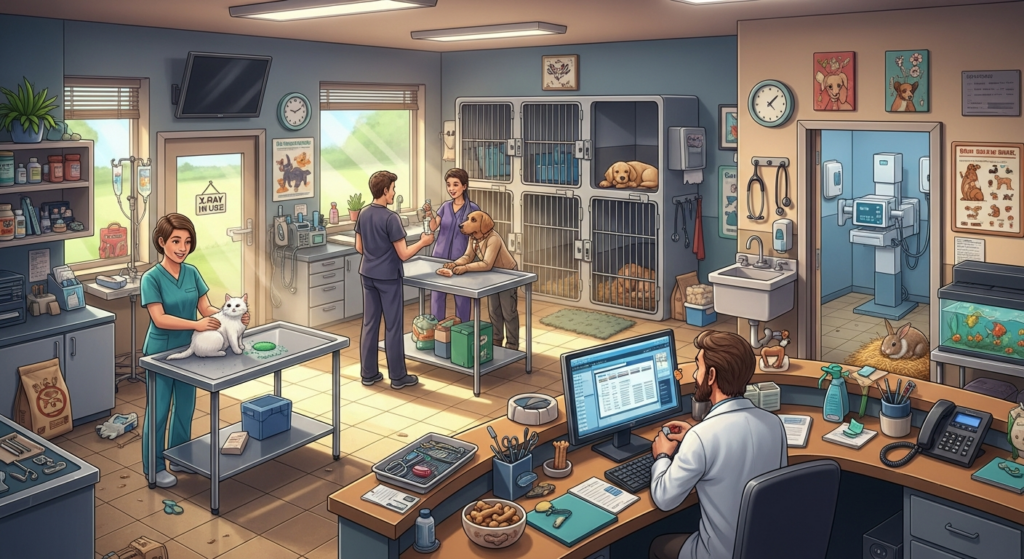
Organizing your veterinary equipment by room is a practical way to ensure each area of your clinic is fully functional. From the exam room to the surgery suite, every space has a specific purpose and requires a unique set of tools. This approach helps you think logically about workflow and ensures nothing is missed.
By outfitting each room with its necessary equipment, you empower your team to perform their tasks efficiently without having to search for tools. This section breaks down the essentials for each key area of your practice, from patient intake to surgical procedures and diagnostic imaging.
Exam Room and Treatment Area Must-Haves
The exam room is where you’ll spend most of your time with clients and patients, making it the heart of your clinic. It must be equipped for thorough physicals and minor procedures. Adjustable exam tables are crucial for comfortably and safely handling animals of all sizes. Good lighting is equally important for accurate assessments.
The treatment area often serves as a hub for more intensive, non-surgical patient care. This space needs durable procedure tables, access to diagnostic equipment, and supplies for wound care, fluid therapy, and sample collection. An efficient layout here is key to managing multiple cases at once.
Essential equipment for these areas includes:
- Adjustable exam tables and patient scales
- Stethoscopes, otoscopes, and ophthalmoscopes
- Digital thermometers and blood pressure monitors
- Restraint tools and basic wound care supplies
- A well-stocked “crash cart” for emergencies
Surgery Suite, Laboratory, and Imaging Area Essentials
The surgery suite requires a sterile environment and specialized equipment for safe and effective procedures. High-quality surgical tables, bright surgical lights, and reliable anesthesia machines are the cornerstones of this space. A full set of surgical tools and a dependable autoclave for sterilization are also non-negotiable for providing excellent veterinary care.
Your in-house laboratory and imaging areas are vital for rapid diagnostics. The lab should have a microscope, centrifuge, and blood analyzers for immediate results. The imaging area will house your digital X-ray machine and possibly an ultrasound, which are key pieces of diagnostic equipment.
Essentials for these critical zones include:
- Surgical tables, surgical lights, and an autoclave
- Anesthesia machines and patient monitoring equipment
- A comprehensive set of surgical tools
- Digital X-ray and/or ultrasound machines
- In-house laboratory analyzers (hematology, chemistry)
Reception, Pharmacy, and Admin Operations Equipment
The efficiency of your practice relies heavily on smooth front-of-house and administrative operations. The reception area is your clients’ first impression, so it needs a reliable computer system with practice management software to handle appointments, billing, and client communication. A point-of-sale (POS) system is also essential for processing payments.
Your pharmacy requires secure storage for medications, including a refrigerator for temperature-sensitive drugs, and accurate labeling systems. Proper organization here is crucial for patient safety and inventory management. These administrative tools are vital for maintaining organized medical records and a seamless client experience.
Key equipment for these areas includes:
- Computers with practice management software
- A multi-line phone system and POS terminal
- Secure shelving and refrigeration for the pharmacy
- Printers for creating labels, invoices, and educational handouts
Conclusion
In conclusion, opening a veterinary clinic is an exciting venture that requires careful planning and informed decision-making regarding equipment. By prioritizing your purchases based on clinic type, patient volume, and workflow, you can ensure that you’re investing in the necessary tools to provide excellent care while maintaining efficiency and safety. Remember, the right equipment not only enhances patient outcomes but also contributes to the overall success of your practice. As you embark on this journey, don’t hesitate to reach out for guidance or consultation. Start your clinic on the right foot—get a free trial or demo to explore your options today!
Frequently Asked Questions
What is the difference between essential and optional equipment for new clinics?
Essential tools are the veterinary equipment you need to perform basic medical services safely and effectively, like exam tables and autoclaves. Optional equipment, such as advanced imaging or therapy lasers, enhances your services but isn’t required to open. New clinics should secure all essential items before considering optional upgrades.
How do I decide which diagnostic tools to purchase first?
Prioritize diagnostic equipment that addresses the most common conditions you expect to see. For most new veterinary clinics, this includes in-house blood analyzers, a microscope, and a digital X-ray machine. These tools provide rapid results, which is crucial for timely patient care and meeting the standard of care.
Are there advantages to buying pre-owned veterinary equipment?
Yes, buying pre-owned veterinary equipment can significantly lower your startup costs. It’s a great way to stretch your budget, especially for items like stainless steel cages or exam tables. However, always buy from a reputable source and verify the equipment’s condition and warranty to ensure it’s reliable.
Do small animal and mixed animal clinics have different equipment needs?
Yes, their equipment needs differ significantly. Small animal clinics focus on tools for pets like cats and dogs, such as adjustable exam tables. Mixed animal clinics also require durable, portable equipment for treating farm animals, including large animal restraint tools and mobile ultrasound machines to accommodate various sizes and species.